Algeria
 Egypt
 Libya
 Morocco
 Tunisia
 Benin
 Burkina Faso
 Cabo Verde
 Côte d'Ivoire
 Ghana
 Guinea
 Guinea-Bissau
 Liberia
 Mali
 Mauritania
 Niger
 Nigeria
 Senegal
 Sierra Leone
 The Gambia
 Togo
 Cameroon
 Central African Republic
 Chad
 DR Congo
 Equatorial Guinea
 Gabon
 Republic of the Congo
 São Tomé and Príncipe
 Burundi
 Comoros
 Djibouti
 Eritrea
 Ethiopia
 Kenya
 Madagascar
 Malawi
 Mauritius
 Mozambique
 Rwanda
 Seychelles
 Somalia
 South Sudan
 Tanzania
 Uganda
 Angola
 Botswana
 Eswatini
 Lesotho
 Namibia
 South Africa
 Zambia
 Zimbabwe
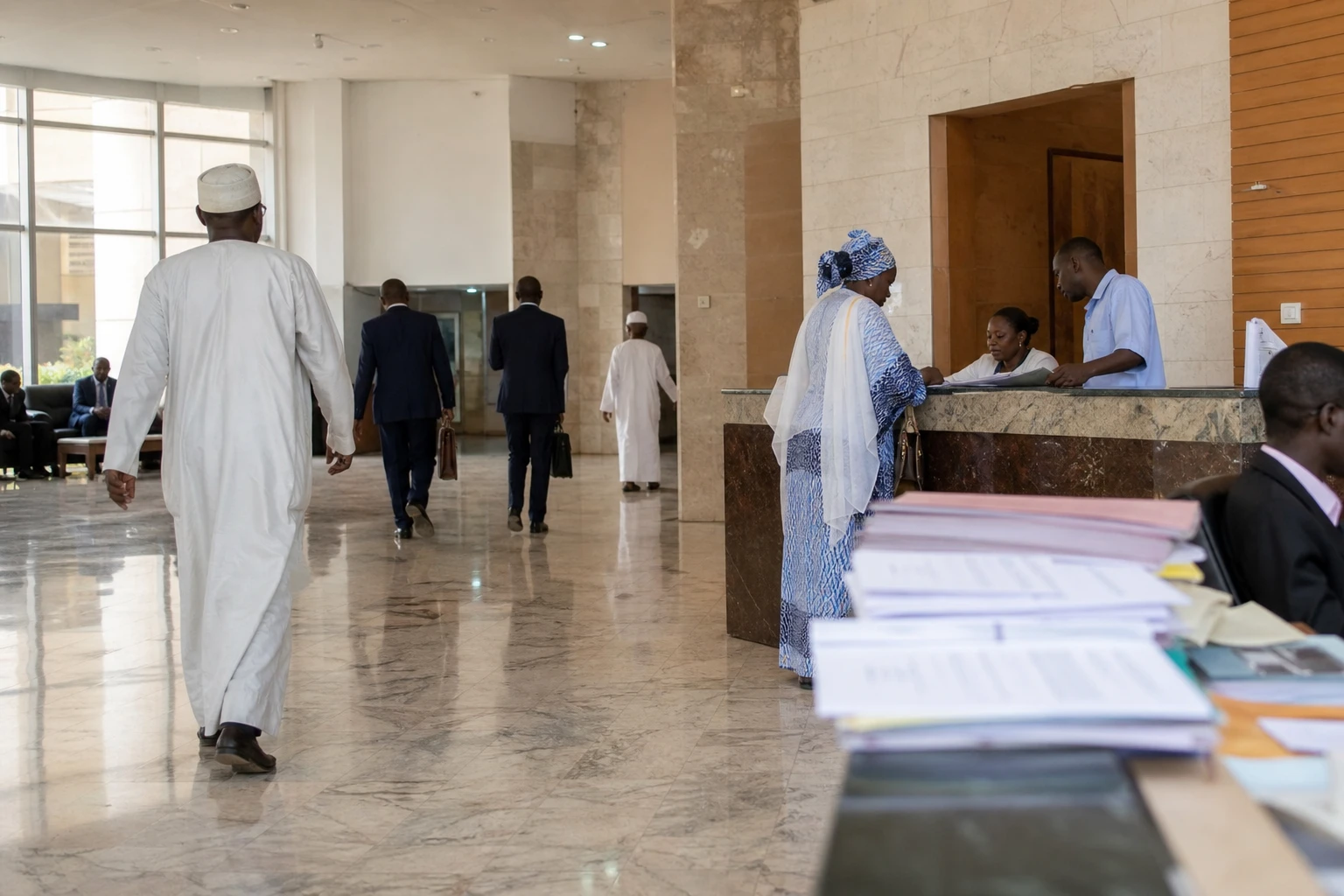
A border under pressure, a statement under scrutiny
In N’Djamena, the war in Sudan is no distant affair. It is visible in the arrival of refugees, pressure on water supplies, border posts, and the way Chad defends its sovereignty internationally. Since April 2023, the conflict in Sudan has driven hundreds of thousands of people into eastern Chad, where public services and host communities are under severe strain.
In this context, recurring accusations that Chad supports Sudan’s Rapid Support Forces (RSF) carry considerable weight. They touch on a sensitive issue: a country hosting large numbers of civilians fleeing the war is also suspected by some parties of serving as a logistical relay for the opposing armed camp. N’Djamena rejects the accusations and reaffirms its neutrality, while the eastern border remains one of the areas most exposed to the fallout from the war.
Chad, a neighbour to a war spilling across its borders
Chad shares a long border with Sudan and is a member of CEMAC, the Economic and Monetary Community of Central Africa. But the Sudanese crisis has brought it face to face above all with a humanitarian and security emergency that goes beyond the usual regional framework. The United Nations says Chad now hosts more than 900,000 Sudanese refugees, as well as hundreds of thousands of returning Chadians, putting growing pressure on schools, healthcare, water and land.
This situation is not new, but it has worsened since open warfare broke out between the Sudanese army and the RSF in April 2023. Chad has thus become a key hub for humanitarian assistance to Darfur, particularly through the Adré crossing, whose opening UN agencies praised for facilitating the delivery of aid. This is a reminder that the Chadian border is not merely a line of control: it is also a vital corridor for civilians trapped by the conflict.
What N’Djamena said in Geneva
At the 63rd session of the UN Human Rights Council, which opened in Geneva on 7 September and runs until 7 October 2026, Chad once again rejected any involvement in the war in Sudan. The Chadian authorities are maintaining a consistent line: rejecting any association with RSF operations, asserting neutrality and emphasising the country’s role as a host to people displaced by the war.
This statement is part of a broader diplomatic battle. For several months, Khartoum has accused N’Djamena of serving as a rear base for its adversaries, while Chad has dismissed the allegations as wartime propaganda. The issue is now bound up with investigations and UN reports that chiefly document the scale of cross-border movements, violations and suspicions of outside support for the conflict, without in themselves determining Chad’s direct responsibility.
Declared neutrality, a complex political equation
For the Chadian government, the position is clear: avoid being drawn into a neighbouring war that is already destabilising the country’s east. But this neutrality faces several realities. First, a porous border makes trafficking and the movement of armed groups difficult to contain. Second, the large refugee presence turns every local incident into a diplomatic issue. Finally, the Chadian state must answer criticism without appearing to yield on its sovereignty, a delicate balancing act at a time when N’Djamena is already taking steps to reassert national authority on other fronts.
On the ground, the impact is tangible. The authorities must secure the border, prevent the conflict from spreading and preserve relations with neighbours, donors and multilateral institutions. For people in eastern Chad, the immediate concerns are different: finding food, accessing water, keeping children in school and sharing already scarce resources. The APD and the UN have also reported rising tensions in host areas, where demographic pressure is contributing to conflicts over water points and land.
Beyond Chad, a test for Central Africa and the AU
This episode resonates far beyond bilateral relations between N’Djamena and Khartoum. It raises questions about the ability of Central Africa, from CEMAC to ECCAS, to respond to a neighbouring conflict spilling beyond its usual frameworks. It is also a reminder that the African Union and regional organisations are expected to do more than mediate politically: they must also protect civilians and manage humanitarian borders.
Chad thus finds itself in a paradoxical position: a country of refuge, a transit country, a country under suspicion, and a country seeking to remain in control of its diplomatic agenda. What happens next will depend less on another statement than on developments on the Sudanese front, movements into eastern Chad and the ability of regional and UN institutions to prevent an already devastating war from widening its reach.