Algeria
 Egypt
 Libya
 Morocco
 Sudan
 Tunisia
 Benin
 Burkina Faso
 Cabo Verde
 Côte d'Ivoire
 Ghana
 Guinea
 Guinea-Bissau
 Liberia
 Mali
 Mauritania
 Niger
 Nigeria
 Senegal
 Sierra Leone
 The Gambia
 Togo
 Central African Republic
 Chad
 DR Congo
 Equatorial Guinea
 Gabon
 Republic of the Congo
 São Tomé and Príncipe
 Burundi
 Comoros
 Djibouti
 Eritrea
 Ethiopia
 Kenya
 Madagascar
 Malawi
 Mauritius
 Mozambique
 Rwanda
 Seychelles
 Somalia
 South Sudan
 Tanzania
 Uganda
 Angola
 Botswana
 Eswatini
 Lesotho
 Namibia
 South Africa
 Zambia
 Zimbabwe
An eagerly awaited mining project, still dependent on financing
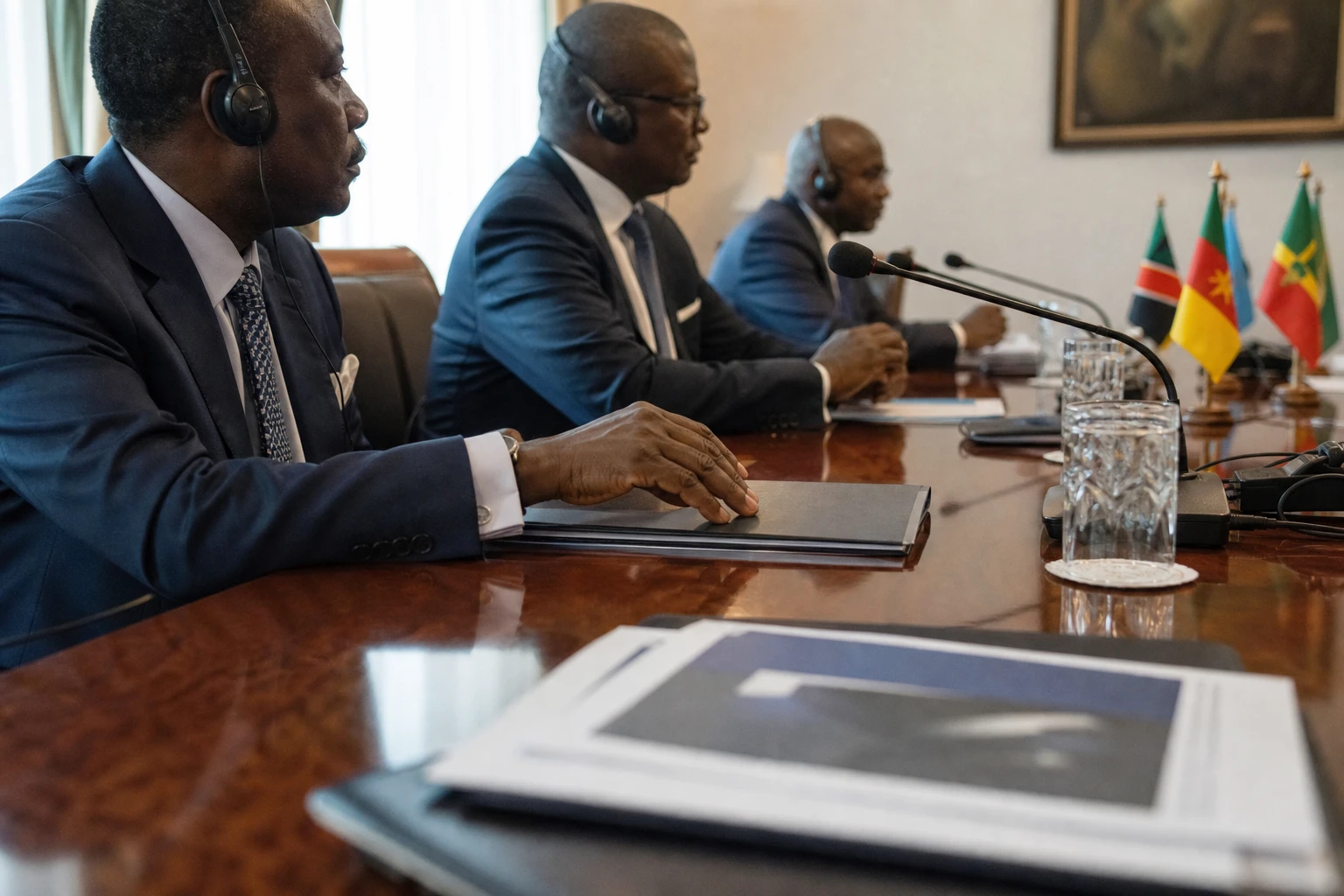
In eastern Cameroon, a deposit can change more than a mining map. It can redirect rail traffic, affect the port of Douala and serve as a full-scale test for Cameroon’s extractive industry, which remains modest as a share of national GDP. The Minim Martap project has reached just such a turning point. It is billed as the country’s future first bauxite mine, but its prospects now depend as much on the global market as on shareholders’ ability to keep pace.
Cameroon is confronting a clear regional challenge. The bauxite must be transported by rail and shipped from the port, at the heart of CEMAC, the economic community of Central Africa. In other words, the project is not only being decided at Minim Martap. It also depends on the railway, operating accounts and governance of an industrial asset that remains sensitive to logistics costs.
Timetable forecasts already revised
As of 8 May 2026, Canyon Resources said the first shipment of bauxite from Minim Martap was still scheduled for the end of the third quarter of 2026. Just a few weeks earlier, the group had still referred in its investor materials to first production in 2026 and a start-up in the first half of 2026. This succession of milestones shows that the timetable is already shifting.
The project’s core ambitions remain substantial. The company has announced a first phase of 1.2 million tonnes a year, followed by a gradual ramp-up to 10 million tonnes a year from the sixth year of operations, according to its feasibility study published in 2025. Canyon also cites reserves of 144 million tonnes and a JORC mineral resource of 1.102 billion tonnes.
But industrial promise alone is not enough to dispel doubts. A2MP Investments, Canyon’s majority shareholder through Eagle Eye Asset Holdings, believes the economic model no longer holds under current market conditions. The group made this view public at the end of July and accompanied it with an offer to buy the remaining shares.
The price per tonne, railway and port: the real fault lines
The disagreement centres first on the financial assumptions. A2MP believes the price premium assumed for Minim Martap bauxite, estimated at around $11 per tonne in the analysis it criticised, no longer reflects the market and should be closer to $5 per tonne. The group also points to pressure from freight, taxes and operating costs. These factors are not incidental. They determine the project’s ability to repay its debt and generate cash.
The international backdrop reinforces this caution. Bauxite prices came under pressure in 2026 amid abundant supply, while Guinea, the world’s largest producer, considered export quotas to support the market. Higher freight costs between West Africa and China have also made the supply chain more expensive. In such an environment, a Cameroonian project must prove it can remain competitive without betting on a rapid price rebound.
The issue becomes more tangible when the infrastructure is considered. Canyon has announced that it increased its stakes in Camrail, Cameroon’s rail operator, and in the Douala port terminal. The group says it made these moves to secure the transportation of the ore. This is central both for people in inland Cameroon and for operators on the coast: without reliable rail and suitable port capacity, the mine remains a costly promise.
What A2MP’s offer means for shareholders and the Cameroonian state
A2MP is offering to buy the shares it does not yet hold for 0.05 Australian dollars each. The offer seeks an acceptance threshold of 75%, followed by a possible compulsory acquisition if its stake reaches 90%. In practice, this means the project’s governance could become more concentrated around a single shareholder, just as its need for capital remains high.
For minority shareholders, the question is straightforward: should they accept an exit at a reduced price to avoid the risk of prolonged financing uncertainty, or bet on the deposit’s future value if the logistics fall into place? For Cameroon, the question is broader. The state holds a free 10% stake in the project, which is presented as a means of diversifying an economy in which mining remains a small sector nationally. Available data also show that Cameroon’s mineral resources remain under-exploited, despite a recently revised legal framework.
The World Bank and the USGS both note that Cameroon’s mining sector still accounts for little of the economy. In this context, Minim Martap is not simply a private asset but a test of the credibility of the national mining strategy. If the project takes off, it could open up a new value chain linking the country’s interior, rail and port. If it stalls, it will be a reminder that the quality of a deposit is never enough to create an industry.
A Cameroonian project, but a signal for all of Central Africa
What happens next will depend first on the response of minority shareholders, then on the group’s ability to secure financing and deliver the project. It will also depend on whether the industrial timetable announced for the third quarter of 2026 is maintained. In an economy in Central Africa that remains highly sensitive to commodities, every delay, cost overrun and debt renegotiation has knock-on effects.
Beyond Cameroon, the project illustrates a continental reality: African mining projects are no longer decided solely by the resource, but by the management of corridors, energy, ports and financing. Minim Martap will therefore say more than something about bauxite. It will show whether an African extractive project can still move forward when the market tightens, logistics become more expensive and investors demand stronger guarantees.