Algeria
 Egypt
 Libya
 Morocco
 Sudan
 Tunisia
 Benin
 Burkina Faso
 Cabo Verde
 Côte d'Ivoire
 Ghana
 Guinea
 Guinea-Bissau
 Liberia
 Mali
 Mauritania
 Niger
 Nigeria
 Senegal
 Sierra Leone
 The Gambia
 Togo
 Central African Republic
 Chad
 DR Congo
 Equatorial Guinea
 Gabon
 Republic of the Congo
 São Tomé and Príncipe
 Burundi
 Comoros
 Djibouti
 Eritrea
 Ethiopia
 Kenya
 Madagascar
 Malawi
 Mauritius
 Mozambique
 Rwanda
 Seychelles
 Somalia
 South Sudan
 Tanzania
 Uganda
 Angola
 Botswana
 Eswatini
 Lesotho
 Namibia
 South Africa
 Zambia
 Zimbabwe
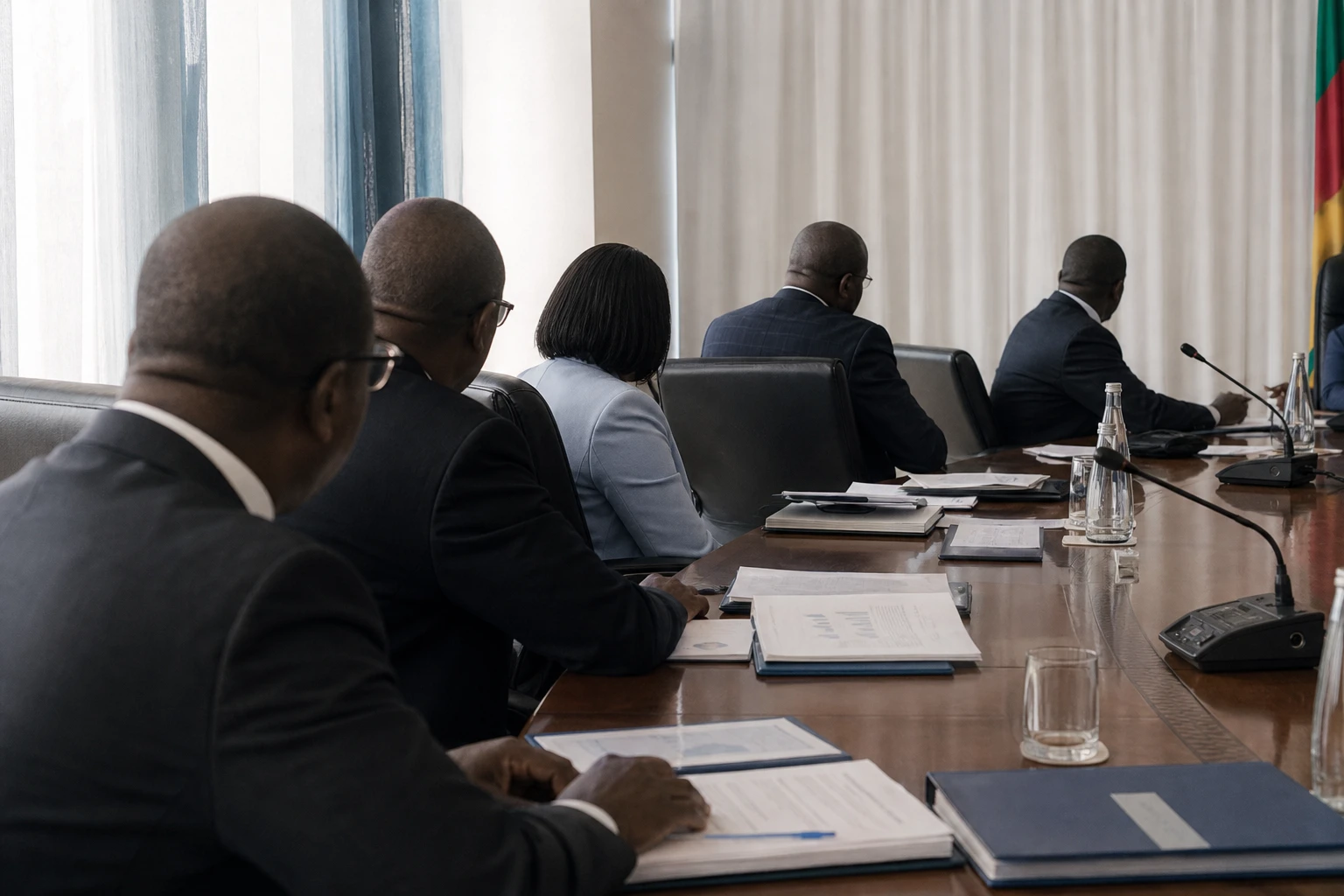
When markets assess risk, Yaoundé also reads the politics
In Yaoundé, a price on the secondary market can quickly become a political verdict. Yet to understand Cameroon’s debt, it is necessary to distinguish the day’s emotion from the accounts that close the month. Indicators published by the Autonomous Sinking Fund show a state that continues to meet its payments, at a time when public attention has focused on the prolonged absence of the head of state and on what is sometimes a too-hasty reading of a market movement in dollar-denominated securities.
Cameroon remains the largest economy in CEMAC, the Central African Economic and Monetary Community, and its financing choices carry weight beyond Yaoundé. In the region, the central bank further eased monetary policy on 29 June 2026, cutting its key policy rate to 4.50% and reducing reserve requirements, signalling an environment seeking to support lending without losing control of prices. The same BEAC points to a stronger recovery in Central Africa, with growth expected to reach 3.2% in 2026 and inflation better contained.
What the public accounts show
Public debt figures published at the end of July offer a more precise reading than the political debate. As at 30 June 2026, Cameroon’s public debt stock stood at CFAF 15,607bn, or 44.2% of GDP, below the internal ceiling of 50% set by the authorities and the 70% convergence criterion applied in CEMAC. In the first half of the year, the state paid CFAF 444.5bn in external debt, with no arrears reported.
The portfolio nevertheless remains under strain. The weighted average cost of debt stands at 2.8%, with 2.5% for external debt and 3.4% for domestic debt. The CAA also notes that Cameroon continues to borrow more on market terms than through concessional windows, which will raise the bill over the medium term. In other words, the country retains access to financing, but has less room to negotiate the price of money.
The International Monetary Fund’s assessment points in the same direction, with an important qualification. In its 2026 assessment, the IMF classifies Cameroon as at high risk of external and overall debt distress, while judging its debt sustainable over the medium term. The Fund also notes that the country’s debt-carrying capacity has been upgraded from weak to medium, slightly improving its profile without removing pressures on debt service and export revenues.
The real point of vulnerability is not just political
Debate in Cameroon has intensified around President Paul Biya’s absence. He left Yaoundé on 7 June 2026 for a private stay in Europe, according to reports carried by Reuters and the Associated Press. His absence is fuelling genuine institutional unease, but is not enough on its own to explain the trajectory of the debt. Cameroon’s Constitution provides for a presidential vacancy only in the event of death, resignation or permanent incapacity established by the Constitutional Council. It sets no maximum duration for a trip abroad.
The crux of the problem lies elsewhere. The CAA says debt service reached CFAF 1,059.3bn in the first half of 2026, compared with CFAF 631.3bn over the same period in 2025. It also says that 87% of new commitments signed in the first half of the year were on market terms, and that disbursements on project loans in June were almost entirely non-concessional. This is not a picture of an impending default. It is a rise in the cost of refinancing.
This development matters more to households and businesses than the noise of the moment. When the state refinances at a higher cost, fiscal space shrinks. Current spending retains priority, public investment is weighed against cash flow, and payment delays on some projects or to suppliers can build up. The question is therefore not only one of market confidence. It is also whether the state can turn borrowing into roads, networks, energy and services that people can see in the regions, as well as in the capital, far from Yaoundé.
What the next phase will bring
The next phase will play out on two fronts. First, the external financing the state is preparing, described in CAA documentation as a package with an environmental, social and governance component, worth about $690m. Second, relations with multilateral partners, including the IMF, at a time when debt sustainability depends as much on budget discipline as on the ability to stabilise export revenues. Cameroon is not cut off from international financing; it simply needs to persuade lenders to provide it at a cost compatible with its revenues.
The country is thus entering a familiar moment for CEMAC economies: debt that remains contained as a share of GDP, but liquidity under pressure, maturities shortening and a market charging more for political uncertainty. Across Africa, the Cameroonian case is a reminder of a simple reality: the debt question cannot be reduced to a tweet or a market chart. It depends on the quality of public revenues, institutional credibility and a state’s ability to pay on time while preparing tomorrow’s investment.