Algeria
 Egypt
 Libya
 Morocco
 Sudan
 Tunisia
 Benin
 Burkina Faso
 Cabo Verde
 Côte d'Ivoire
 Ghana
 Guinea
 Guinea-Bissau
 Liberia
 Mali
 Mauritania
 Niger
 Nigeria
 Senegal
 Sierra Leone
 The Gambia
 Togo
 Central African Republic
 Chad
 DR Congo
 Equatorial Guinea
 Gabon
 Republic of the Congo
 São Tomé and Príncipe
 Burundi
 Comoros
 Djibouti
 Eritrea
 Ethiopia
 Kenya
 Madagascar
 Malawi
 Mauritius
 Mozambique
 Rwanda
 Seychelles
 Somalia
 South Sudan
 Tanzania
 Uganda
 Angola
 Botswana
 Eswatini
 Lesotho
 Namibia
 South Africa
 Zambia
 Zimbabwe
A semi-final that tells a bigger story than the score
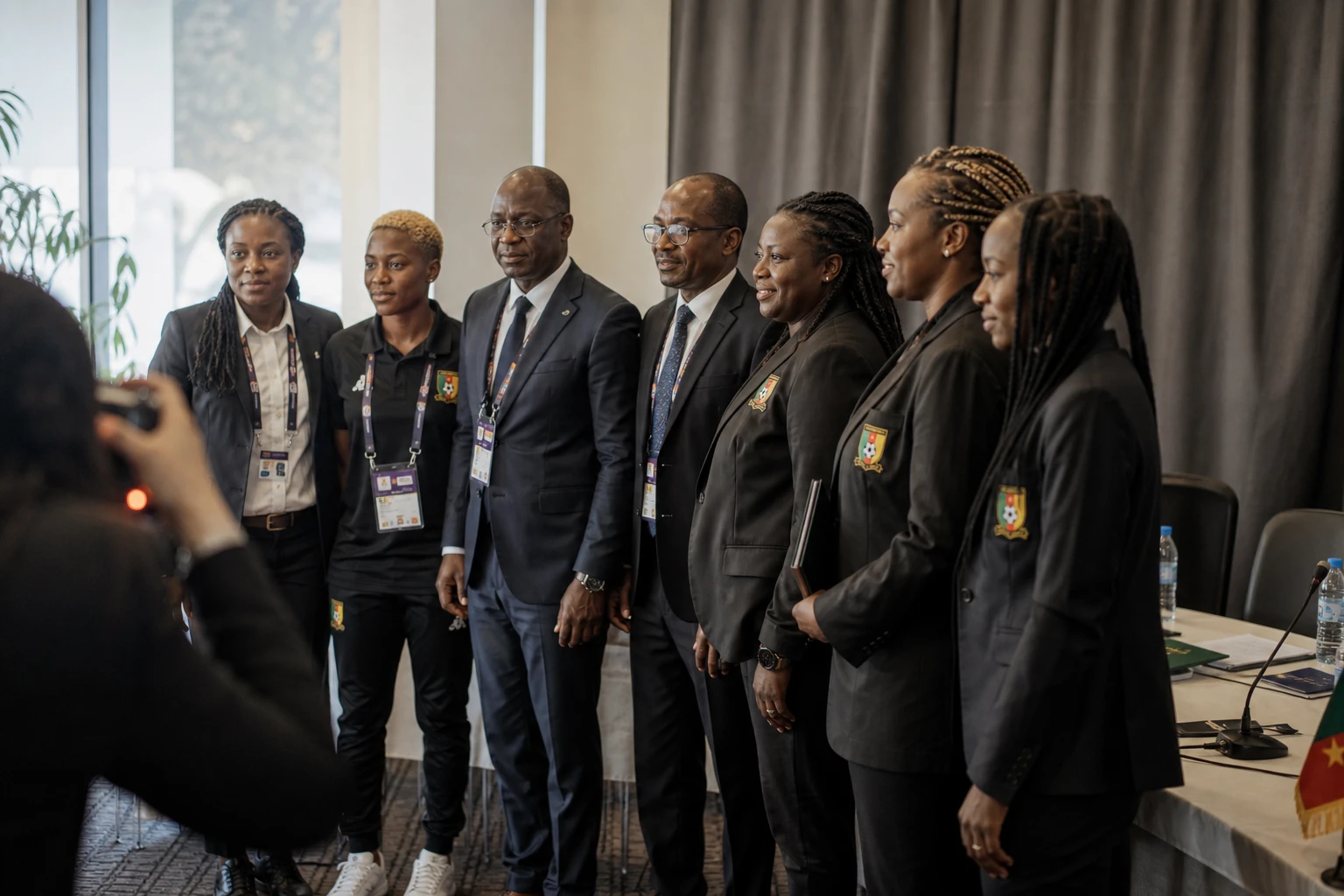
In Rabat, African women’s football brought home a simple truth: the tightest matches are not always won at the first opportunity, but through control and composure. Cameroon knocked out hosts Morocco after a semi-final that remained locked until the penalty shoot-out, in a 2026 edition already marked by the tournament’s expansion to 16 teams and by stakes extending beyond the trophy alone.
For Cameroon, the significance goes far beyond simply qualifying for the final. In a Central African region where Cameroon is one of the pillars of CEMAC, a performance of this calibre is a reminder that the continent’s women’s teams are no longer playing merely to appear on the scoreboard. They are taking centre stage, with increasingly clear sporting, media and economic ambitions.
The setting: Rabat, an expanded WAFCON and a World Cup place at stake
The 2026 Women’s Africa Cup of Nations is taking place in Morocco from 26 July to 16 August 2026. The CAF has confirmed the expansion to 16 teams, a first at this level, and scheduled the semi-finals for Wednesday 12 August in Rabat. The competition also serves as a qualifying route for the 2027 Women’s World Cup in Brazil, with four direct places awarded through the semi-finalists.
Morocco went into the match as hosts, with the advantage of a home crowd behind them. Cameroon arrived with a more troubled history but a longstanding reputation as a team that is difficult to handle in major tournaments. The CAF also notes that the Indomitable Lionesses are among the notable teams in the tournament’s history, with several appearances at the highest level.
The sporting setting matters too. Women’s competitions in Africa are gaining in visibility, television coverage and intensity. The fact that this WAFCON is being held in Morocco, in Rabat and Casablanca stadiums already accustomed to major fixtures, gives the tournament a strong foundation. This is no minor detail: the environment, organisation and media exposure now influence the significance of results.
The match: Cameroon hold firm, then shine in the shoot-out
On Wednesday 12 August 2026, at Moulay El Hassan Stadium in Rabat, Cameroon and Morocco were level after 120 minutes. The score remained goalless after regulation time and extra time. Cameroon held their ground through the middle, closed down space and resisted pressure from the hosts until the decisive shoot-out.
The turning point came in extra time, when Morocco were awarded a penalty. Cameroon goalkeeper Michaely Bihina saved the attempt and kept her team in the game. In a semi-final that was often cagey, that save mattered as much as a goal. The penalty shoot-out then confirmed the shift in momentum: Bihina saved three more Moroccan attempts, and Cameroon won 3-1.
The FRMF acknowledged its team’s defeat after losing the shoot-out 1-3, following a goalless match. That confirmation tallies with what unfolded on the pitch: Morocco dominated some spells, but Cameroon managed the critical moment better. In major African competitions, handling periods of pressure is often what separates a team that succumbs from one that progresses.
What this victory means for Cameroon
For Cameroon, qualifying has immediate sporting significance. It validates the group’s solidity in a tournament where the margin for error has become minimal. It also puts the Indomitable Lionesses back in a continental final, after years in which their fortunes have alternated between strong performances and setbacks. Beating the hosts in a knockout semi-final gives the result particular value.
The signal is institutional too. In Central Africa, Cameroon remains one of the few countries to combine demographic weight, a footballing tradition and the ability to make an impact in major competitions. This victory raises the profile of Cameroonian women’s football across CEMAC, where sports infrastructure, federation budgets and professionalisation vary widely from one country to another. The Lionesses’ performance thus sets an example well beyond the dressing room.
For Morocco, elimination ends the hope of playing a final on home soil. But the host country remains committed to a broader strategy to develop women’s football. Its campaign forms part of a wider momentum that has already taken the men’s team onto the world stage and made the kingdom a regular host of major African competitions. Even in defeat, Morocco retains a leading role in showcasing women’s football across the continent.
An unexpected final, with a distinctly African message
The final will therefore pit Cameroon against Malawi, who earlier beat Algeria 3-1, with a brace from Tabitha Chawinga according to the CAF’s match report. The fixture says something about the current state of African women’s football: teams long regarded as outsiders can now rise to the top of a continental tournament. Malawi will play their first final, while Cameroon return to this level of competition.
The continental stakes are clear. All four semi-finalists secure a direct place at the 2027 Women’s World Cup in Brazil, under the system approved by FIFA. The Rabat final is therefore about more than African prestige. It also has a bearing on the continent’s future presence at the highest level of the global game, where every place counts.
Across Africa, this match confirms a trend already in evidence: women’s teams are growing in depth, tactical discipline and ability to derail the favourites. Cameroon did more than eliminate the hosts. They showed that hierarchies in Africa remain open when the conditions are demanding and the preparation is serious. That story will reach its conclusion in Rabat on Sunday 16 August 2026.