Algeria
 Egypt
 Libya
 Morocco
 Sudan
 Tunisia
 Benin
 Burkina Faso
 Cabo Verde
 Côte d'Ivoire
 Ghana
 Guinea
 Guinea-Bissau
 Liberia
 Mali
 Mauritania
 Niger
 Nigeria
 Senegal
 Sierra Leone
 The Gambia
 Togo
 Cameroon
 Central African Republic
 Chad
 DR Congo
 Equatorial Guinea
 Gabon
 Republic of the Congo
 São Tomé and Príncipe
 Burundi
 Comoros
 Djibouti
 Eritrea
 Ethiopia
 Kenya
 Madagascar
 Malawi
 Mauritius
 Mozambique
 Rwanda
 Seychelles
 Somalia
 South Sudan
 Tanzania
 Uganda
 Angola
 Eswatini
 Lesotho
 Namibia
 South Africa
 Zambia
 Zimbabwe
A rapprochement that says much about Botswana’s new economic diplomacy
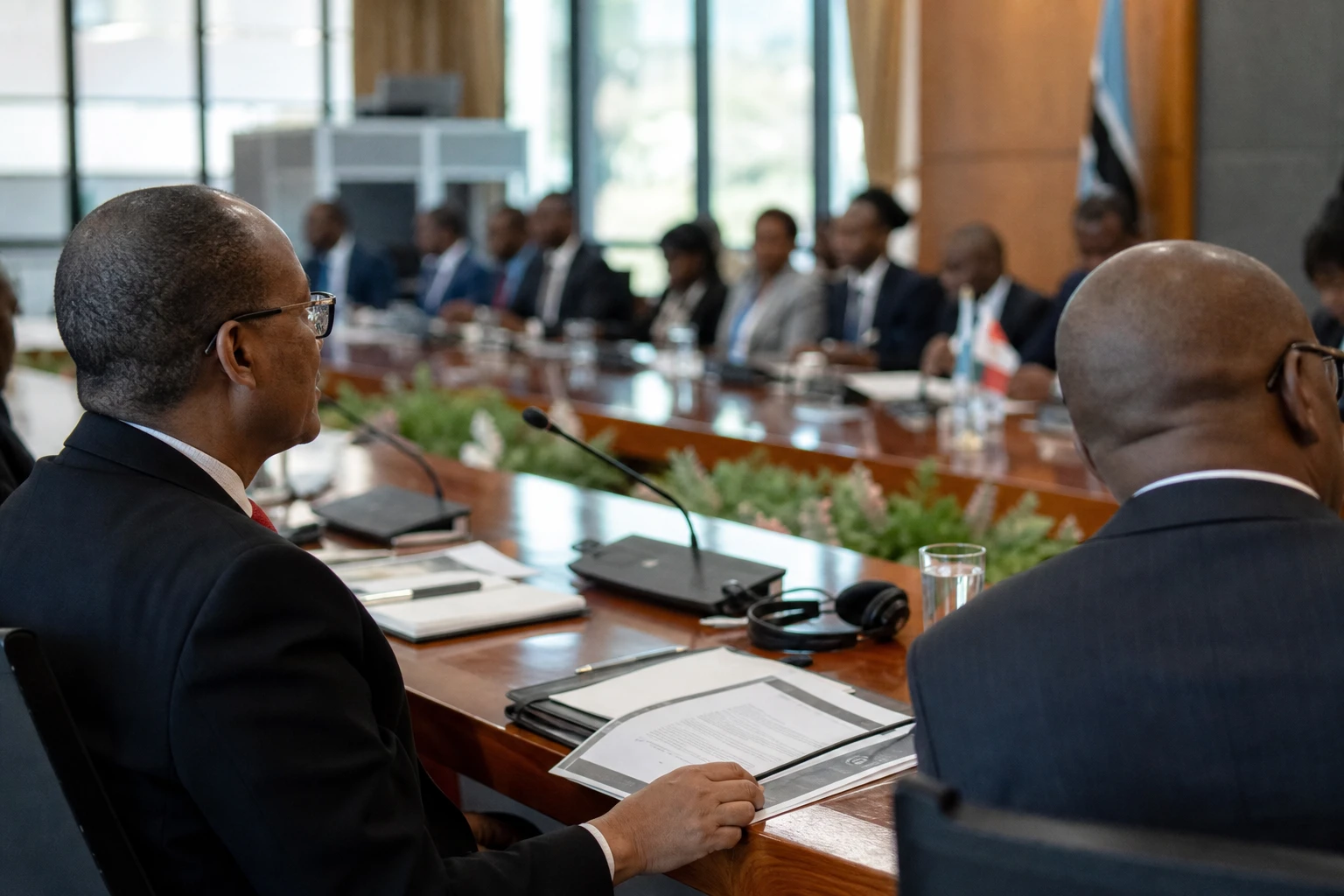
In Gaborone, Botswana is no longer content merely to diversify its partners. It is also seeking to turn this openness into concrete results: capital, technology, markets and jobs. The state visit by Oman’s Sultan Haitham bin Tariq on 16 and 17 September 2026 fits this approach. It comes less than a year after the two countries established diplomatic relations, on 14 October 2025.
The move is significant for a southern African country that remains highly exposed to volatility in diamonds, its main export driver, and has been seeking for several months to broaden its productive base. As part of this strategy, Botswana acts within SADC, the Southern African Development Community, a bloc that encourages its members to strengthen regional value chains, local processing and investment appeal.
Nine agreements to frame a still-young relationship
At the end of the visit, the two countries signed nine bilateral agreements and instruments. They cover general cooperation, political consultations, visa exemptions for certain holders of diplomatic and special passports, health services, investment promotion and protection, energy security, regional energy development, security of medicines supply, regulatory cooperation, trade and industry. Botswana’s authorities confirmed these details in Gaborone.
The most anticipated agreement concerns mining. Botswana and Oman intend to explore opportunities for co-development in copper and gold. The stated aim is clear: to strengthen links between public institutions, companies and private operators, in order to promote local value addition, technology transfers and skills development. This directly supports Botswana’s economic agenda, which seeks to reduce its dependence on exporting minerals in raw form.
Another instrument concerns energy. It provides for cooperation on energy security, sustainable energy and regional energy integration. This is no minor matter. In southern Africa, electricity needs, grid reliability and the transition to cleaner sources remain central issues. SADC has also recently stressed critical minerals, local value addition and industrial value chains, showing that resources are now being considered at a regional rather than solely national level.
The pharmaceutical component addresses another practical concern: the security of medicines supply. Here, too, the two governments have announced a partnership on regulation, pharmaceutical products and investment. For a state such as Botswana, this kind of agreement goes beyond ceremonial diplomacy. It concerns the resilience of the health system, import capacity and, in time, the emergence of production or assembly activities.
On mobility, the visa exemption announced from 28 July 2026 for Omani nationals, for stays of up to 90 days, facilitates business travel and institutional contacts. Gaborone also plans to open an embassy in Muscat, a sign that this is no longer a brief rapprochement but a relationship the two capitals intend to establish for the long term.
What this partnership changes for Botswana, and what it reveals across Africa
For Botswana’s government, the benefits are twofold. First, it can attract partners able to provide funding and expertise beyond the usual channels. Second, it can send a signal of stability to investors who closely monitor governance, infrastructure and legal certainty. Gaborone’s government has already shown this year that it wants to use diplomacy as a lever for economic transformation, particularly through visits and agreements focused on productive sectors.
For Oman, Botswana offers a gateway to southern Africa, a region where needs in energy, minerals and infrastructure remain high. Muscat has been expanding its economic presence on the continent for several months, focusing on mining, renewable energy and trade. The relationship with Gaborone therefore fits into a broader strategy of projecting Omani economic influence into Africa.
The most sensitive issue, however, remains implementation. Agreements in principle are plentiful in African economic diplomacy. Their real impact depends on timetables, implementation rules and the ability of administrations to follow through. In Botswana’s case, success will be measured by very concrete indicators: joint ventures launched, jobs created, local value added, stronger energy supply, or exports diversified beyond diamonds.
The continental significance of this case goes beyond the bilateral relationship between Gaborone and Muscat. It illustrates a broader trend: African countries are seeking more South-South partnerships, which are more flexible than traditional frameworks and often quicker to negotiate in sectors where economic urgency is high. For Botswana, a SADC member, the challenge is to turn this diplomacy into a regional value chain, not a mere bilateral showcase. The next stage will therefore depend on implementation of the agreements, the expansion of energy and mining projects, and the shift from signatures to actual investment.