
 Algeria
 Egypt
 Libya
 Morocco
 Sudan
 Tunisia
 Benin
 Burkina Faso
 Cabo Verde
 Côte d'Ivoire
 Ghana
 Guinea
 Guinea-Bissau
 Liberia
 Mali
 Mauritania
 Niger
 Nigeria
 Senegal
 Sierra Leone
 The Gambia
 Togo
 Central African Republic
 Chad
 DR Congo
 Equatorial Guinea
 Gabon
 Republic of the Congo
 São Tomé and Príncipe
 Burundi
 Comoros
 Djibouti
 Eritrea
 Ethiopia
 Kenya
 Madagascar
 Malawi
 Mauritius
 Mozambique
 Rwanda
 Seychelles
 Somalia
 South Sudan
 Tanzania
 Uganda
 Angola
 Botswana
 Eswatini
 Lesotho
 Namibia
 South Africa
 Zambia
 Zimbabwe
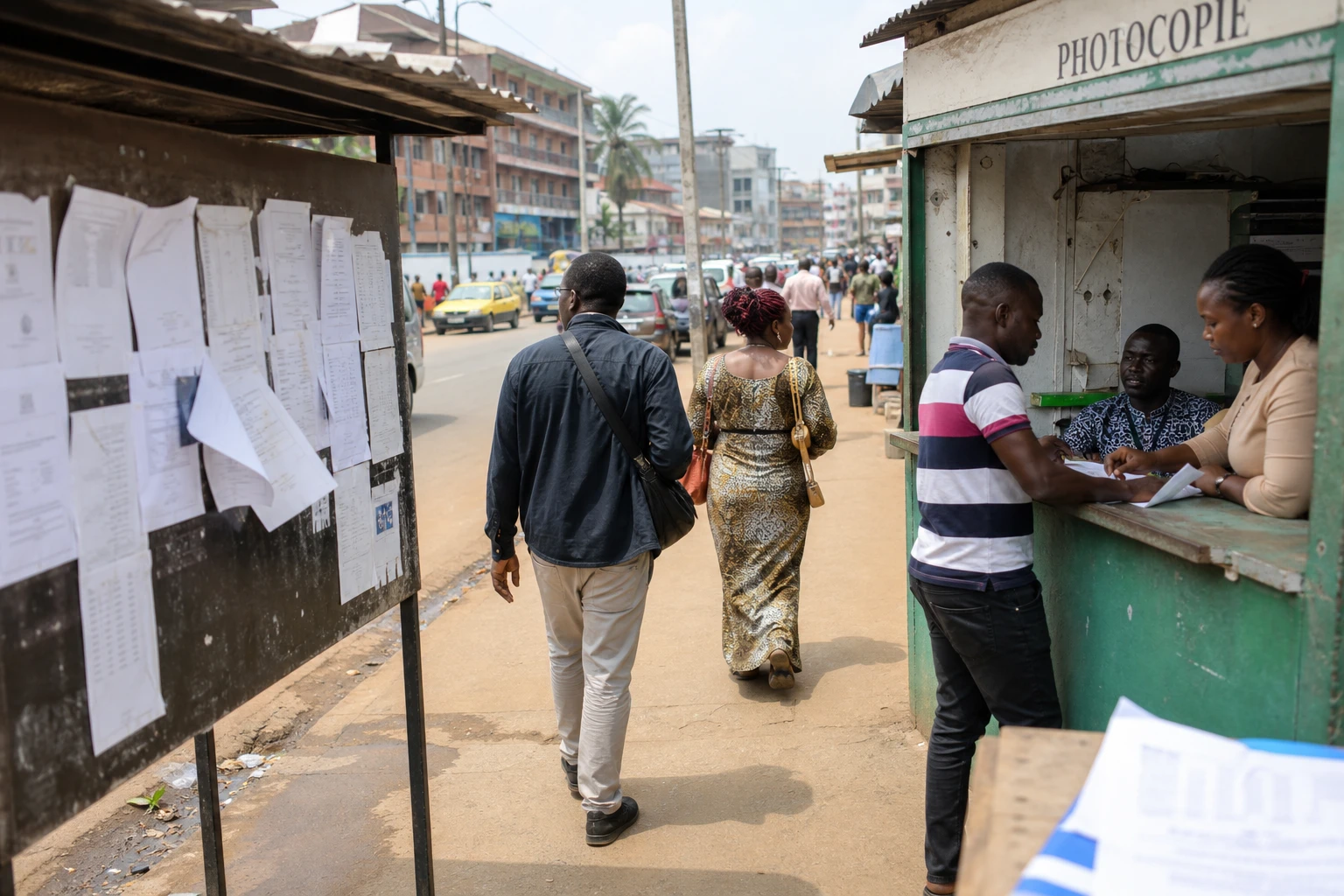
In Cameroon, continuity of power is now expressed through decrees
When a head of state is absent for a long time, two narratives immediately clash: that of institutional continuity and that of a political vacuum. In Cameroon, this tension has taken hold around 93-year-old Paul Biya, who has been away from Yaoundé since 7 June 2026 on a short private visit to Europe, according to the presidency.
In a country where presidential power holds most of the authority to arbitrate, every signature becomes a signal. In recent weeks, the presidency has issued a stream of official acts: appointments within the defence establishment, promotions in the armed forces and authorisations for loans linked to public projects. This administrative machinery is intended to show that the state continues to function from Yaoundé, even without the head of state making public appearances.
The issue is far from trivial. In Cameroon, questions of succession, a power vacuum and the visibility of the head of state weigh heavily in political debate. The country is in the midst of a post-election period, following the presidential election scheduled for 12 October 2025, and remains marked by a highly presidentialised institutional life.
Military and financial acts show the machinery is turning
On 3 August 2026, several presidential decrees promoted five colonels to the rank of major-general and organised personnel movements at the Ministry Delegate at the Presidency in charge of Defence. On 28 July, another decree placed a general officer in the second section, the term used in Cameroon for the retirement of generals. On 30 July, a decree authorised the Minister of the Economy to sign financing agreements worth nearly CFA francs 28 billion with the Islamic Development Bank.
These acts are part of the institutional routine. Decrees on promotions, appointments and financing are common at Cameroon’s presidency. But in the current context, they carry additional political weight. They serve to document the exercise of power, rather than show the head of state himself.
The strategy also meets a need to control the narrative. In June 2026, the government disputed press reports that Biya had been hospitalised in Switzerland. It confirmed that Paul Biya was in Geneva, but had not been admitted to a medical facility. On 2 July, official communications also denounced the circulation of a fake decree purporting to appoint a vice-president of the Republic.
This sequence points to a change in method. Where the authorities once sought to reassure through appearances, public audiences or carefully staged images, they now rely on documentary evidence. The message is simple: institutions sign, administrations implement, and the chain of command remains in place.
State communications, but genuine political concern
The problem for the authorities is that this demonstration through official acts does not answer every question. It says little about the president’s physical ability to arbitrate day-to-day affairs, receive visitors, make decisions and set a clear political direction. It says even less about the timetable for a handover, as the question of a power vacuum regularly returns to public debate in Cameroon.
In the short term, this approach may ease some concerns. Military decrees reassure the security establishment. Financial texts reassure ministries and lenders. But among the public, the logic is less convincing. When presidential pronouncements are rare, institutional communications can seem cold, distant, almost procedural. They keep files moving, without necessarily dispelling doubts.
The debate also has a social dimension. In cities, social media amplify rumours and counter-rumours. In the regions, concerns are more concrete: wages, security, roads, prices and public services. For a population waiting for visible answers, a growing pile of decrees can seem remote from daily needs. That is where the battle for trust is being fought.
The political implications are broader still. The government is seeking to show that the state does not depend on a permanent physical presence in Yaoundé. But this demonstration also reinforces an obvious point: in a highly centralised system, even the slightest absence at the top of the executive raises the question of the transfer of power, even as documents continue to be signed.
A test for Yaoundé, CEMAC and the image of power in Central Africa
Cameroon is not an isolated case. In Central Africa, where CEMAC shapes some of the region’s economic balances, the stability of presidential institutions remains a sensitive issue. When the heart of the executive appears to be functioning remotely, markets, administrations and regional partners watch for continuity in practice, not just its staging.
The continental significance also lies in the precedent. Several African governments have already shown that longevity in power ultimately turns state communications into a tool for managing implicit succession. The Cameroon case is therefore being watched beyond Yaoundé, because it raises a broader question: how does a highly personalised state prepare for continuity when its leader becomes less visible?
In the short term, Paul Biya’s announced return remains the key development to watch. The government reshuffle discussed in late 2025, as well as clarification on possible institutional reforms, will shape what follows. In the meantime, decrees will remain the main language of a government seeking to prove its existence in writing, at a time when part of the country is calling above all for clearer signs of political leadership.



