Algeria
 Egypt
 Libya
 Morocco
 Sudan
 Tunisia
 Burkina Faso
 Cabo Verde
 Côte d'Ivoire
 Ghana
 Guinea
 Guinea-Bissau
 Liberia
 Mali
 Mauritania
 Niger
 Nigeria
 Senegal
 Sierra Leone
 The Gambia
 Togo
 Cameroon
 Central African Republic
 Chad
 DR Congo
 Equatorial Guinea
 Gabon
 Republic of the Congo
 São Tomé and Príncipe
 Burundi
 Comoros
 Djibouti
 Eritrea
 Ethiopia
 Kenya
 Madagascar
 Malawi
 Mauritius
 Mozambique
 Rwanda
 Seychelles
 Somalia
 South Sudan
 Tanzania
 Uganda
 Angola
 Botswana
 Eswatini
 Lesotho
 Namibia
 South Africa
 Zambia
 Zimbabwe
In Porto-Novo, an upper house reshapes the institutional balance
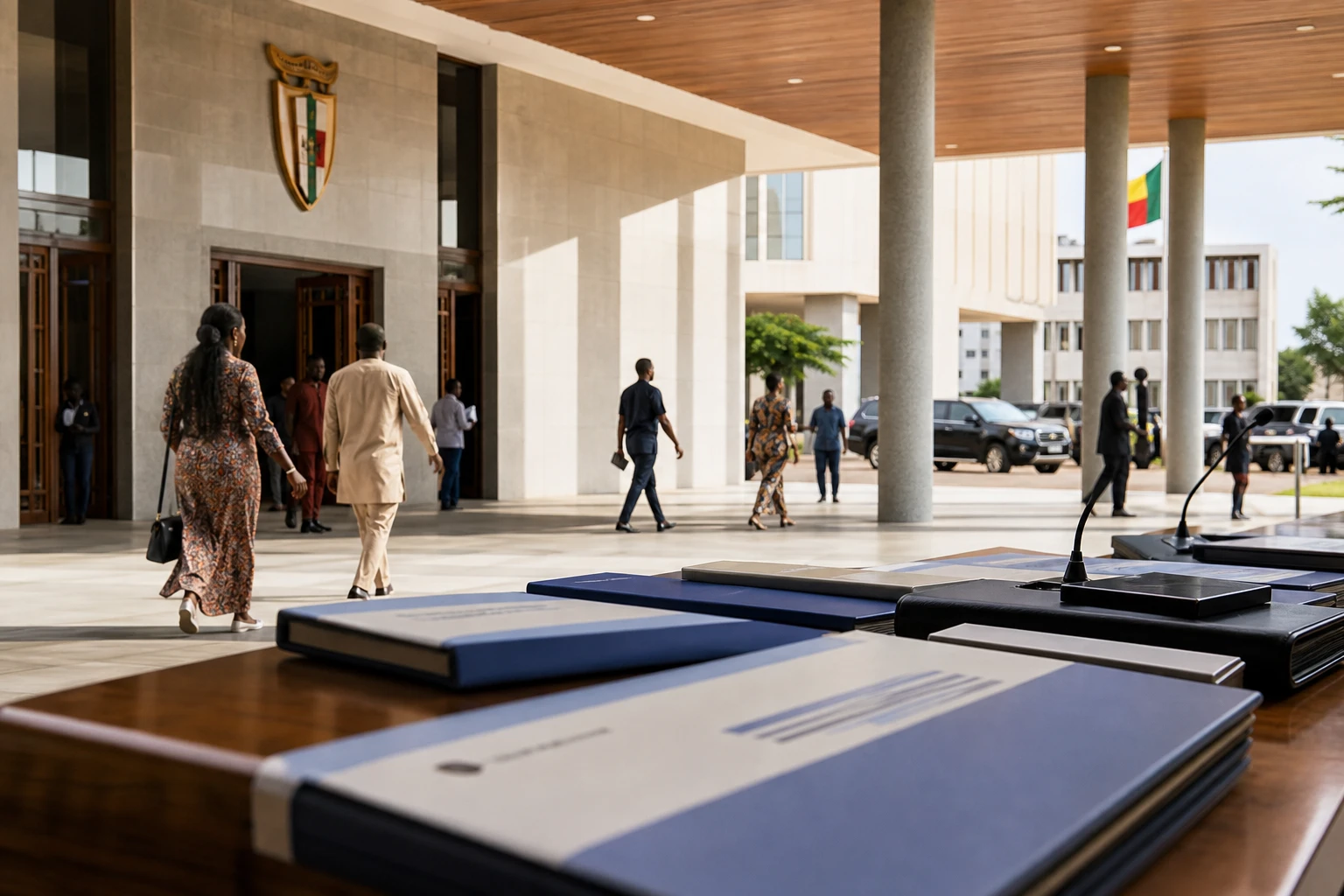
Benin’s political life is entering a new phase. On Thursday 30 July 2026, the Senate is due to be inaugurated in Porto-Novo, the political capital, while its members will subsequently sit in Cotonou. The symbolism is strong. The Republic of Benin is adding a second parliamentary chamber as the country emerges from a period of rapid institutional change.
For many Beninese, the reform is about more than institutional architecture. It raises a simple question: will this new chamber help better regulate public decision-making, or concentrate more power in the hands of the same actors? The debate is already playing out among parties, legal experts and former state figures.
The regional context matters too. Benin remains a pivotal country in West Africa and a member of ECOWAS, the Economic Community of West African States, which brings the countries of the sub-region together around integration and democratic governance. In a political landscape often weakened by transitions, electoral tensions and military coups, any institutional reform in Benin is watched beyond its national borders.
A reform passed in November 2025 and defended by its proponents
The Senate’s inauguration follows the constitutional revision adopted on 14 November 2025 by the National Assembly, with 90 votes in favour and 19 against. The text amended the 1990 Constitution and established an upper house tasked, in the wording adopted by MPs, with “regulating political life” and helping safeguard national unity, development, public security, democracy and peace.
In practice, Benin’s new Senate will have 25 members. The composition published by the government shows a hybrid system, with ex officio members and appointed members. Those expected to take their seats include former heads of state, former institutional officials and people appointed by the relevant authorities. At this stage, no seat is filled by a direct vote of citizens, which explains some of the criticism voiced by the opposition.
The chamber was not established quietly. On 1 July 2026, the Council of Ministers approved a list of members, and the future senators held their first preparatory meeting on 24 July in Cotonou. The formal inauguration, announced for 30 July, is first to approve the rules of procedure, before the bureau is established following an opinion from the Constitutional Court.
The political capital, Porto-Novo, is hosting the ceremony. The functional headquarters, however, will be in Cotonou. This dual location says something about Benin’s compromise: an institution is set up in the historic capital, but operates in the country’s administrative and economic centre.
Boni Yayi, Soglo and the battle over political meaning
The debate around the Senate has crystallised around Boni Yayi and Nicéphore Soglo. Both are former presidents of the Republic and ex officio members. Both had expressed reservations about the reform. Nicéphore Soglo, the institution’s oldest member, even played a logistical role in convening the inauguration. Boni Yayi initially refused to take his seat, before announcing that he would ultimately take part in proceedings to raise issues of freedom, democracy and the detention of certain political figures.
The decision has clear political significance. By joining the body, the former head of state has chosen not to leave the new institution solely in the hands of supporters of the government. He has turned an external protest into an internal presence. For his supporters, this is a way to defend freedoms from within. For his opponents, it is also a sign that the Senate is becoming a forum for negotiations between former rivals rather than simply an instrument of institutional regulation.
The expected presence of other figures such as Robert Dossou, Théodore Holo, Adrien Houngbédji, Bruno Amoussou and Ousmane Batoko gives the body considerable symbolic weight. The Senate brings together actors who have long shaped the Republic of Benin. It is therefore not a narrowly technical chamber, but a space where longstanding balances between electoral legitimacy, institutional experience and political memory are being revisited.
For the executive, the aim is to stabilise political life and safeguard major national decisions. For the opposition, the risk is different: that this upper house will serve as an additional filter, or even a roadblock, in a system that is already highly centralised. The heart of the debate is not only the presence of former presidents. It lies in the method of appointment, the absence of direct elections and the precise role the Senate will play in relation to the National Assembly.
What Benin is testing, West Africa is watching
The Beninese case has regional significance. In a West Africa marked by military transitions, disputed elections and debates over the concentration of power, the creation of an upper house can be seen in two ways: either as an effort to create an institutional counterweight, or as a means of redrawing the rules of the game to benefit the government in power.
The Beninese precedent is attracting particular attention because the country has often presented itself as a beacon of constitutional stability in the sub-region. That institutional standing does not erase tensions. On the contrary, it demands greater clarity. If the Senate is to win public confidence, it will have to show that it provides meaningful scrutiny of laws, political mediation and protection of democratic debate. If it does no more than play a decorative role, criticism that it is a costly and largely useless institution will quickly return.
For citizens, the stakes are tangible. An upper house can curb excesses, improve the quality of legislation and give greater weight to experience. But it can also lengthen procedures and distance decision-making still further from the direct vote. Everything will depend on its actual powers, the discipline of its members and its ability to resist factional politics.
The next steps will come in the coming days, with the establishment of the bureau, the publication of the rules of procedure and the way the Senate positions itself on the most sensitive issues: civil liberties, the political climate, the balance between institutions and the place of former presidents. For Benin, this is a test of constitutional maturity. For West Africa, it is a signal of how a democracy can reorganise itself without breaking with pluralism.