Algeria
 Egypt
 Libya
 Morocco
 Sudan
 Tunisia
 Benin
 Burkina Faso
 Cabo Verde
 Côte d'Ivoire
 Ghana
 Guinea
 Guinea-Bissau
 Liberia
 Mali
 Mauritania
 Niger
 Senegal
 Sierra Leone
 The Gambia
 Togo
 Cameroon
 Central African Republic
 Chad
 DR Congo
 Equatorial Guinea
 Gabon
 Republic of the Congo
 São Tomé and Príncipe
 Burundi
 Comoros
 Djibouti
 Eritrea
 Ethiopia
 Kenya
 Madagascar
 Malawi
 Mauritius
 Mozambique
 Rwanda
 Seychelles
 Somalia
 South Sudan
 Tanzania
 Uganda
 Angola
 Botswana
 Eswatini
 Lesotho
 Namibia
 South Africa
 Zambia
 Zimbabwe
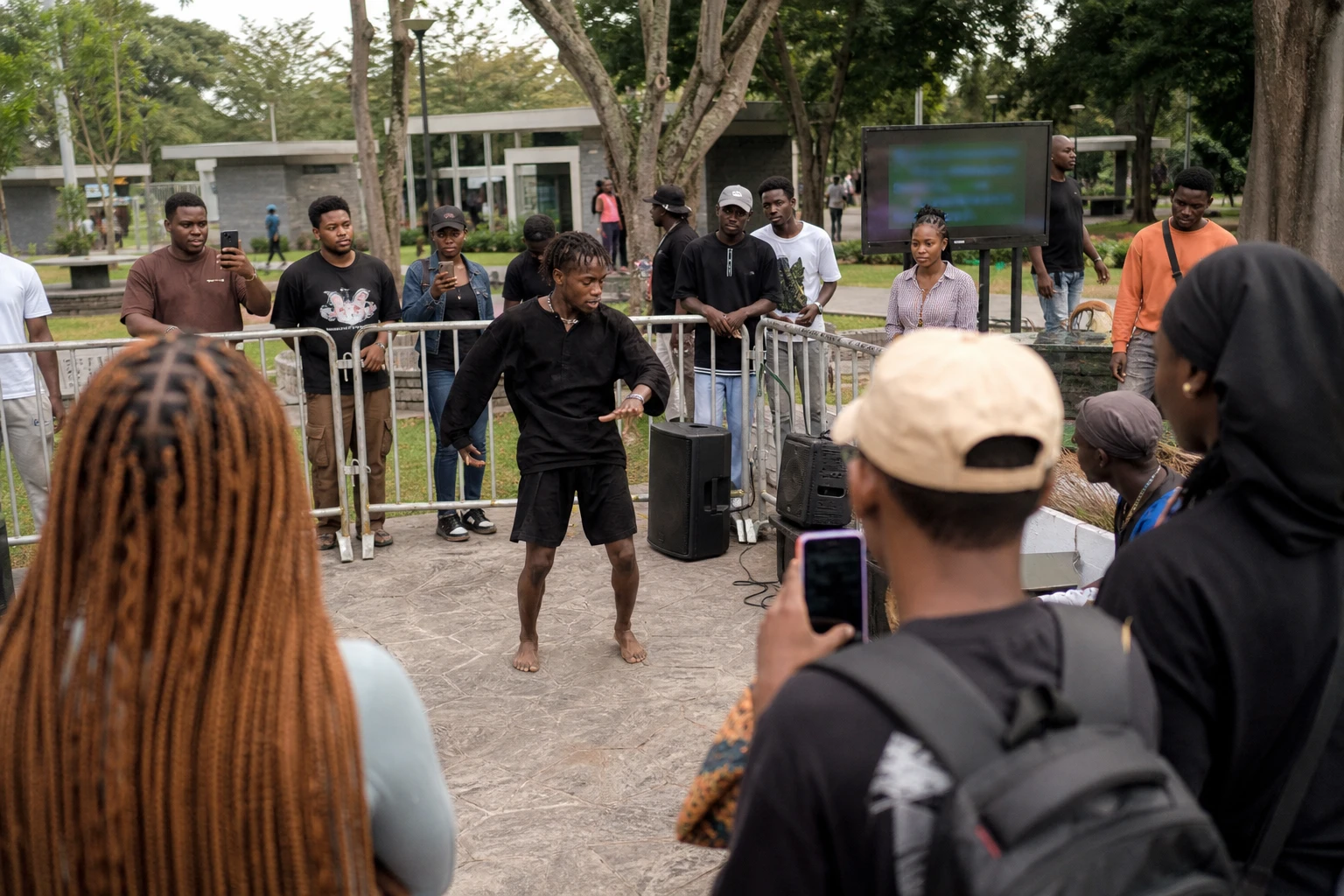
In Lagos, dance has become a test of endurance, but also a stage for telling a different story about Nigeria. For a week, Benjamin Daniel, known as Ben Dancer, sought to turn an individual performance into a celebration of Nigeria’s cultural diversity.
His goal was precise: to dance for 168 hours, or seven days, in the hope of setting a new world record. The initiative is part of a series of challenges that have recently drawn young people across Nigeria to attempt Guinness World Records titles.
An attempt followed in the heart of Lagos
Ben Dancer announced a performance at Freedom Park, a cultural space in central Lagos. According to reports published by the Nigerian press, the dancer was aiming for the title of the longest individual dance marathon.
The attempt was due to run from 21 to 27 September 2026. The format involves continuous activity, with scheduled rest breaks. Guinness World Records rules allow five minutes of rest for every hour of uninterrupted activity. These breaks can be accumulated to allow for a longer rest.
The benchmark record remains the one set by India’s Srushti Sudhir Jagtap. In 2023, aged 16, she danced for 127 hours in Latur, in the state of Maharashtra. Her performance was based mainly on kathak, a major Indian classical dance tradition. Guinness World Records confirms the 127-hour mark.
With 168 hours announced, Ben Dancer was therefore seeking to surpass that record by 41 hours. However, an attempt becomes an official record only after the evidence submitted to the organisation has been reviewed. Validation depends in particular on video footage, the tracking of breaks, witness statements and compliance with the stipulated conditions.
A performance shaped by Nigerian cultures
The stage set up at Freedom Park was not intended for a simple display of physical endurance. Ben Dancer’s project aimed to explore several of Nigeria’s musical and choreographic traditions.
Afrobeats was to take centre stage. Fuji, jazz and other popular influences were also to feature in the performance. The dancer was also expected to wear clothing associated with different traditions, including the agbada and dashiki.
This approach gives the attempt particular significance. Nigeria has more than 250 ethnic groups, according to commonly cited estimates. The country’s cultural diversity cannot therefore be reduced to a single style. It finds expression in languages, rhythms, costumes, ceremonies and urban practices.
In Lagos, this plurality is reflected in a city where local traditions sit alongside digital cultures. Choreographies spread rapidly on social media. Artists build their audiences in venues as well as on online platforms.
Images of the attempt drew spectators to Freedom Park. Young people gathered behind the barriers. Some filmed the scene, while others danced alongside the performer. The performance gradually took on the character of a collective event.
Physical endurance at the centre of concerns
A dance marathon places considerable demands on the body. Muscle fatigue, dehydration, injuries and sleep disturbances can quickly affect the dancer. The medical support announced for Ben Dancer was therefore set to play an essential role.
His team said he had undertaken intensive physical training. It also cited work on nutrition, with a focus on carbohydrates and cardiovascular conditioning.
During the event, the dancer was expected to drink regularly and eat small amounts. The rest breaks provided for under the rules could be grouped together. This option allows the strategy to be adapted, but does not eliminate the risks associated with prolonged activity.
Spectators in Lagos described changes in his energy levels over the days. Some said they were impressed by his determination. Others voiced concern about the possible physical consequences.
The reaction is a reminder of an important limit: public enthusiasm cannot replace medical supervision. In a record attempt, the participant’s safety remains a separate issue from media success.
After Hilda Baci, a new wave of records
Ben Dancer’s challenge comes amid a national appetite for lengthy, highly publicised performances. In 2023, Nigerian chef Hilda Baci cooked for 93 hours and 11 minutes in Lagos. Guinness World Records later officially recognised her performance.
The organisation says Hilda Baci prepared 55 recipes during her cooking marathon. Her feat helped popularise record attempts in Nigeria and several West African countries.
The phenomenon is not limited to cooking. Nigerians have launched challenges involving reading, chess, painting and artistic creation. In 2025, young artist Kanyeyachukwu Tagbo-Okeke secured a Guinness record for a giant canvas intended, among other things, to raise awareness of autism.
This trend reflects a desire for international visibility. It also highlights the power of Nigerian digital communities. A local performance can now be followed live by audiences in Abuja, Port Harcourt, London, Johannesburg or New York.
An undertaking that goes beyond the record itself
For Ben Dancer, the significance of the attempt is not limited to a line in a world rankings table. The project presents dance as a profession, a cultural language and a creative sector.
In a country where Lagos is home to much of the music and audiovisual industry, this kind of event can also raise the profile of choreographers. It shows that artists can create popular events without relying solely on traditional cultural circuits.
The regional significance is also real. ECOWAS, which brings West African countries together around common economic and political projects, shares a cultural space in which music, dance and digital formats circulate. Afrobeats, fuji and highlife have long crossed national borders.
The next step now depends on the official verification of the performance and the evidence provided by the dancer’s team. The outcome will show whether the 168 hours were completed and all the rules followed. Whatever the result, the event will already have demonstrated one reality: in Nigeria, artistic creation is also becoming a tool for bringing people together, telling a national story and projecting the country onto the world stage.