Algeria
 Egypt
 Libya
 Morocco
 Sudan
 Tunisia
 Benin
 Burkina Faso
 Cabo Verde
 Côte d'Ivoire
 Ghana
 Guinea
 Guinea-Bissau
 Liberia
 Mali
 Mauritania
 Niger
 Nigeria
 Senegal
 Sierra Leone
 The Gambia
 Togo
 Cameroon
 Central African Republic
 Chad
 DR Congo
 Equatorial Guinea
 Gabon
 Republic of the Congo
 São Tomé and Príncipe
 Burundi
 Comoros
 Djibouti
 Eritrea
 Ethiopia
 Kenya
 Madagascar
 Malawi
 Mauritius
 Mozambique
 Rwanda
 Seychelles
 Somalia
 South Sudan
 Tanzania
 Uganda
 Angola
 Botswana
 Eswatini
 Lesotho
 South Africa
 Zambia
 Zimbabwe
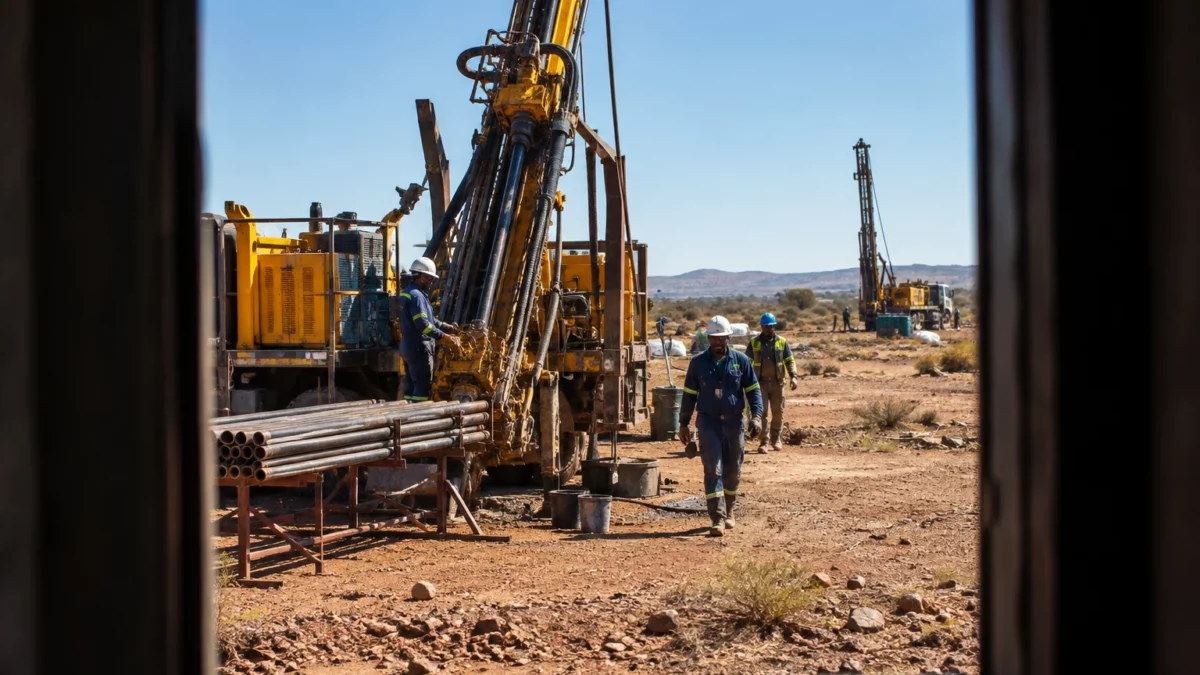
A large circle of surface indicators does not yet make a mine. In Namibia, a new drilling campaign is set to test whether the Nordenberg target conceals copper at depth, as several projects in the sector advance at very different paces.
A geological test, not yet a discovery
On 19 November 2026, Australian company Aldoro Resources announced the start of diamond drilling at Copper Hill, in central Namibia. The operation is focused on Nordenberg, a target about 20 kilometres north of Kalkfeld, according to information provided by the company.
The programme calls for 1,930 metres of drilling across two holes, being drilled simultaneously by two rigs. Aldoro is seeking to determine whether a geophysical and geochemical anomaly identified at the surface corresponds to copper mineralisation — possibly associated with gold — at depth. The anomaly is more than 2.5 kilometres in diameter, according to the company. This dimension describes an exploration target, not an economically recoverable reserve.
The distinction is essential. At this stage, no copper grades from the new drilling have been published, and no mineral resource has been established for Copper Hill. Assay results and their interpretation will determine whether the project can take an initial step towards an economic assessment.
Aldoro says two holes are under way, while a third location remains dependent on the analysis of geophysical data. The cost of the programme has not been disclosed. These details come from company announcements reported on 19 November; they describe the explorer’s stated timetable and objectives, not independently verified results.
A sector with projects at different stages
Exploration at Copper Hill is part of a broader Namibian mining landscape. The country’s Chamber of Mines says several copper mines closed or were put on care and maintenance after the global financial crisis, before activity began to recover, notably at Tschudi. The restart of Kombat and new projects are now contributing to the sector’s outlook, without guaranteeing that every announcement will lead to sustained production.
Projects are at markedly different stages. Hope & Gorob, in the centre of the country, is described as close to production, while the large Haib deposit in the south recently published the results of a pre-feasibility study. Omitiomire is also part of the portfolio of projects under development. These situations are not comparable with Copper Hill, which remains at the exploration stage. Timelines and investments announced for the other projects must also be distinguished from achievements already verified.
The Chamber of Mines places the return of copper projects in a history of restarts and market cycles. Regionally, Namibia is part of the Southern African Development Community (SADC), which brings together neighbouring countries with significant resources and mining infrastructure. Competition for capital therefore takes place in a region where operators can compare costs, permits, access to energy and transport.
From copper to rare earths: diversifying the portfolio
Copper Hill would give Aldoro a second exploration focus in Namibia. The company is already working on Kameelburg, a project associated mainly with rare earths and niobium. It attributes a resource estimate of 804.5 million tonnes to the project, including neodymium and praseodymium oxides. These figures relate to Kameelburg and should not be confused with a copper resource at Nordenberg.
For an exploration company, broadening its portfolio can spread risk across several commodities. But diversification removes neither geological nor financing risk. Drilling may confirm mineralisation without demonstrating that it can be extracted profitably. The volumes, grades, water and energy requirements, necessary infrastructure and environmental impacts must then be assessed.
Potential benefits are therefore measured in more than the value of the metal. They will also depend on the jobs actually created, contracts available to Namibian businesses, public revenues and the share of processing carried out in the country. These issues are particularly important in a sector where investment decisions and financing are often directed by foreign groups, while costs and changes in land use are felt locally.
What to watch next
Copper is sought for electricity networks, equipment and several energy-transition technologies. This demand supports investor interest in new resources, but global prospects do not prove the viability of any particular deposit. At Nordenberg, the next concrete milestone will be the publication of sufficiently detailed drilling results to confirm, or otherwise, the presence of continuous mineralisation.
For Namibia and its SADC partners, the challenge is also to turn mining interest into lasting local value. Authorities, communities, workers and national businesses will need to monitor permits, consultations, resource requirements and the projects’ economic commitments. At Copper Hill, however, the first question remains more basic: does the anomaly visible at the surface continue into the rock? The drill cores will have to provide the answer.
Contextual sources: copper history according to the Chamber of Mines of Namibia, Kombat restart and developments in the sector, status of the Hope & Gorob project and Haib pre-feasibility study.