Algeria
 Egypt
 Libya
 Morocco
 Sudan
 Tunisia
 Benin
 Burkina Faso
 Cabo Verde
 Côte d'Ivoire
 Ghana
 Guinea
 Guinea-Bissau
 Liberia
 Mali
 Mauritania
 Niger
 Nigeria
 Senegal
 Sierra Leone
 The Gambia
 Togo
 Cameroon
 Central African Republic
 Chad
 DR Congo
 Equatorial Guinea
 Gabon
 Republic of the Congo
 São Tomé and Príncipe
 Burundi
 Comoros
 Djibouti
 Eritrea
 Ethiopia
 Kenya
 Madagascar
 Malawi
 Mauritius
 Mozambique
 Rwanda
 Seychelles
 Somalia
 South Sudan
 Tanzania
 Uganda
 Angola
 Botswana
 Eswatini
 Lesotho
 Namibia
 South Africa
 Zambia
When schools enter the age of digital assistants
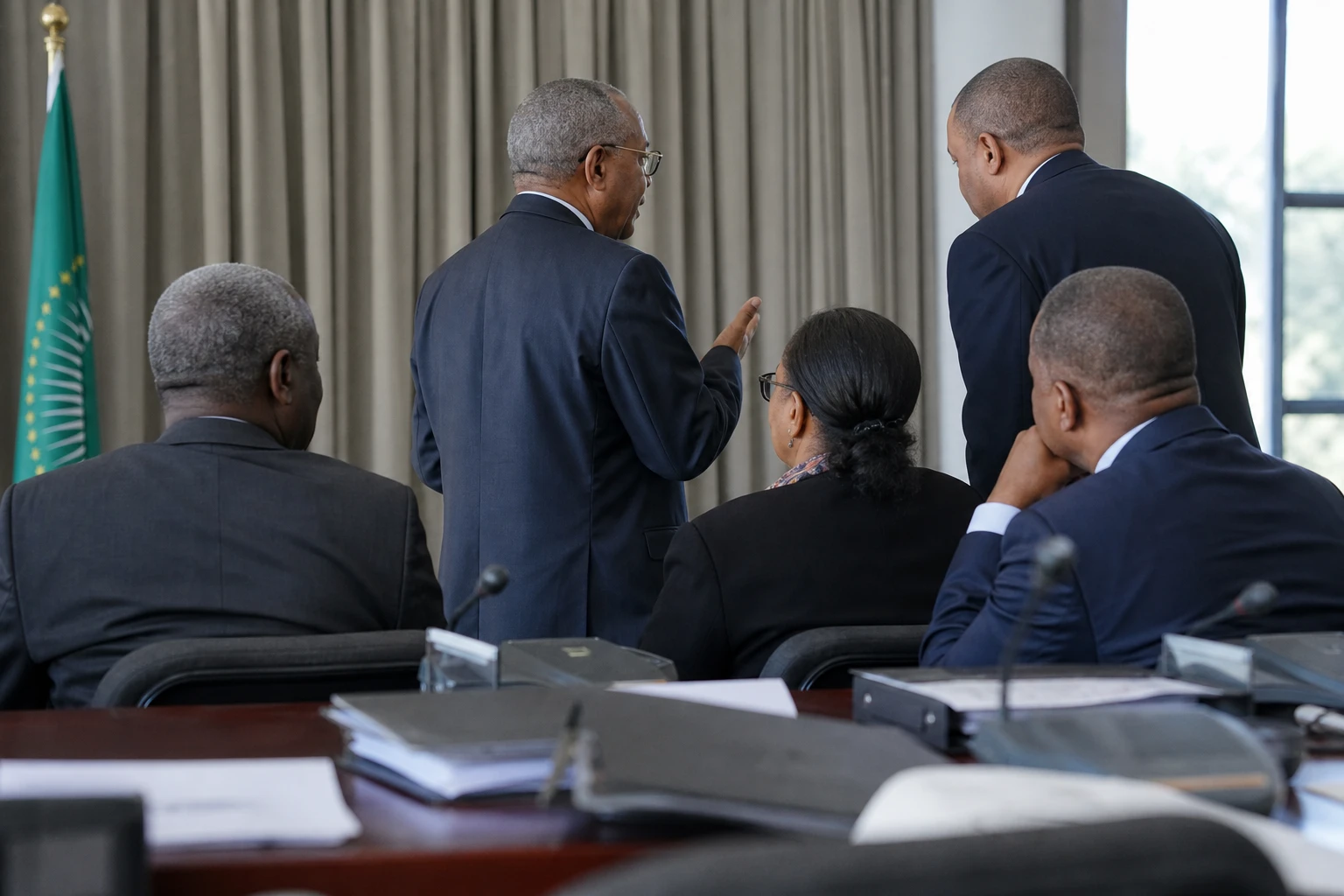
In many African classrooms, the question is no longer whether artificial intelligence will enter schools. It is already there, sometimes in a pupil’s pocket, sometimes on a teacher’s computer, often without a clear framework. In Paris, the UNESCO Digital Learning Week therefore put the debate at the right level: not as a passing trend, but in terms of governance, uses and limits of these tools in education. The 2026 edition, held from 8 to 11 September at UNESCO headquarters, is set to bring together more than 25 education ministers and produce a joint declaration on schools in the age of AI.
For African countries, the issue is immediate. UNESCO says it wants to consider what counts as “fact” in an environment saturated with synthetic content, the friction AI creates in education systems, and the new boundaries emerging between digital sovereignty, the public interest and community-based solutions. This approach echoes the line advocated by the African Union, which endorsed in 2024 a Continental Artificial Intelligence Strategy based on an African approach focused on development, ethics and skills.
Train, regulate, adapt: ministries’ tightrope
The debate opened with a keynote by Shingai Manjengwa, head of AI education at Mila, the Quebec Artificial Intelligence Institute. Her career spans continents: born in Zimbabwe, she moved through South Africa, studied in the United States and settled in Canada. This background allows her to speak about Africa without exoticism or detachment. In her view, AI is like a technology that must be governed in the same way as electricity: by educating people about it, regulating it and making it safe to use.
The central point of her argument is simple. AI can help, but it can also mislead. Models sometimes generate false answers with deceptive confidence. They also reproduce biases present in their training data. In a classroom, this means that a pupil may receive a plausible but incorrect answer, and a teacher may rely on a tool that has misunderstood the local context. The expert therefore stresses that AI replaces neither human supervision nor the learning of fundamentals. Before putting these tools in young people’s hands, they must be taught how to use them.
This caution resonates strongly in Africa, where governments are seeking to make AI a driver of modernisation without worsening existing divides. The African Union says AI can support innovation, skilled jobs, health, agriculture and education, but only if countries adopt coherent national approaches. In the same vein, the Economic Commission for Africa says AI governance must go hand in hand with strong institutions, assessment frameworks and technical capacity.
In Kenya, this logic has already taken the form of a 2025-2030 national strategy, published by the Ministry of Information, Communications and the Digital Economy. The document explicitly links AI to agriculture, health, governance and education, while stating an ambition to develop local solutions. In Zimbabwe, institutional and economic sources also refer to a 2026-2030 national strategy, designed around talent development, sovereign infrastructure, sectoral adoption and ethical governance.
African languages, local data and educational sovereignty
The question of languages gives this issue particular depth. Shingai Manjengwa tests major models in Shona, her mother tongue, and still finds many errors. The problem goes beyond translation alone. If AI systems are trained mainly in English, they struggle to capture cultural nuances, educational references and local usage. Yet for millions of pupils, the language of instruction is already a first barrier to equality. AI could therefore broaden access to content, but it could also reproduce a hierarchy of languages if nothing is done to correct this upstream.
The continent is not starting from scratch, however. Networks such as the Deep Learning Indaba have already built an African community of researchers, engineers and teachers around machine learning. This work matters because it reduces dependence on models developed elsewhere and paves the way for uses rooted in African realities. UNESCO, for its part, has included themes such as digital sovereignty, AI in the public interest and community-based approaches in its 2026 programme. In other words, the discussion is no longer simply about innovation versus caution; it asks who controls the uses, data and purposes.
This is where the issue becomes political, in the best sense of the word. If content produced in Shona, Wolof, Pulaar, Swahili or Amharic is used to train commercial systems hosted outside the continent, the value created does not automatically return to the communities that provided the linguistic and cultural raw material. Shingai Manjengwa raises this question without dramatising it, but without evading it: governments and communities must decide what knowledge can be shared, with whom and for what purpose. In a continent where UNESCO and the ECA still highlight the limits of access to electricity and the internet, the promise of AI cannot be separated from the question of infrastructure.
The coming months will show whether ministerial declarations translate into budgets, training programmes and tools suited to African schools. The real test will be in textbooks, educational platforms, teacher-training centres and rules governing access to data. The continent-wide stakes are clear: Africa lacks neither expertise nor strategy. It must now turn these foundations into lasting capacity, country by country, while balancing digital sovereignty, language, equity and the quality of learning.