Algeria
 Egypt
 Libya
 Morocco
 Sudan
 Tunisia
 Benin
 Burkina Faso
 Cabo Verde
 Côte d'Ivoire
 Ghana
 Guinea
 Guinea-Bissau
 Liberia
 Mali
 Mauritania
 Niger
 Nigeria
 Senegal
 Sierra Leone
 The Gambia
 Togo
 Cameroon
 Central African Republic
 Chad
 DR Congo
 Equatorial Guinea
 Gabon
 Republic of the Congo
 São Tomé and Príncipe
 Burundi
 Comoros
 Djibouti
 Eritrea
 Kenya
 Madagascar
 Malawi
 Mauritius
 Mozambique
 Rwanda
 Seychelles
 Somalia
 South Sudan
 Tanzania
 Uganda
 Angola
 Botswana
 Eswatini
 Lesotho
 Namibia
 South Africa
 Zambia
 Zimbabwe
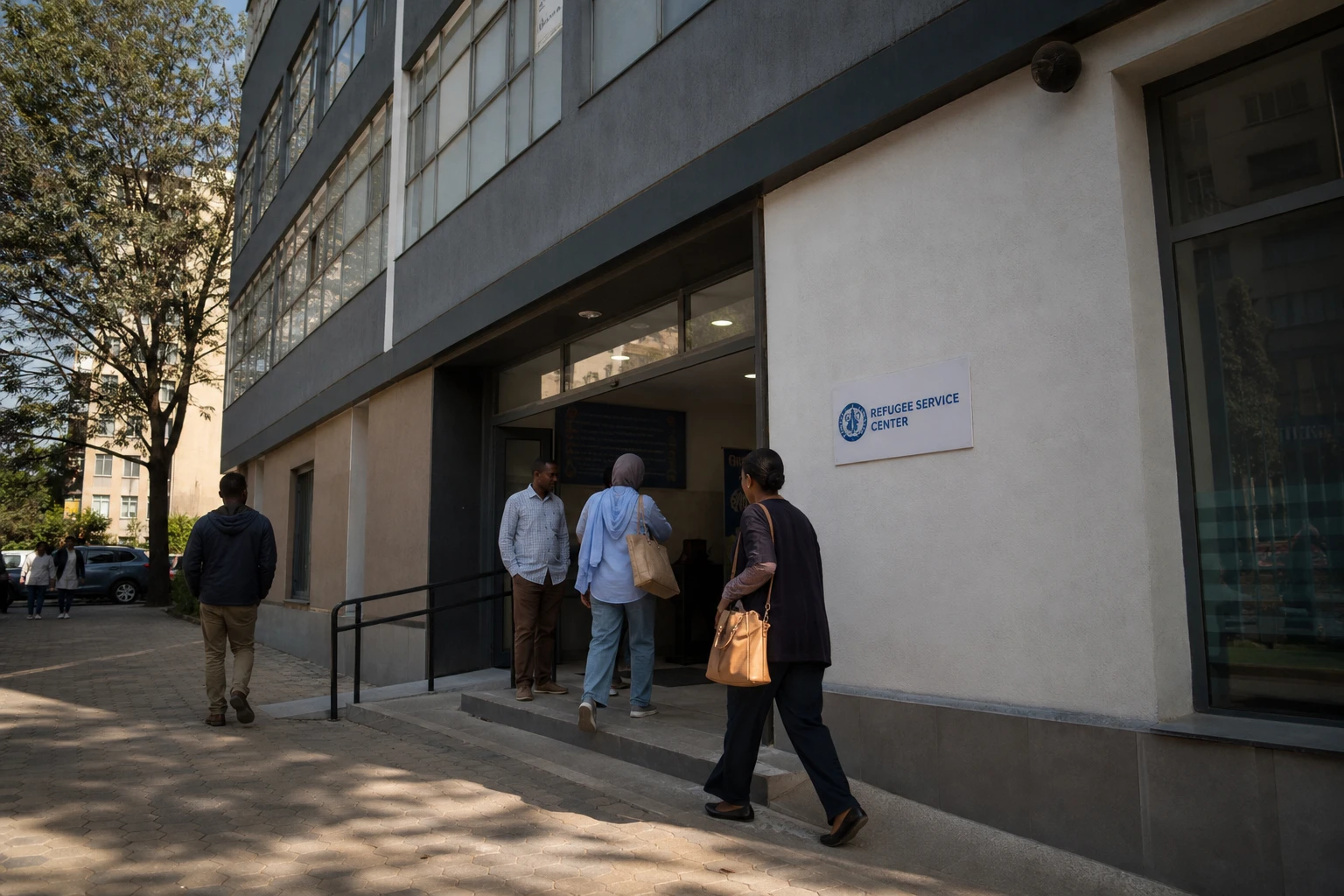
In Addis Ababa, refugees first seek a point of support
In Addis Ababa, many refugees lack more than just a roof over their heads. Above all, they lack a point of reference. Between procedures, appointments and waiting, days can drag on without a clear answer. It is in this uncertain space that an aid centre has opened in the Kirkos district, designed to bring order to journeys that are often fragmented.
The initiative is set against a challenging but stable reality: Ethiopia hosts more than 1.12 million refugees and asylum seekers, according to figures updated as of 31 May 2026. There are nearly 70,983 in the Ethiopian capital. Addis Ababa is therefore both a place of transit and a place of temporary or lasting settlement, where administrative processes determine access to work, healthcare and, at times, personal safety.
The new centre was announced on 18 July 2026 in Addis Ababa as a multi-purpose space for protection, guidance and advice for refugees, asylum seekers and other people in vulnerable situations. It is based at the Addis Ababa-Jesuit Refugee Service Centre in Kirkos, with support from the United Nations High Commissioner for Refugees, Ethiopia’s refugee and returnee service, the government of Japan and the African Union Commission.
The choice of location is no coincidence. Kirkos is already a point of contact for the UN agency’s services in Addis Ababa. The idea is simple: bring reliable information, legal assistance, administrative guidance, advice on family reunification and referrals to appropriate services together in one place. In a capital city, this kind of one-stop centre reduces repeated trips, procedural errors and social isolation.
The need is real. Ethiopia remains one of the continent’s main refugee-hosting countries. UN agency data show that the country mainly hosts nationals of South Sudan, Somalia, Eritrea and Sudan. Most of this population lives in camps, but a significant proportion is in urban areas, especially Addis Ababa. For those living there, the distance from services is not merely geographical. It is also bureaucratic.
An administrative response, but also a political signal
The centre’s opening comes as Addis Ababa seeks to change its inclusion policy. In June 2026, the Ethiopian government launched the Makatet Roadmap, presented as a turning point in integrating refugees into national services. A few years earlier, Ethiopia had already embarked on an inclusion drive with a digital identity system intended to make it easier for refugees to access public services. The new Kirkos centre extends that approach: it does more than provide assistance, directing people towards clearer inclusion within the national administrative framework.
For refugees, the issue goes beyond simply providing information. Without clear documents, follow-up and help navigating administrative processes, many remain stuck for months, sometimes years. Some eventually consider other routes, notably to Libya and then across the Mediterranean. This is not a theoretical risk. It often stems from exhaustion, enforced inactivity and a sense of being absent from the system. A local centre can therefore reduce the appeal of risky departures by showing that other options, however modest, exist within the host country.
The message is also political. By bringing together the Ethiopian government, the UN agency and the African Union Commission, the initiative offers an African perspective on forced displacement: protect first, document next, include where possible. Ethiopia, a member of IGAD — the Intergovernmental Authority on Development in East Africa — is thus part of a regional shift in which displacement is addressed not only through emergency response, but also through access to services, work and autonomy.
This approach has different effects for different groups. For the authorities, it makes it possible to monitor people more effectively, limit blind spots and reduce tensions linked to irregular administrative status. For urban refugees, it could provide more practical access to assistance, help translating documents, legal advice and some economic opportunities. For families, it could also simplify a crucial process: family reunification, often decisive in stabilising a journey into exile.
A fundamental limitation remains: a one-stop centre cannot replace a job, affordable housing or faster procedures. Addis Ababa already faces considerable social needs. The most vulnerable beneficiaries remain exposed to rents, informality and waiting. That is why the challenge is not confined to an office in Kirkos, but lies in the ability of the Ethiopian state, its partners and external funders to turn inclusion from rhetoric into real services.
The Ethiopian case matters across the continent. It shows that a major refugee-hosting country can seek solutions that do not rely solely on camps, but also on cities, public services and institutional co-ordination. In an East African region affected by the consequences of the war in Sudan, protracted crises in Somalia and displacement linked to internal tensions, this kind of centre becomes a practical test: can people be protected without being isolated, and included without weakening the right to asylum? The answer will now depend on how long the effort lasts, how widely it reaches and what comes next in Ethiopia’s roadmap.