Algeria
 Egypt
 Libya
 Morocco
 Sudan
 Tunisia
 Benin
 Burkina Faso
 Cabo Verde
 Ghana
 Guinea
 Guinea-Bissau
 Liberia
 Mali
 Mauritania
 Niger
 Nigeria
 Senegal
 Sierra Leone
 The Gambia
 Togo
 Cameroon
 Central African Republic
 Chad
 DR Congo
 Equatorial Guinea
 Gabon
 Republic of the Congo
 São Tomé and Príncipe
 Burundi
 Comoros
 Djibouti
 Eritrea
 Ethiopia
 Kenya
 Madagascar
 Malawi
 Mauritius
 Mozambique
 Rwanda
 Seychelles
 Somalia
 South Sudan
 Tanzania
 Uganda
 Angola
 Botswana
 Eswatini
 Lesotho
 Namibia
 South Africa
 Zambia
 Zimbabwe
In Abidjan, a congested junction does more than slow cars. It can also lengthen the working day, make journeys more expensive and delay goods. The new agreement with Japan targets three intersections in Cocody. But the effectiveness of these structures will also depend on public transport and how traffic is managed around the construction sites.
An urban corridor under pressure
The project concerns Germain Coffi Gadeau Boulevard, formerly François-Mitterrand Boulevard, in Greater Abidjan. The three interchanges are planned at the intersections of the National Police Academy, Riviera 3 and Riviera Palmeraie. These routes connect residential districts to centres of activity and carry heavy daily traffic.
Abidjan is the economic capital of Côte d’Ivoire, whose political and administrative capital is Yamoussoukro. The metropolis is growing, and its mobility needs are following the same trajectory. The challenge is not limited to moving more vehicles: it is also about making journeys accessible, predictable and affordable for residents.
The interchanges form part of a broader infrastructure policy. The Abidjan Urban Transport Project (PTUA) involves the Ivorian state, the Japan International Cooperation Agency (JICA) and the African Development Bank, among others. The programme includes roads and structures, while other initiatives, such as the metro and bus rapid transit, are intended to strengthen public transport.
Financing to be repaid, not a grant
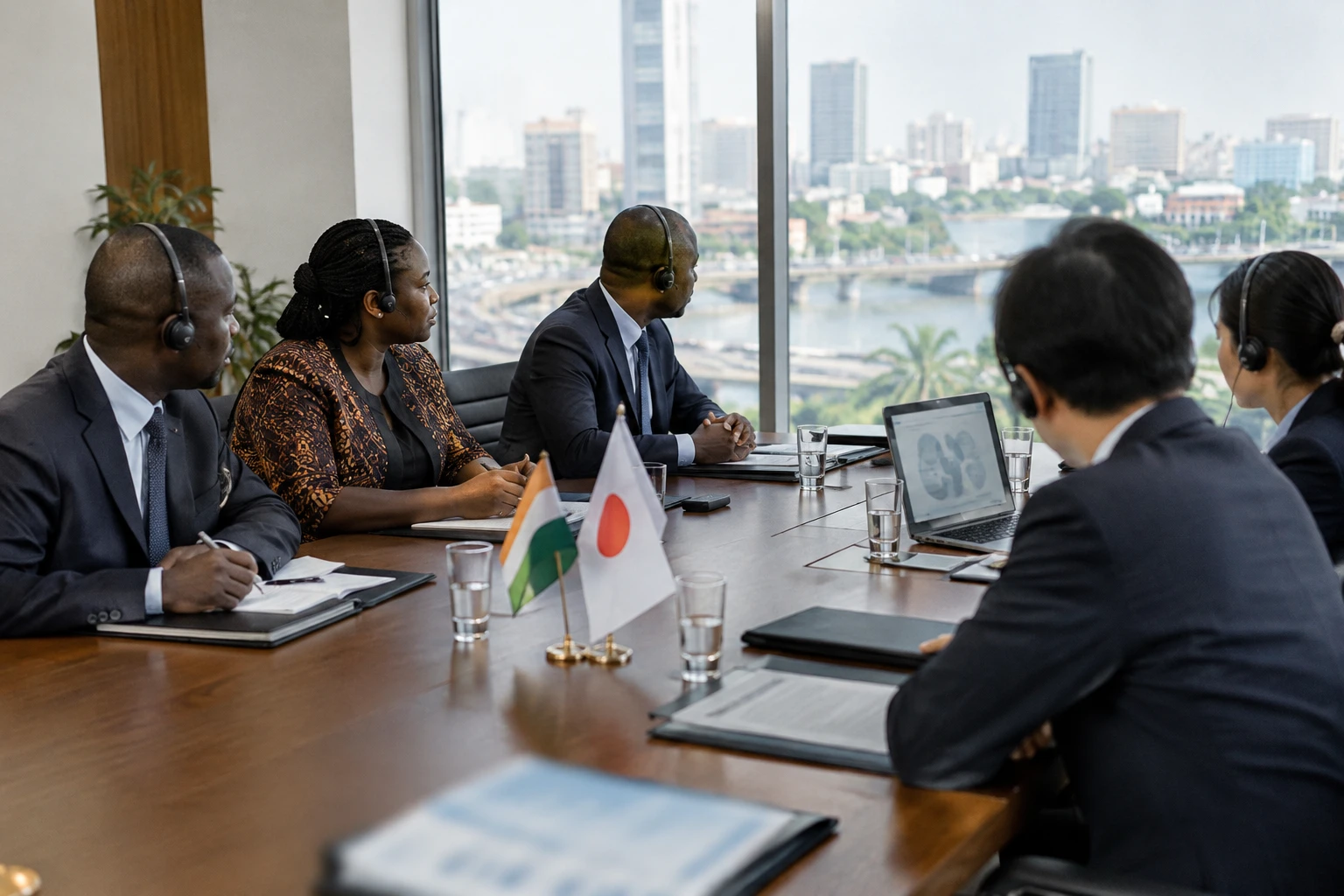
On 4 November 2026, Côte d’Ivoire and Japan signed an exchange of notes for the project’s second phase. The Japanese embassy puts the financing at around CFAF 48.4 billion. It is a concessional loan, not a grant: the announced interest rate is 0.8%, with repayment over 40 years, including a ten-year grace period. This distinction matters because it clarifies the nature of the state’s financial commitment.
The agreement was signed by Nialé Kaba, Minister of State for Foreign Affairs and International Cooperation, and Japanese ambassador Gomakubo Junji. Yacouba Hien-Sié, Minister of Infrastructure and Road Maintenance, was present. The authorities present the structures as a way to increase traffic capacity and facilitate the transport of people and goods.
This new phase extends Japanese cooperation on Abidjan’s infrastructure. It comes as the three junctions are already included in the boulevard development programme. However, the schedules and costs announced for the different phases should not be conflated: the newly signed financing covers Phase II, while PTUA documents cover a broader programme and earlier commitments.
The figures and financial terms of the agreement are reported by the Japanese embassy in Côte d’Ivoire. Ivorian business media have also reported the signing on 4 November and the announced amount. The official agreement explicitly describes the financing as a loan, correcting the description as a “grant” sometimes repeated in reports.
The daily cost of getting around
The consequences of traffic congestion are unevenly distributed. In 2019, a World Bank analysis found that Abidjan’s poorest households spent between 20% and 30% of their income on public transport and spent an average of 200 minutes a day travelling or waiting for transport. These figures describe the situation studied at the time; they are not an updated measure for 2026.
The same institution estimated at the time that the direct costs and time lost because of mobility problems weighed heavily on the economy. Its analysis cited losses of up to 4% to 5% of national income. This is a 2019 estimate, not a current accounting of losses. It nevertheless underscores why mobility is both a social and an economic issue: delays affect employees, small traders, delivery companies and activities that rely on regular schedules.
The effects of the construction work will also be unevenly shared. Transport companies and motorised users can hope for smoother journeys once the structures are completed. But during construction, diversions and delays are likely to complicate journeys for workers and freight operators. People who combine several modes of transport, particularly in districts far from major routes, will not automatically benefit from time savings.
An interchange can eliminate a conflict point between traffic flows. It cannot replace a sufficiently frequent bus network, easy connections or a coherent traffic policy. Without integration with public transport, some of the gains could mainly benefit car journeys. The challenge, then, is to connect the structure to the full range of urban journeys, rather than measuring its success solely by vehicle throughput.
Results to be measured beyond construction
Côte d’Ivoire is not alone in facing these issues. Across ECOWAS, the Economic Community of West African States, several capitals are experiencing rapid urbanisation and seeking to organise travel between residential districts, employment zones and logistics hubs. Abidjan’s experience is therefore of interest to the region, although it is not a model that can be transferred unchanged: every city has its own geography, institutions and resources.
The programme adds to projects combining roads, public transport and urban development. Their coordination will affect the results. Poorly synchronised construction work can shift congestion rather than reduce it. In the longer term, maintaining the structures and funding their operation will also determine how long the benefits last.
For residents, the most meaningful indicators will be tangible: journey times, transport costs, bus reliability and access to employment districts. The authorities will also need to monitor traffic conditions during construction, final expenditure and maintenance. The three interchanges address a visible need on the road network. Their impact will depend on their integration into a mobility policy that does not leave public transport users on the margins.
Background sources: the PTUA overview by AGEROUTE and a 2019 analysis of mobility in Abidjan.