Algeria
 Egypt
 Libya
 Morocco
 Sudan
 Tunisia
 Benin
 Burkina Faso
 Cabo Verde
 Côte d'Ivoire
 Ghana
 Guinea
 Guinea-Bissau
 Liberia
 Mali
 Mauritania
 Niger
 Nigeria
 Senegal
 Sierra Leone
 The Gambia
 Togo
 Cameroon
 Central African Republic
 Chad
 DR Congo
 Equatorial Guinea
 Gabon
 Republic of the Congo
 São Tomé and Príncipe
 Burundi
 Comoros
 Djibouti
 Eritrea
 Ethiopia
 Kenya
 Madagascar
 Malawi
 Mauritius
 Mozambique
 Rwanda
 Seychelles
 Somalia
 South Sudan
 Tanzania
 Uganda
 Angola
 Botswana
 Eswatini
 Lesotho
 Namibia
 Zambia
 Zimbabwe
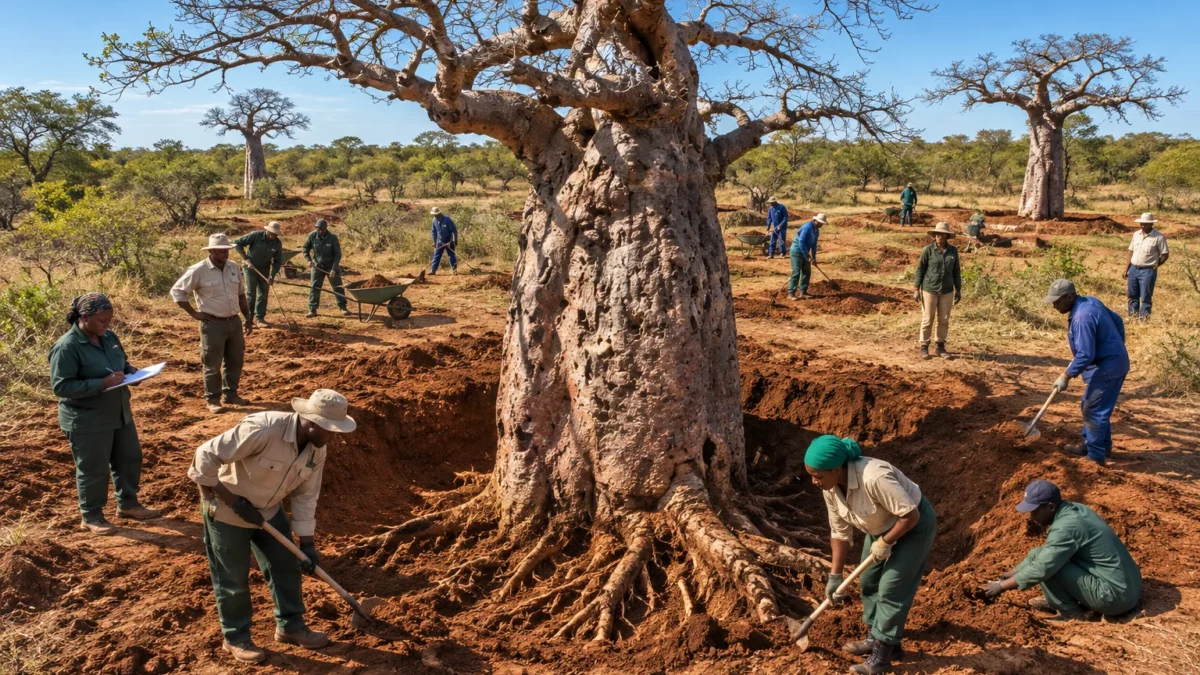
A baobab is not just another garden object. In southern Africa, these imposing trees are part of the landscapes, ecosystems and local heritage. Their relocation to private properties abroad therefore raises a practical question: who can decide the fate of a protected tree, and under what conditions?
From Limpopo to the port of Durban
On 17 July 2026, five baobabs were intercepted at a logistics warehouse in Durban, in KwaZulu-Natal province. They had been taken from the municipality of Lephalale, in Limpopo, and transported to the coast for export to Georgia, a Caucasus country bordered by the Black Sea. South African authorities say the documents required for their removal and transport were not in order.
South Africa’s Department of Forestry, Fisheries and the Environment has opened a criminal investigation. The landscaping company implicated subsequently applied for permission for the trees. The application was rejected, and an appeal also failed: on 25 October, the minister confirmed the refusal. The criminal case remains ongoing. The government says the hearing has been postponed until 15 January 2027.
Baobabs are protected under the national Forests Act, which regulates their felling, relocation, sale and export, among other things. A permit is required. According to the government, a second case has also been opened in Limpopo under the provincial Environmental Management Act. A conviction could result in a fine, a prison sentence of up to three years, or both.
The authorities have not officially confirmed the identity of the final recipient. Georgian media have reported a possible link to Bidzina Ivanishvili, a former prime minister and Georgian billionaire who owns an arboretum on the Black Sea coast. This lead is among the details reported in the investigation, but it is not public proof that the trees were intended for him.
Seizure, then a return to their natural habitat
Their fate has changed since they were intercepted. After several months of uncertainty in Durban, the five trees were transported in November to Timbavati Nature Reserve in Limpopo, where their replanting was arranged. The department says specialists removed wood affected by rot and treated the trees before their relocation. Their survival remains a concern: uprooting an adult baobab, keeping it in transit and then replanting it all carry significant risks.
The choice of site mattered. The government says it ruled out the national botanical gardens, where excessively wet soils could have encouraged root rot. The Baobab Foundation, a South African organisation specialising in the conservation of the species, helped fund the rescue and relocation. The chosen destination lies within the tree’s natural range, rather than in a very different environment.
Africa Global Logistics, the company whose warehouse housed the trees, said it had acted as a logistics provider and was neither the owner nor the exporter. It says it halted the shipment as soon as compliance issues were raised and is co-operating with the authorities. It is not facing prosecution in the case, according to statements reported by South African outlet Daily Maverick.
The lesson of a Kenyan precedent
A similar case occurred nearby. In 2022, eight baobabs taken from Kilifi county in Kenya were due to be sent to Georgia. Amid criticism over permits, benefit-sharing and the effects on local communities, the Kenyan government suspended their transport and announced an investigation. The trees were eventually planted in Georgia in 2023. In 2024, Kenyan outlet NTV reported that they had died after several months of stress and poor storage conditions. The park administration, for its part, blamed the losses on delays and difficulties encountered during the process.
The two episodes are not identical. The South African case concerns permits that the relevant authorities say were missing or refused. In Kenya, the debate had also focused on the validity of permits and the role of Kilifi’s communities. But both raise the same difficulty: a species does not need to be officially threatened with extinction for the removal of mature specimens and their transport to become a conservation and governance issue.
For people in the areas where the trees originated, the issue goes beyond the market value of a tree. Baobabs contribute to local landscapes and ecosystems. Their removal can also raise questions about consultation, economic benefits and the preservation of natural heritage. Conversely, enforcing the rules does not rely solely on checks in rural areas: ports, transporters, exporters and authorities must be able to verify permits throughout the supply chain.
A South African and regional issue
The case puts South Africa’s ability to enforce its environmental laws, from the place of removal to the port, in the spotlight. The country is a member of the Southern African Development Community (SADC), which brings together states in the region and encourages co-operation between them. The case is not being presented as a SADC investigation, but cross-border routes for natural specimens are a reminder that protecting biodiversity also depends on co-ordinated checks between countries of origin, logistics hubs and destinations.
From Pretoria, South Africa’s capital, the authorities will now have to continue the investigation and monitor the trees’ recovery after planting. The legal proceedings will determine individual responsibility. For the baobabs, returning to Limpopo prevents a contested export, but does not guarantee their survival. That is also the tangible measure of what is at stake: protecting a species means controlling its trade, but also preserving the conditions that allow it to continue living where it grew.