Algeria
 Egypt
 Libya
 Morocco
 Sudan
 Tunisia
 Benin
 Burkina Faso
 Cabo Verde
 Côte d'Ivoire
 Guinea
 Guinea-Bissau
 Liberia
 Mali
 Mauritania
 Niger
 Nigeria
 Senegal
 Sierra Leone
 The Gambia
 Togo
 Cameroon
 Central African Republic
 Chad
 DR Congo
 Equatorial Guinea
 Gabon
 Republic of the Congo
 São Tomé and Príncipe
 Burundi
 Comoros
 Djibouti
 Eritrea
 Ethiopia
 Kenya
 Madagascar
 Malawi
 Mauritius
 Mozambique
 Rwanda
 Seychelles
 Somalia
 South Sudan
 Tanzania
 Uganda
 Angola
 Botswana
 Eswatini
 Lesotho
 Namibia
 South Africa
 Zambia
 Zimbabwe
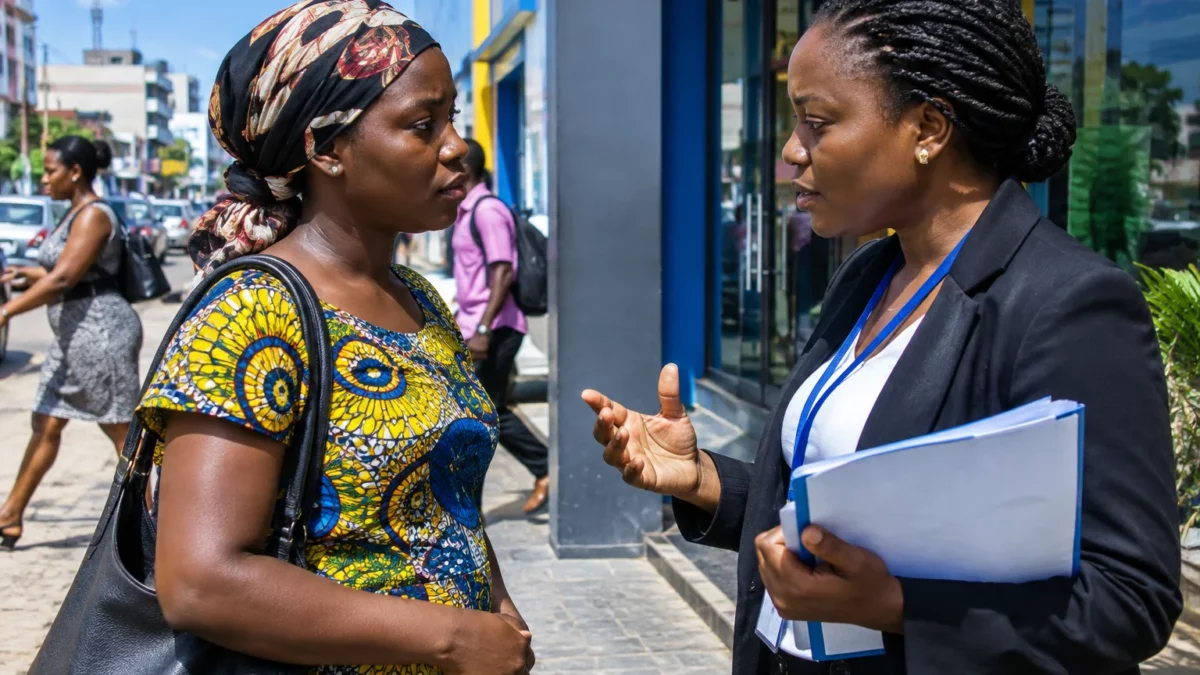
A job abroad can represent an expected income for a family and money to pay for education. But when the promised conditions do not match reality, a worker isolated far from home may have few ways to seek help. The account of Stephanie Nkrumah, who returned to Ghana after working as a domestic worker in Iraq, has put the issue at the centre of the debate on labour recruitment.
From recruitment to labour dependency
Stephanie says she went to Iraq in 2025 through an agent, after being promised an eight-hour working day and periods of rest. She also says she had to repay some of the costs incurred in recruiting her. Once there, she says, her working days stretched until the family employing her went to bed. She says she had no days off and received no wages during her first two weeks of work.
These details are her account. They do not, in themselves, constitute a judicial finding on the responsibility of the employer or the agency. A video shared online shows a woman being struck several times. Ghanaian authorities identified her as Stephanie and say they formally protested to Iraq. The identity of the man accused and the outcome of any investigation remain to be publicly established.
According to Stephanie, the assault followed her request for medical care while she was ill. She says the man, whom she identifies as the person in charge of the agency, hit and threatened her. She says she was then locked in until the following day. “I escaped because I did not want to die,” she said in her account.
An escape planned across several cities
Stephanie says she spoke regularly with her parents, who helped her plan her departure. Her father, who lives in Canada, is said to have bought her plane ticket. She says she kept her passport because travelling between different houses sometimes meant having to show it at checkpoints. A taxi driver is said to have taken her to the airport for $150. These details come from her account and have not all been independently corroborated in publicly available information.
After her return, Ghana’s foreign minister, Samuel Okudzeto Ablakwa, received her in Accra with members of her family on 23 November 2026. The ministry announced medical and psychological care, 50,000 Ghanaian cedis in support to start a small business, and a pledge of a scholarship to resume her studies. The government also says it has lodged a protest with the Iraqi authorities and is calling for appropriate measures.
On 24 November, the ministry said a moratorium on recruiting domestic workers for Iraq was under consideration. This is a proposed measure, not a ban whose entry into force has been announced. The distinction matters to people who already have a contract or are considering leaving: the political statement specifies neither a timetable nor its scope, nor how workers already in the country would be protected.
Ghana’s past experience offers a reason to weigh a moratorium’s effects
The debate is not new. In 2017, Ghana imposed a temporary suspension on private recruitment to Gulf countries. A summary by the International Organization for Migration notes that the measure halted the activities of registered agencies, while studies cited in an assessment of migration in Ghana link restrictions to some departures shifting to informal channels. This does not mean a suspension would be unjustified; it highlights the need to accompany it with oversight and safe recruitment routes.
In Stephanie’s case, the costs she says she had to repay and the unfulfilled promises about working hours raise a practical question: who checks the contract before departure, and who intervenes when it is breached? A ban may reduce departures organised by visible agencies. Without enforcement and monitoring mechanisms, it may also make some processes harder to trace. Workers in distress, their families in Ghana and formal recruiters would therefore not be affected in the same way.
The support announced by Accra addresses immediate needs, but lasting protection also depends on rules that can be enforced before and after departure. This means checking agencies, making fees and working conditions clear, keeping in contact with citizens abroad and providing accessible recourse. Information published by the government does not yet detail a comprehensive system of this kind for Iraq.
Responsibility extends beyond bilateral diplomacy
For Ghana, the case tests the state’s ability to defend its citizens beyond its borders. For Iraq, Ghana’s protest calls for a response from the competent authorities, but no conclusion on criminal liability can be drawn before an investigation. The video has brought the case to public attention; it cannot show how many other workers are experiencing difficulties without being able to report them.
Across West Africa, the issue concerns labour migration and recruitment networks that cross borders. ECOWAS, the West African regional economic community, provides a framework for co-operation among states in the region, but Stephanie’s case also involves bilateral relations with a Middle Eastern country. The regional challenge is therefore a practical one: sharing alerts, regulating intermediaries and ensuring consular assistance, without conflating the circumstances in each destination country.
The next steps to watch are twofold: Iraq’s response to the diplomatic protest and a formal Ghanaian decision on the moratorium. It will also be important to see whether the authorities publish specific rules for the agencies and workers concerned. For Stephanie, the stated priority is care and resuming her studies. For other prospective workers, the outcome will depend above all on safeguards that can be verified before travel and remedies available once they are abroad.