Algeria
 Egypt
 Libya
 Morocco
 Sudan
 Tunisia
 Benin
 Burkina Faso
 Cabo Verde
 Côte d'Ivoire
 Ghana
 Guinea
 Guinea-Bissau
 Liberia
 Mali
 Mauritania
 Niger
 Nigeria
 Senegal
 Sierra Leone
 The Gambia
 Togo
 Cameroon
 Central African Republic
 Chad
 DR Congo
 Equatorial Guinea
 Gabon
 Republic of the Congo
 São Tomé and Príncipe
 Burundi
 Comoros
 Djibouti
 Eritrea
 Ethiopia
 Kenya
 Madagascar
 Malawi
 Mauritius
 Mozambique
 Rwanda
 Seychelles
 Somalia
 South Sudan
 Tanzania
 Uganda
 Angola
 Botswana
 Eswatini
 Lesotho
 Namibia
 Zambia
 Zimbabwe
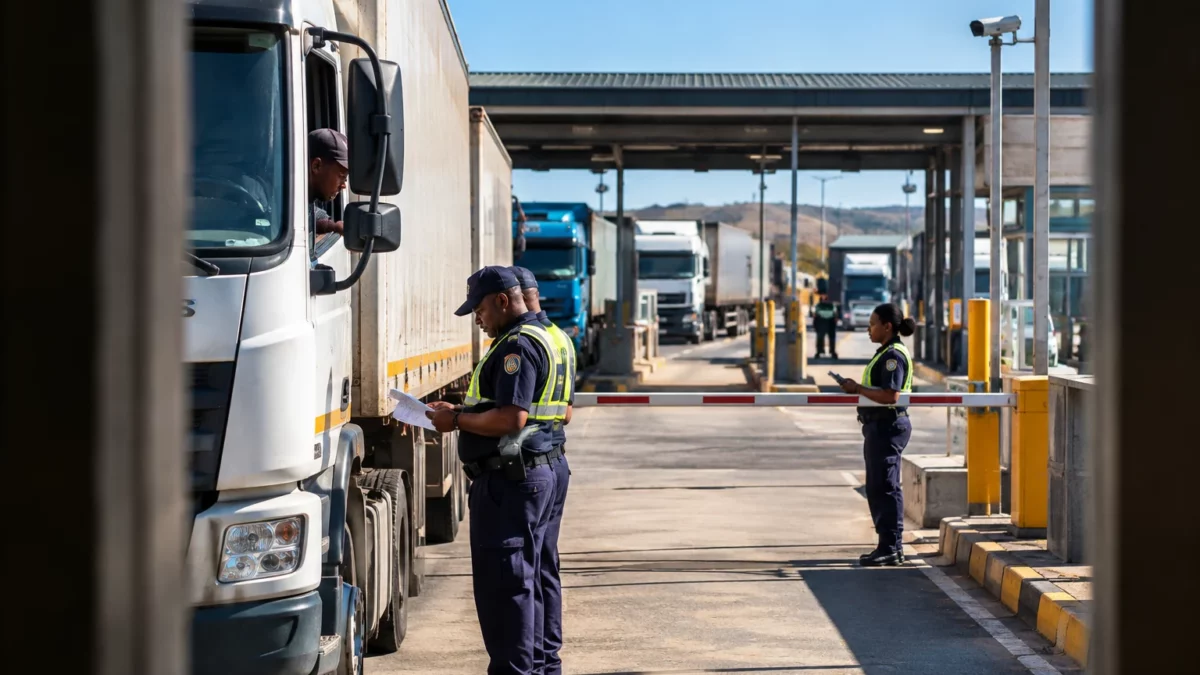
For businesses moving goods between South Africa and Zambia, time spent at a border affects costs, stock levels and delivery times. The two countries now want customs information to circulate before cargo arrives, so that inspections can be prepared in advance.
Declarations transmitted before goods arrive
The South African Revenue Service (SARS) and the Zambia Revenue Authority (ZRA) signed their interconnection agreement on Friday 20 November 2026, according to SARS. Publicly announced on 23 November, the arrangement provides for the electronic exchange of cargo information between the customs administrations of the two countries.
The data concerned include the identities of exporters and recipients, descriptions and quantities of products, their tariff classification, value, origin and destination. The authorities can also share transport information. This will enable them to compare export and import declarations earlier.
The principle is simple: identify inconsistencies before goods arrive, rather than examining each file at the border post. The administrations will be able to assess risks, prepare targeted inspections and, where declarations are compliant, avoid some repeated checks. The system is also intended to facilitate audits after cargo has passed through.
SARS Commissioner Johnstone Makhubu describes this approach as a shift towards controls guided more by data. It does not eliminate inspections. Rather, it aims to distinguish more effectively between operations that present a risk and those that comply with the rules, so that inspection resources can be directed where they are most useful.
A regional initiative already under way
The agreement between Pretoria and Lusaka is part of a broader South African customs connectivity programme. SARS concluded a similar arrangement with the Malawi Revenue Authority on 30 July 2026. Talks with Zimbabwe are progressing, while the Democratic Republic of the Congo is being considered for possible future integration.
The project also draws on a regional roadmap adopted in Pretoria in August 2026. Customs officials from Malawi, Mozambique, South Africa, Zambia and Zimbabwe agreed to work towards interconnecting their systems. The secretariat of the Southern African Development Community (SADC), the regional co-operation organisation, took part in the work.
This co-operation is therefore not limited to a bilateral agreement. It aims to make data exchanges between several administrations compatible. For the system to work across corridors, formats, references used to identify cargo and risk-management procedures will need to be harmonised. An IT connection alone does not guarantee identical practices at every border.
Potential gains, but no guarantees
For transport operators and businesses, the main promise is greater predictability. Less variable transit times can make delivery planning easier and reduce costs associated with vehicles or goods being held up. Businesses with limited resources to finance stocks or wait for invoices to be paid could particularly benefit from more regular transit.
However, the agreement does not quantify expected reductions in time or costs. Its impact will depend on data quality, system speed and officials’ ability to process alerts. Road infrastructure, procedures in other countries along the route and any non-customs checks will also continue to affect transport times. It is therefore a trade-facilitation tool, not a solution to every logistical obstacle.
Data-sharing also brings responsibilities. The two administrations say safeguards govern confidentiality, personal information and authorised uses. How these are applied in practice will matter as much as the technology: operators must be able to understand what data are exchanged, for what purpose and under what protections. Trust between administrations and businesses will be essential to ensure that the information provided is complete and reliable.
Finally, customs authorities are pursuing two objectives at once: speeding up legitimate trade and protecting public revenue. Comparing records can help detect undervaluation, false declarations or discrepancies between exports and imports. This can strengthen checks, even as official statements also emphasise smoother trade. The challenge is to make inspections more targeted without turning data-sharing into an additional obstacle for businesses that comply with the rules.
A practical test for the AfCFTA
The corridor forms part of the ambitions of the African Continental Free Trade Area (AfCFTA), which aims to develop trade between African countries. Cutting tariffs is not enough to get goods moving: formalities, differences in procedures and a lack of co-ordination can still slow trade. Connected customs systems can help address these difficulties at an operational level.
The regional potential is real. According to Afreximbank’s 2025 report, intra-African trade reached $208 billion in 2024, up from $193 billion in 2023. Southern Africa accounted for $58.1 billion of that trade, the highest regional figure in the report’s estimates. These figures describe the scale of trade flows, but do not mean that the agreement between South Africa and Zambia will, by itself, produce a measurable increase in trade.
For South Africa, whose capital is Pretoria, customs co-operation offers a practical way to strengthen connections with its partners in Southern Africa. For Zambia, it could improve co-ordination on goods traded with an important trading partner. At SADC level, the next challenge will be to turn agreements and the roadmap into operational data exchanges, while maintaining common rules for protection and control.
The continental reach of the initiative will therefore depend on implementation: systems will need to communicate, officials will need training and operators will need to see a real improvement in transit. The progress of discussions with Zimbabwe, followed by possible expansion to the DRC, will indicate how quickly this model can grow. For the AfCFTA, the test will not be digital alone: it will be measured by the ability to save time for legitimate trade without weakening necessary controls.