Algeria
 Egypt
 Libya
 Morocco
 Sudan
 Tunisia
 Benin
 Burkina Faso
 Cabo Verde
 Côte d'Ivoire
 Ghana
 Guinea
 Guinea-Bissau
 Liberia
 Mali
 Mauritania
 Niger
 Nigeria
 Senegal
 Sierra Leone
 The Gambia
 Togo
 Cameroon
 Central African Republic
 Chad
 DR Congo
 Equatorial Guinea
 Gabon
 Republic of the Congo
 São Tomé and Príncipe
 Burundi
 Comoros
 Djibouti
 Eritrea
 Ethiopia
 Kenya
 Madagascar
 Malawi
 Mauritius
 Mozambique
 Rwanda
 Seychelles
 Somalia
 South Sudan
 Tanzania
 Uganda
 Angola
 Botswana
 Eswatini
 Lesotho
 Namibia
 Zambia
 Zimbabwe

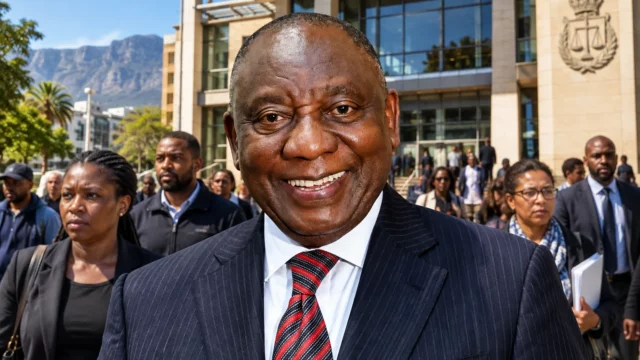
A judgment can close off a political avenue without settling every question raised by a case. That is the essential distinction after the ruling handed down on Wednesday 25 November 2026 by the Western Cape High Court on the Phala Phala case, which concerns South African President Cyril Ramaphosa.
The court set aside the 2022 parliamentary report, which found that there was preliminary evidence warranting further examination of his conduct. It also invalidated decisions taken by the National Assembly on the basis of that report. The judgment concerns the legality of the committee’s work, not a general declaration of innocence on every aspect of the case.
A report at the heart of an institutional standoff
Phala Phala is a farm in Limpopo province, north of Pretoria, South Africa’s capital. The case dates back to a burglary in February 2020. Around $580,000 in cash was allegedly stolen. Ramaphosa said the money came from the sale of buffalo and that he had reported the theft to the head of his security.
The case became public in 2022 after a complaint by former intelligence chief Arthur Fraser. He alleged, among other things, that the theft had not been reported as it should have been and that the president had ordered his protection unit to investigate. The accusations raised questions about the handling of the incident, the origin of the funds and the transparency obligations of a head of state. They should not be conflated with facts established by the judgment handed down this week.
An independent committee, set up by Parliament under the procedure provided for in section 89 of the Constitution, had found preliminary evidence that could warrant a parliamentary inquiry. In December 2022, the National Assembly voted against referring the report to impeachment proceedings. Opposition parties subsequently challenged that vote in the Constitutional Court.
In May 2026, the Constitutional Court ruled that the 2022 vote was unconstitutional and ordered that the report be referred to the relevant parliamentary committee. Ramaphosa was separately challenging the legality of the report itself. On 25 November, the Western Cape High Court ruled in his favour on that point: it found that the committee had exceeded its mandate, asked inappropriate questions and made serious errors of law. The ruling and its reasoning are reported by Mail & Guardian and Associated Press.
What the ruling settles — and what it does not
The court found that the committee had, among other things, broadened its inquiry to include matters which, in its view, fell outside the allegations submitted under its mandate. It also noted the use of information reported by third parties who had no direct knowledge of the facts. As a result, the report can no longer serve as the basis for parliamentary steps taken in response to its findings. The National Assembly’s actions based on the document were also set aside.
The ruling does not, by itself, reconstruct the events of the burglary or automatically validate every explanation given by the president. Nor does it alter the separate decision by the National Prosecuting Authority (NPA), announced on 11 October 2024: after an investigation, it said it would prosecute no one because there was no reasonable prospect of securing a conviction. The NPA specified that its assessment concerned the evidence available in the criminal case. The decision was published by the South African government’s information service, SAnews.
Three strands must therefore be distinguished: the allegations made after the burglary, the prosecutors’ assessment of the criminal evidence, and judicial scrutiny of the parliamentary report. The 25 November judgment concerns the third. It neither turns the initial allegations into established facts nor makes the report’s annulment a definitive answer to every political question.
For Cyril Ramaphosa, the immediate effect is nevertheless political. The report that had weakened his position within the African National Congress (ANC) and fuelled calls for his impeachment can no longer support the process launched on that basis. Conversely, the parties calling for a parliamentary inquiry have, for now, lost that particular lever. The outcome therefore affects the balance of power between the presidency, Parliament and the opposition, as well as the legal course of the case.
A test for South Africa’s checks and balances
The course of the case highlights the role of institutions in South African political life. The ANC’s parliamentary majority rejected the report in 2022. The Constitutional Court subsequently censured the way that vote had been conducted. The High Court then examined the committee’s own methods and mandate. These successive rulings illustrate a central principle: oversight of the executive must follow constitutional rules, just as the bodies responsible for exercising it must do.
This succession of legal challenges may seem technical, but its consequences are concrete. MPs must act on the basis of valid procedures; public officials remain subject to oversight mechanisms; and citizens need to understand what has been established, what is alleged and what remains contested. Setting aside a report for a legal flaw also upholds the requirement for rigour in political inquiries. It does not, however, relieve institutions of the duty to explain their decisions clearly.
At regional level, the case concerns a major member of the Southern African Development Community (SADC), an organisation for political and economic cooperation among countries in the region. It is a reminder that debates about leaders’ accountability and the independence of the courts extend beyond national borders. But the ruling remains that of a South African court, delivered under South African law: it is not a general verdict on practices across the region as a whole.
What happens next will depend in part on any further legal steps following the judgment and on the response of political actors. For now, the immediate legal effect is clear: the 2022 report has been set aside and the parliamentary actions stemming from it no longer stand. The political question is broader: how can credible oversight of presidential power be maintained without departing from the rules governing that oversight?