Algeria
 Egypt
 Libya
 Morocco
 Sudan
 Tunisia
 Benin
 Burkina Faso
 Cabo Verde
 Côte d'Ivoire
 Ghana
 Guinea
 Guinea-Bissau
 Liberia
 Mali
 Mauritania
 Niger
 Nigeria
 Senegal
 Sierra Leone
 The Gambia
 Togo
 Cameroon
 Central African Republic
 Chad
 DR Congo
 Equatorial Guinea
 Gabon
 Republic of the Congo
 São Tomé and Príncipe
 Burundi
 Comoros
 Djibouti
 Eritrea
 Ethiopia
 Kenya
 Madagascar
 Malawi
 Mauritius
 Mozambique
 Rwanda
 Seychelles
 Somalia
 South Sudan
 Tanzania
 Uganda
 Angola
 Botswana
 Eswatini
 Lesotho
 Namibia
 Zambia
 Zimbabwe
For South African companies exporting to the United States, the coming weeks matter as much as the diplomatic negotiations. If Pretoria fails to change Washington’s decision, some products could lose a tariff advantage from 1 January 2027. The effects will not be the same across sectors, however, nor will they mean the US market is closed.
60 days’ notice, but a decision that could still be reversed
On 2 November, Washington notified South Africa of its intention to remove the country from AGOA, the African Growth and Opportunity Act. The programme gives eligible African countries preferential, generally duty-free, access to the US market for certain products. The withdrawal is set for 1 January 2027, following 60 days’ notice. The process therefore leaves time for discussion, even though the White House has linked its decision to trade and political grievances.
On Tuesday 25 November, speaking before the National Council of Provinces in Cape Town, President Cyril Ramaphosa confirmed that talks with Washington were continuing. He also acknowledged that the government was not counting on the decision being reversed. At the same time, he said, companies were already seeking other outlets and the state was exploring new markets. Diplomatic discussions are continuing, but Pretoria is also preparing an economic response in case the exclusion takes effect.
The dispute is unfolding against the backdrop of an important trading relationship for both countries. Bilateral trade in goods and services reached $28.8 billion in 2025, according to South Africa’s Department of Trade, Industry and Competition. But AGOA covers only part of that trade: around 10% of South African exports to the United States benefited from it in 2025, compared with 28% in 2024. Most already entered under the World Trade Organization’s ordinary tariff rules.
Costs concentrated in certain sectors
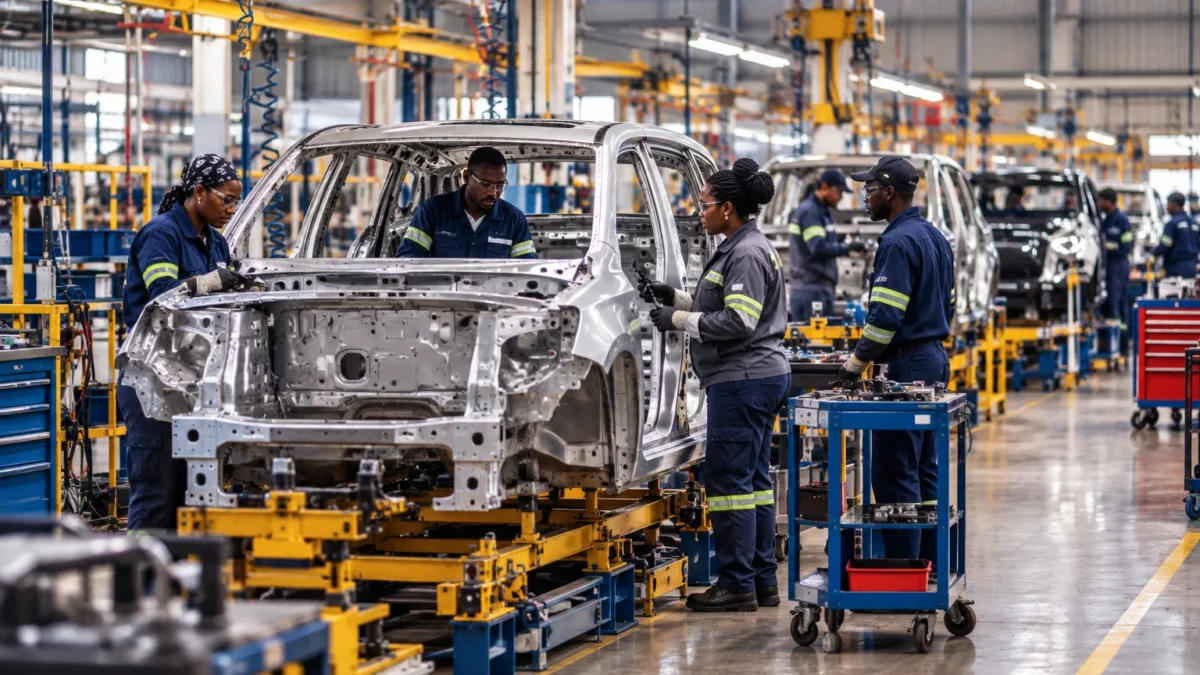
The end of preferences does not mean South African exports will be banned from the United States. However, goods that relied on AGOA could become subject to the ordinary tariffs applicable to their product categories. The additional cost will vary and could make them less competitive against suppliers benefiting from more favourable terms. Cars and car parts, some agricultural products, textiles and other manufactured goods are among the sectors to watch.
The consequences would also be felt in employment hubs. Exporting companies, their suppliers and workers who depend on these production chains do not all have the same scope to absorb higher costs or quickly find new customers. Larger companies can sometimes redirect some of their sales. For small businesses, agricultural producers and subcontractors, finding a new market often means meeting different standards, negotiating contracts and arranging transport.
The South African government stresses that most trade with the United States is not covered by AGOA. It also points out that hundreds of US companies operate in the country and that the economies remain linked through investment and supply chains. This interdependence underpins Pretoria’s case for dialogue. It does not, however, guarantee that the most exposed sectors can avoid losing orders or adjusting staffing levels if the preferences disappear.
Diversifying without claiming to replace the US market
Ramaphosa presents the search for new outlets as work already under way, not an instant solution. The Department of Trade cites the African Continental Free Trade Area (AfCFTA), which aims to facilitate trade between African Union countries, as well as the Southern African Development Community (SADC), India, the European Union, the United Kingdom and other partners. The government also says it has opened up new opportunities for some South African fruit. These prospects still need to translate into concrete sales for the companies concerned.
The regional dimension is particularly important. South Africa is a central member of SADC, an organisation for cooperation and economic integration in southern Africa. Strengthening trade with its neighbours could support regional value chains, particularly in agribusiness and manufacturing. But logistical hurdles, rules of origin, infrastructure and non-tariff barriers still limit how quickly this trade can grow. A more integrated continental market offers a prospect; it cannot replace existing contracts with US buyers overnight.
The issue therefore extends beyond the stand-off between Pretoria and Washington. AGOA affects several African economies, which must contend with market-access rules set in the United States. For governments across the continent, there is a twofold challenge: to defend predictable trade relations with their partners and to strengthen trade within Africa to reduce dependence on a single external market. AfCFTA and SADC can contribute to this strategy, provided trade commitments are matched by production and transport capacity and access to information for businesses.
In the short term, two milestones will show how much room South Africa has to manoeuvre: the outcome of talks during the US notice period and the possible start of the withdrawal on 1 January 2027. Pretoria will need to monitor the effects sector by sector, support the most exposed businesses and workers, and maintain its talks with Washington. Diversification will only matter if new markets offer accessible and lasting opportunities, without obscuring the importance of established trading ties.