Algeria
 Egypt
 Libya
 Morocco
 Sudan
 Tunisia
 Benin
 Burkina Faso
 Cabo Verde
 Côte d'Ivoire
 Ghana
 Guinea
 Guinea-Bissau
 Liberia
 Mali
 Mauritania
 Niger
 Nigeria
 Senegal
 Sierra Leone
 The Gambia
 Togo
 Cameroon
 Central African Republic
 Chad
 DR Congo
 Equatorial Guinea
 Gabon
 Republic of the Congo
 São Tomé and Príncipe
 Burundi
 Comoros
 Djibouti
 Eritrea
 Ethiopia
 Kenya
 Madagascar
 Malawi
 Mauritius
 Mozambique
 Rwanda
 Seychelles
 Somalia
 South Sudan
 Tanzania
 Uganda
 Angola
 Botswana
 Eswatini
 Lesotho
 Namibia
 Zambia
 Zimbabwe
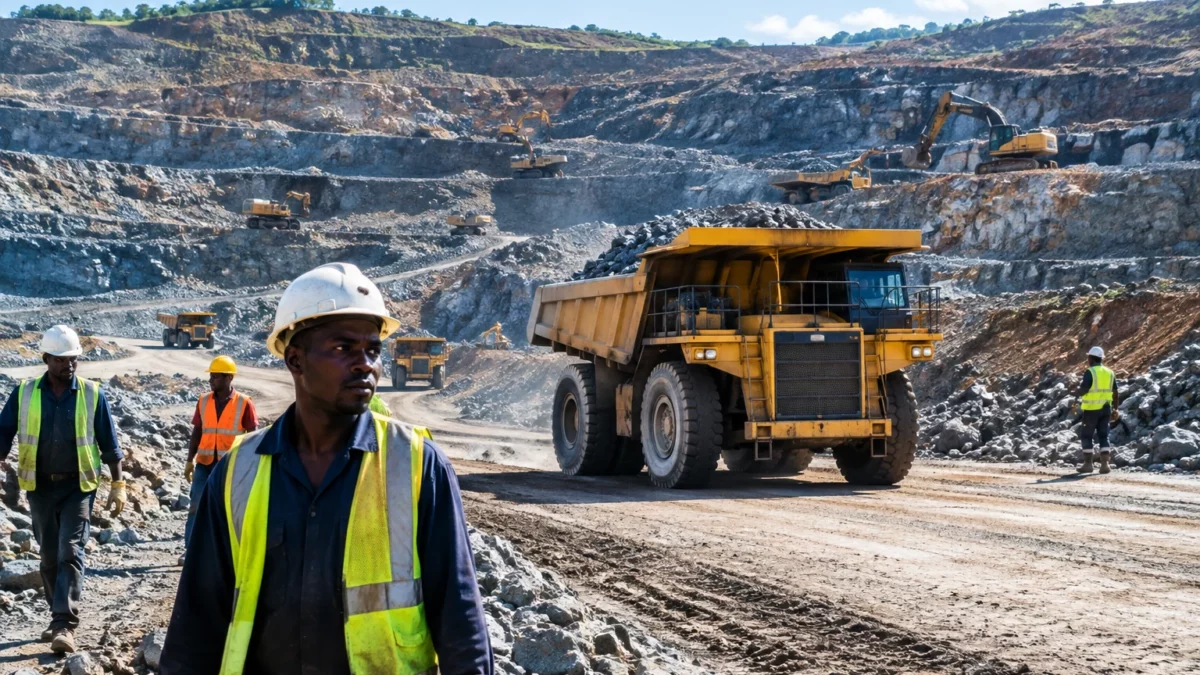
At Tarkwa, in south-western Ghana, the future of a major gold mine is being decided as much in offices in Accra as on the ground. The question goes beyond whether an operator stays on: it concerns the terms on which mining resources contribute sustainably to the national economy and to the communities living around the site.
A deadline that puts the state and operator on the spot
Tarkwa’s five mining concessions are due to expire in April 2027. Gold Fields, the South African group that owns 90% of the mine, applied to renew them in November 2025. The Ghanaian state owns the remaining 10%. At the date of its third-quarter 2026 report, the company said it was still waiting for an official response to its commercial proposal, submitted in July.
The group describes uncertainty over the timing, outcome and terms of any renewal as “significant”. It also cites stepped-up regulatory inspections at Tarkwa and says it is reviewing its legal options. These points describe the company’s position; on their own, they do not establish that the authorities have rejected its application.
Separately, Gold Fields Ghana managing director Elliot Twum has cited potential investment of $7.5 billion over about 21 years. This figure relates to a development scenario if the concessions are renewed, not investment already committed. The proposal therefore sets a promise of long-term spending alongside a dispute whose terms remain to be negotiated.
At Tarkwa, the project concerns an open-pit operation in the country’s gold belt. The mine produced 474,500 ounces of gold in 2025, down from 537,200 in 2024, according to results published by Gold Fields. This annual decline gives a measure of recent activity, but is not enough to establish production prospects over 20 years.
Damang, a useful but different precedent
The case of neighbouring Damang mine weighs on the discussions. Its initial 30-year lease expired in April 2025. After Gold Fields’ renewal application failed, the Ghanaian government took steps to regain operational control. An agreement subsequently provided for a 12-month transition period, until April 2026.
This precedent shows that the expiry of a lease can lead to a new operating arrangement, rather than simply an automatic renewal. But the two sites are not interchangeable: Gold Fields presents Damang as a mine whose economically recoverable reserves were nearing exhaustion, while the company says it wants to extend Tarkwa’s life. The decision on Tarkwa will therefore depend on its own technical, economic and regulatory case.
Ghana’s legal framework gives the state a central role in awarding mining rights. Renewing a concession means deciding the terms of access to a national resource: the lease period, the company’s obligations, public benefits and compliance with applicable rules. The government must also weigh continuity of production, tax revenues, jobs and the expectations of affected communities.
Local benefits at the heart of the debate
Gold Fields says it has invested about $5 billion in Tarkwa over the past 30 years. For 2025, the company reports paying 5.77 billion Ghanaian cedis in taxes, royalties, dividends and other mandatory levies, and spending 8.8 billion cedis with local suppliers and service providers. These figures are provided by the company; on their own, they do not measure how revenues are distributed or their effects in neighbouring communities.
The distinction matters. Public revenues flow to the state, while procurement contracts can benefit Ghanaian businesses, subject to their effective access to the markets. Mine workers, contractors, businesses and host communities do not all have the same interests. For communities, the question also concerns infrastructure, job opportunities, disruption and how social and environmental commitments are monitored.
The figures put forward by Gold Fields thus support its case for renewal, but the decision cannot be reduced to comparing an announced investment figure with reported revenues. The full proposal and Accra’s response are still unknown. Oversight terms, local commitments and revenue transparency will matter in the public assessment of the case.
A Ghanaian issue in a mining region
In Ghana, Africa’s largest gold producer according to annual results reported by Gold Fields, decisions on Tarkwa form part of a wider debate about how much value remains in the producing country. They also come as gold, export revenues and sector regulation feature prominently in national economic policy. The situation at this mine does not, however, sum up the entire Ghanaian industry or the choices of other producing countries.
At the West African level, ECOWAS — the regional organisation for economic and political co-operation — provides a forum for dialogue between states, but does not decide whether Ghanaian concessions are renewed. The case falls first to national institutions. It may nevertheless be watched by neighbouring countries facing similar trade-offs between private capital, public control of resources and benefits for local populations.
The next decisive step will be the Ghanaian government’s official position and any publication of the proposed terms. Until the concessions are due to expire in April 2027, the course of negotiations will show whether the two parties can agree on a new period of operation, and at what economic and regulatory cost. At this stage, neither renewal nor a transfer of Tarkwa to the state is a foregone conclusion.
To establish the available facts, this article draws on the Gold Fields 2026 quarterly report, its Tarkwa production results, and information from the Ghana News Agency on the Damang transition agreement. The announced investment figure was cross-checked against coverage by Ghana’s 3News.