Algeria
 Egypt
 Libya
 Morocco
 Sudan
 Tunisia
 Benin
 Burkina Faso
 Cabo Verde
 Côte d'Ivoire
 Guinea
 Guinea-Bissau
 Liberia
 Mali
 Mauritania
 Niger
 Nigeria
 Senegal
 Sierra Leone
 The Gambia
 Togo
 Cameroon
 Central African Republic
 Chad
 DR Congo
 Equatorial Guinea
 Gabon
 Republic of the Congo
 São Tomé and Príncipe
 Burundi
 Comoros
 Djibouti
 Eritrea
 Ethiopia
 Kenya
 Madagascar
 Malawi
 Mauritius
 Mozambique
 Rwanda
 Seychelles
 Somalia
 South Sudan
 Tanzania
 Uganda
 Angola
 Botswana
 Eswatini
 Lesotho
 Namibia
 South Africa
 Zambia
 Zimbabwe
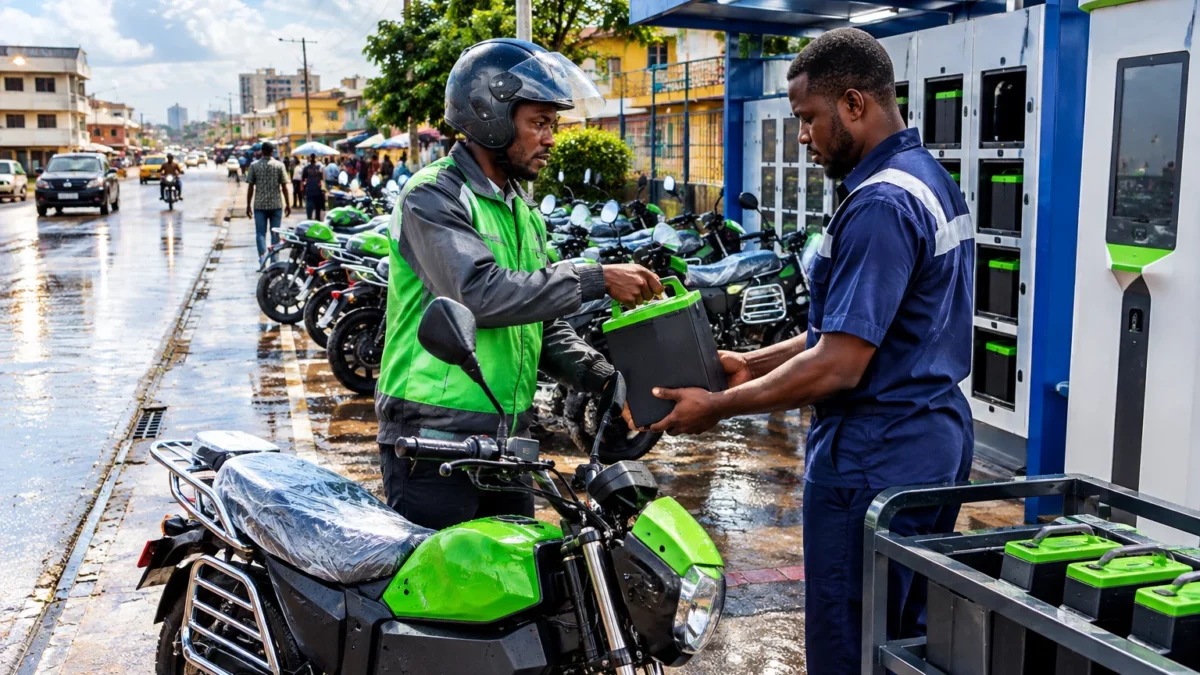
For a motorcycle taxi rider in Accra, a few cedis more or less over a working day matter. An electric motorbike promises to reduce fuel and maintenance costs. But its value also depends on battery prices, station locations and the time spent getting to them.
Spiro’s launch in Ghana puts this equation to the test. The company presented an initial fleet of 100 electric motorbikes in Accra in October 2026, with a battery-swapping system. The stakes go beyond technological novelty: they concern riders’ incomes, the organisation of urban transport and the rules governing the sector.
A new model in a changing sector
“Okadas” — motorbikes used to carry passengers for a fare — meet travel needs that buses and cars do not always serve in the same way. Their activity, long conducted without a comprehensive legal framework, is now entering a phase of formalisation. Ghana adopted a reform in 2025 paving the way for the commercial use of motorbikes, then published rules in 2026 specifying, among other things, the conditions for licensing riders.
This shift confronts riders with several changes at once: administrative requirements, road safety, vehicle financing and the choice of powertrain. In a dense city such as Accra, a motorbike can offer flexible mobility. But the work remains demanding: daily expenses and hours spent off the road have a direct impact on income.
Ghana is also seeking to organise the development of electric vehicles. In September 2026, the Energy Commission announced that rules on charging stations and battery-swapping systems had been submitted to parliament. They are intended, in particular, to regulate permits and safety standards. This framework matters for Spiro, as well as for other companies developing electric solutions in the country.
Batteries are a recurring cost to factor in
The swapping system is based on a simple operation: the rider hands in a discharged battery at a station and leaves with a charged one. This avoids keeping the motorbike out of service during a lengthy recharge. Spiro promotes its Ekon 450 M1 V3 model and says operating-cost savings could reach two dollars a day compared with a petrol motorbike. This figure is the company’s estimate, not a guaranteed saving for every rider.
Accounts from riders illustrate differing experiences. One highlights simpler maintenance and riding comfort. Another says repeated swaps and journeys to stations can make the working day longer. He says he sometimes has to change batteries several times. These individual accounts do not establish an average cost for all users, but they highlight the variables to watch.
The comparison is therefore not limited to the price of electricity versus petrol. It must take in the cost of each swap, the number of changes needed, the distance to stations, rental or purchase arrangements and maintenance expenses. For a rider taking one fare after another, a detour or an unavailable station can reduce paid working time. For an operator, the battery network and the quality of after-sales service are as important as the motorbike itself.
A Ghanaian electric-mobility specialist quoted in the accounts believes that charging at home can deliver significantly greater energy-cost savings than relying exclusively on swapping stations. This comparison depends, however, on tariffs and usage. Above all, it serves as a reminder that riders do not all have the same options: access to a power socket, parking space, working hours and proximity to stations can all change the calculation.
From vehicle to service ecosystem
The shift to electric also depends on the availability of parts and repairs. Riders report difficulties finding some spare parts. If a breakdown takes a motorbike off the road, lost earnings can quickly wipe out some of the expected savings. Training mechanics, securing local supplies and providing prompt after-sales service are therefore practical factors in the model’s viability.
For riders who rent their motorbike, the contract is just as important. They need to know who is responsible for repairs, how swaps are charged and what happens if they stop working or the vehicle breaks down. A model that reduces running costs may nevertheless remain difficult to adopt if weekly payments are high or the conditions for accessing a vehicle are inflexible. The benefits must be measured in net income, not just energy consumption.
The fleet of 100 motorbikes launched in Accra is an initial deployment, not yet a large-scale demonstration. The company’s figures will need to be compared with actual spending observed over several months. The network’s geographical coverage will also need to be assessed: a well-placed station in the centre will not necessarily meet the needs of riders working on the outskirts or travelling between different neighbourhoods.
A Ghanaian test with regional implications
Ghana is not approaching electric mobility without local experience. Companies such as Kofa have already developed electric motorbikes and swapping stations in the country. Spiro’s arrival therefore expands the range of options and could stimulate competition. But the proliferation of networks raises an important question: will batteries and stations be compatible across operators, or will each company impose its own system? Closed networks can limit riders’ freedom of choice and complicate the development of a shared market for parts and batteries.
Across West Africa, the challenge is to expand electric-mobility solutions without reducing them to vehicle imports. Assembly, maintenance, training and component manufacturing can generate economic activity in Ghana. To achieve this, predictable rules and reliable infrastructure are needed. ECOWAS, the Economic Community of West African States, also offers a regional framework in which standards and trade can matter as companies expand their operations across several countries.
What happens next will depend on day-to-day conditions: the total cost for riders, station availability, battery life, access to repairs and enforcement of the new rules. If these elements hold up, electric motorbikes could become a viable work tool for some riders. Otherwise, the promise of savings will remain dependent on a network still under construction.