Algeria
 Egypt
 Libya
 Morocco
 Sudan
 Tunisia
 Benin
 Burkina Faso
 Cabo Verde
 Côte d'Ivoire
 Ghana
 Guinea
 Guinea-Bissau
 Liberia
 Mali
 Mauritania
 Niger
 Nigeria
 Senegal
 Sierra Leone
 The Gambia
 Togo
 Cameroon
 Central African Republic
 Chad
 DR Congo
 Equatorial Guinea
 Gabon
 Republic of the Congo
 São Tomé and Príncipe
 Burundi
 Comoros
 Djibouti
 Eritrea
 Ethiopia
 Kenya
 Madagascar
 Malawi
 Mauritius
 Mozambique
 Rwanda
 Seychelles
 Somalia
 South Sudan
 Tanzania
 Uganda
 Angola
 Eswatini
 Lesotho
 Namibia
 South Africa
 Zambia
 Zimbabwe
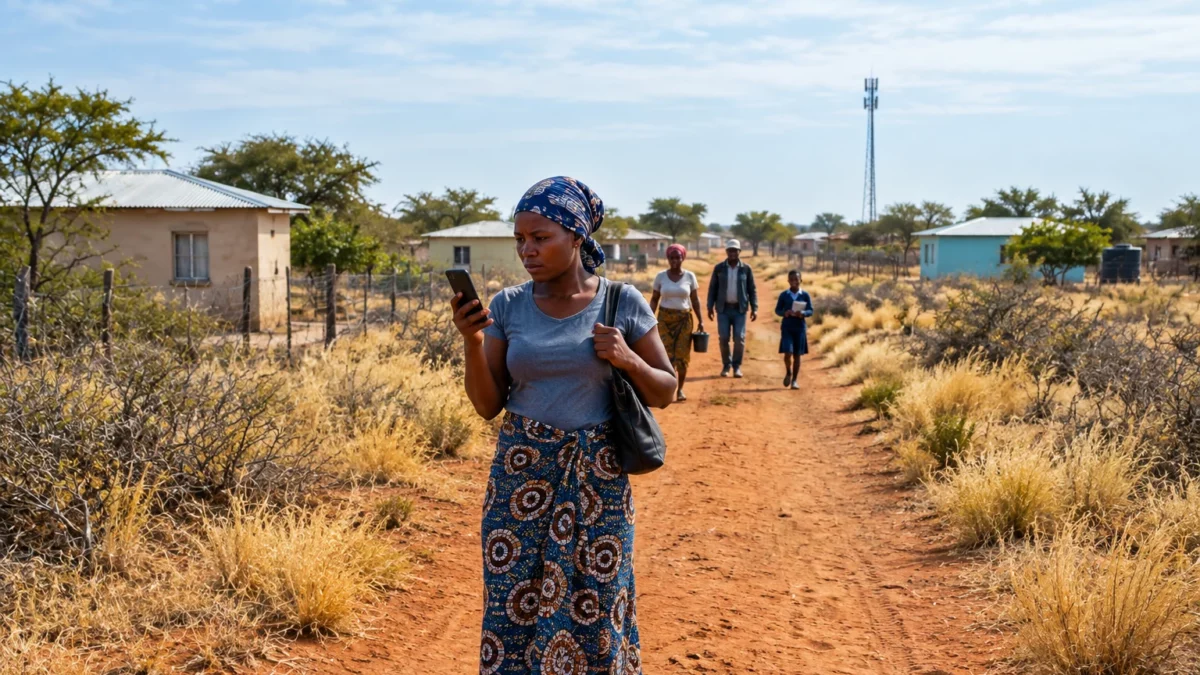
In a vast, sparsely populated country, mobile masts cannot always follow roads, reach remote villages or cover conservation areas. Botswana wants to test another option: relaying some phone services via satellites, without requiring subscribers to have a dish or dedicated terminal.
National coverage remains uneven
The project addresses a practical challenge for Botswana: extending the signal beyond areas where terrestrial networks are easiest to deploy. Gaborone and the main urban centres account for some of the infrastructure. In rural, border or sparsely populated areas, installing and maintaining masts can be costly for a limited number of users.
The country’s population density was about 4.4 people per square kilometre in 2024, according to the United Nations. This figure helps explain the potential appeal of satellite connectivity, but does not, by itself, show where people live or which areas lack a signal. Botswana is a member of the Southern African Development Community (SADC), which brings together countries facing, to varying degrees, the challenge of connecting large territories that are sometimes far from major routes.
Population coverage should not be confused with territorial coverage. The BOCRA, Botswana’s communications regulator, estimates that 4G covered 98% of the population in 2024-2025. This measure does not mean that 98% of the country’s land area has network coverage. The authority has also noted persistent difficulties in sparsely populated areas, along borders and on some corridors.
An orbital relay for essential services
Botswana Telecommunications Corporation (BTC), the national operator, is preparing an offer called BTC Satellite with Starlink. According to public announcements reported by several media outlets, the launch is targeted for early 2027. The service is intended to allow compatible phones to connect to satellites when the terrestrial mobile network is unavailable. Commercial and regulatory arrangements have yet to be specified.
This technology, often called “direct-to-device” or “satellite-to-mobile”, enables a compatible phone to communicate directly with a satellite. It is not the fixed satellite internet service provided through a Starlink kit. Instead, the satellite acts as a mobile relay in orbit, supplementing the operator’s network. The initial uses announced are modest: messaging, location sharing, maps or applications that use little data.
The distinction matters to users. The service does not promise a fast connection comparable to 4G or fibre. Its initial aim is to maintain a link in some places where a phone would otherwise lose network coverage. Reception will depend in particular on the handset’s compatibility, satellite availability and a clear view of the sky. Buildings and other obstructions can weaken the signal.
BTC will therefore play a central role. Starlink provides the space infrastructure, but the operator will have to integrate the service into its network and decide how to include it in its offers. So far, BTC has not specified which devices will be supported, the prices, the plans covered or how the service will be activated. The licence granted to Starlink for its conventional satellite activities is not, on its own, enough to establish which authorisations apply to a direct satellite-to-phone connection.
Supplementary technology, not a replacement for masts
The promise of wider coverage must be weighed against technical limitations. In its study published in February 2026, the GSMA, the global association of mobile operators, concludes that direct-to-device technology can help in isolated areas, but its capacity depends on the number of satellites, available frequencies and signal strength. Even under highly favourable assumptions, the technology does not replace terrestrial networks.
In practice, satellites can provide a useful service to some subscribers without offering the same capacity to everyone at the same time. Messaging and lightweight applications are better suited to the technology than video or data-intensive uses. Access may also be less reliable inside homes and offices. Announced coverage therefore guarantees neither a consistent speed nor a permanent connection.
Regional experience is still recent. In December 2025, Airtel Africa and SpaceX announced a partnership to introduce Starlink Direct-to-Cell in Airtel’s 14 markets, subject to national authorisations. In the Democratic Republic of the Congo, the two groups announced the commercial launch of the service in August 2026. Uganda then launched it on 24 September 2026, according to its Ministry of Information and Communication Technology. These precedents show that the service operates through a mobile operator and is subject to each country’s own rules.
Access will also depend on price and regulation
For remote communities, people working on the move or services operating outside cities, a basic signal can improve the ability to communicate. But technical availability does not automatically mean affordable access. The price of a compatible phone, the cost of the plan and the quality of service will affect take-up, particularly among lower-income households and small rural businesses.
The impact will not be the same for everyone. Travellers and businesses working in isolated areas may value a continuous connection. For residents, the benefit will depend more on whether they can use the service regularly without excessive expense. For BTC, the challenge will be to supplement masts rather than reduce investment in terrestrial networks, which remain essential for high-capacity services.
Botswana is thus joining a trend taking shape in several African markets: operators are seeking to extend coverage by combining ground-based infrastructure and satellites. The next step will be to learn the confirmed timetable, the BOCRA authorisations, the list of compatible phones and the prices for BTC Satellite. These are the conditions that will determine whether the project genuinely reduces areas without a signal, beyond the promise of wider coverage.