Algeria
 Egypt
 Libya
 Morocco
 Sudan
 Tunisia
 Benin
 Burkina Faso
 Cabo Verde
 Ghana
 Guinea
 Guinea-Bissau
 Liberia
 Mali
 Mauritania
 Niger
 Nigeria
 Senegal
 Sierra Leone
 The Gambia
 Togo
 Cameroon
 Central African Republic
 Chad
 DR Congo
 Equatorial Guinea
 Gabon
 Republic of the Congo
 São Tomé and Príncipe
 Burundi
 Comoros
 Djibouti
 Eritrea
 Ethiopia
 Kenya
 Madagascar
 Malawi
 Mauritius
 Mozambique
 Rwanda
 Seychelles
 Somalia
 South Sudan
 Tanzania
 Uganda
 Angola
 Botswana
 Eswatini
 Lesotho
 Namibia
 South Africa
 Zambia
 Zimbabwe
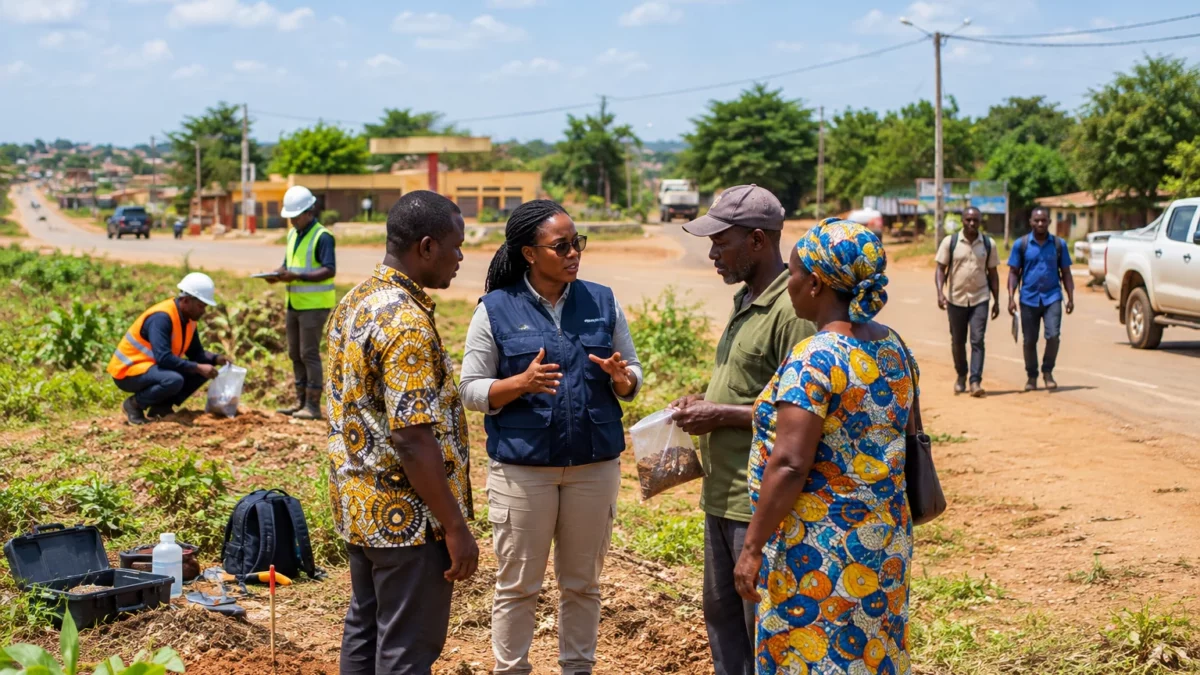
In Zuénoula, in central-western Côte d’Ivoire, the next stage of gold exploration will depend as much on what lies underground as on discussions with residents. The partner companies have announced preparations for drilling in 2027. But the indicators identified so far do not yet prove the existence of an economically viable deposit.
Indicators to be tested at depth
On 23 November 2026, MetalsGrove Mining announced that fieldwork had resumed on the Zuénoula permit. The Australian company says it has defined seven targets across four exploration areas. It plans a drilling campaign in early 2027, but has yet to specify a detailed schedule or budget.
The targets were mapped using soil analyses and shallow drilling. This work is used to identify anomalies, meaning gold concentrations that differ from typical levels. Teams now want to pinpoint their location and determine whether they extend into the rock.
A single result or a surface anomaly is not enough to establish the presence of an exploitable resource. The planned drilling will provide rock samples and measure their gold content. The continuity and depth of mineralised zones, as well as the technical and economic conditions for any potential mining, will then need to be assessed.
At this stage, no estimate of the quantity of gold at Zuénoula has been published. The seven targets therefore refer to areas to be tested, not confirmed deposits. This distinction is essential in a country where exploration announcements are part of a sharp increase in gold-mining activity.
A project backed by two partners
The permit, covering close to 400 km², is held by Aucrest, the Ivorian subsidiary of Canadian company Stellar AfricaGold. MetalsGrove is responsible for operations. The agreement between the two groups would allow it to acquire up to 80% of the project gradually by funding exploration work.
This arrangement gives the operator a central role in spending and technical decisions. For nearby communities, however, the project is first and foremost about activities on the ground: sampling, teams moving through the area and possible disruption linked to the work. Local acceptance is therefore a practical condition for operations to continue, not merely a communications issue.
The recent pause demonstrated this. According to Stellar AfricaGold’s quarterly update, community concerns led to the suspension of field activities. MetalsGrove says work resumed after it hired a community relations officer and began discussions with stakeholders. Independent coverage also reported the halt to the auger-drilling programme and efforts to engage in dialogue.
The companies have not publicly detailed, in the information available, the precise nature of the concerns raised or the position of the residents affected. It would therefore be premature to present the resumption as a general agreement. The quality and continuity of discussions, and whether local land uses are taken into account, will need to be monitored as work progresses.
A growing industry, with benefits to monitor
Zuénoula is part of the transformation of Côte d’Ivoire’s mining sector. National gold production rose from 18 tonnes in 2014 to 58 tonnes in 2024, according to the Ivorian government. The 2024 report of the Extractive Industries Transparency Initiative (EITI), which tracks the sector’s revenues and activities, also confirms production of 58 tonnes that year.
This growth has accompanied the start of operations at new mines and a proliferation of projects. It does not, however, mean that every exploration permit will become a mine. Between a geological anomaly and commercial mining, companies must demonstrate the presence of a sufficient resource, obtain the necessary permits and assess costs, environmental impacts and the infrastructure required.
Local benefits will also depend on the conditions established as the project progresses: jobs accessible to Ivorians, procurement from local businesses, water and soil management, information on risks and mechanisms for dialogue. The Mining Code also provides for contributions to community development in the areas concerned. Their implementation and monitoring matter as much as investment announcements.
For Zuénoula residents, the immediate effects of exploration differ from those of a producing mine. Current work is neither the opening of a mine nor an automatic source of lasting jobs. Rural areas where operations take place may be directly affected by access to land, while tax revenues or subcontracting activity would materialise only at later stages.
An Ivorian issue in a West African context
Côte d’Ivoire, whose political capital is Yamoussoukro, is strengthening its position among West Africa’s gold producers. This momentum is unfolding in a region where mining activities cross economic borders and where ECOWAS, the Economic Community of West African States, provides a framework for cooperation between states. For Abidjan, the challenge is to turn production growth into public revenue and local value added while regulating projects.
In Zuénoula, the next milestone will be the concrete definition of the drilling campaign announced for early 2027. Until then, sampling and shallow drilling are expected to refine the targets. Both the geological results and the continuation of discussions with communities will need to be monitored. No exploitable deposit has been established to date.
Information cross-checked with Stellar AfricaGold, Ivorian coverage by Or Noir Africa, the 2024 EITI Côte d’Ivoire report and the Ivorian government.