Algeria
 Egypt
 Libya
 Morocco
 Sudan
 Tunisia
 Benin
 Burkina Faso
 Cabo Verde
 Côte d'Ivoire
 Ghana
 Guinea
 Guinea-Bissau
 Liberia
 Mali
 Mauritania
 Niger
 Nigeria
 Senegal
 Sierra Leone
 The Gambia
 Togo
 Cameroon
 Central African Republic
 Chad
 DR Congo
 Equatorial Guinea
 Republic of the Congo
 São Tomé and Príncipe
 Burundi
 Comoros
 Djibouti
 Eritrea
 Ethiopia
 Kenya
 Madagascar
 Malawi
 Mauritius
 Mozambique
 Rwanda
 Seychelles
 Somalia
 South Sudan
 Tanzania
 Uganda
 Angola
 Botswana
 Eswatini
 Lesotho
 Namibia
 South Africa
 Zambia
 Zimbabwe
In Gabon, the rules governing a strike can weigh as heavily as the dispute that sparked it. In the oil, mining and energy sectors, the proportion of employees who would remain at work could determine whether industrial action retains its leverage — and whether services deemed essential continue to operate.
The debate is opening as Gabon’s Constitution recognises the right to strike for private-sector employees and public servants, while requiring it to be reconciled with the provision of essential services. The bill announced by the Ministry of Labour is intended to clarify the conditions under which this right can be exercised. However, it has not yet been adopted by the government or submitted to Parliament.
A bill still under consultation
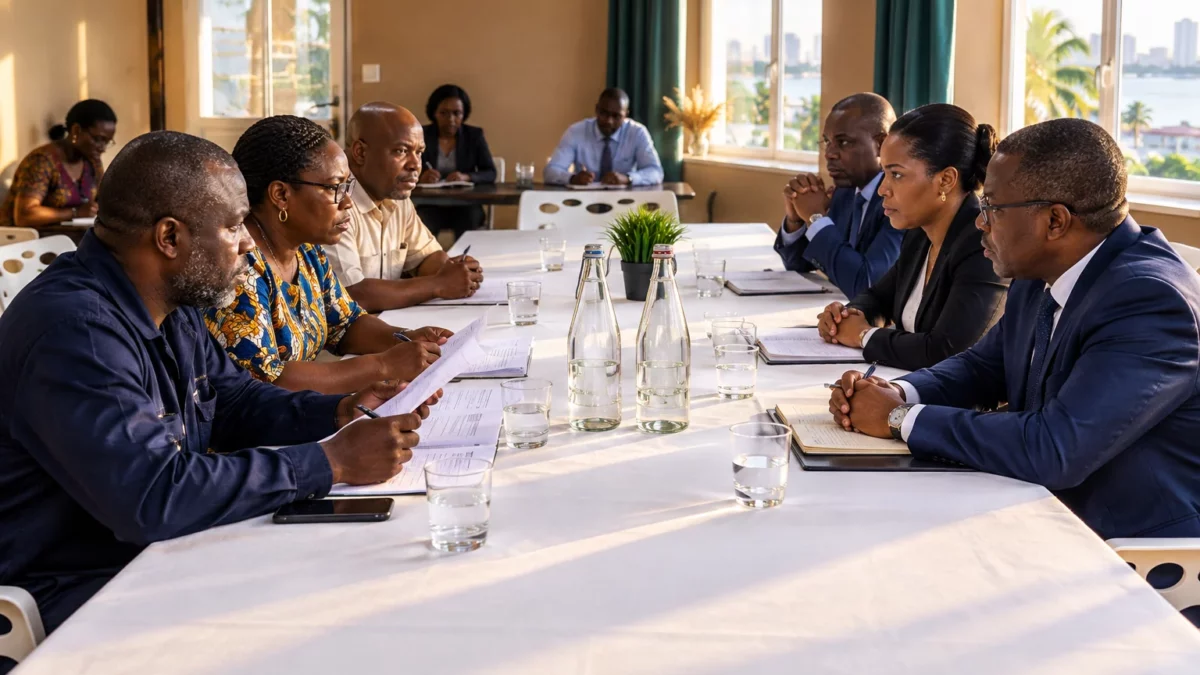
The ministry handed the bill to trade union and employers’ organisations in Libreville on 16 November 2026. The social partners were invited to submit their comments and amendments before any possible submission to the government. According to several Gabonese media outlets, the initial period allowed for reviewing the text was three working days. This deadline has already prompted criticism of the quality of the consultation.
On Sunday 22 November, the Force ouvrière federation of extractive and energy industries called for the bill to be withdrawn. It represents workers in the oil, mining and energy sectors. Its federal secretary-general, Sylvain Mayabith, denounced a text he considers hostile to workers. This is the union’s assessment, not a provision that has already been adopted.
The federation says the bill would require a minimum service equivalent to 70% of operational staff during a strike. It also attributes to the bill a limit of ten strike days a year and a ban on calling a strike before negotiations and arbitration have concluded. These details could not be cross-checked against a publicly available version of the bill. They should therefore be presented as the organisation’s objections, rather than as confirmed rules.
The ministry, for its part, has defended the consultation with the social partners and said it remains committed to freedom of association. The executive describes the process as a preparatory phase, ahead of scrutiny of the text and efforts to reach agreement. At this stage, neither the full version of the bill nor the ministry’s detailed responses to union criticism have been publicly established.
What Gabonese law already provides
The bill is being drawn up within a framework that already includes obligations. The 2021 Labour Code notably requires ten clear days’ notice before a strike in the private sector. It also requires a minimum service in companies, with stricter rules for activities such as electricity, water, hydrocarbons, mining products and healthcare.
For companies covered by these provisions, the Code sets the minimum service at 40% of activity, spread across the day. It also regulates any requisitioning and specifies that it cannot exceed 20% of the workforce. These thresholds do not confirm the 70% rule cited by Force ouvrière: they concern the law currently in force, while the 70% figure is attributed to the contested bill.
The distinction matters to employees and service users alike. A minimum service is intended to prevent an interruption from endangering health or safety, or access to water and electricity. But a high threshold can also reduce a strike’s ability to halt production and influence negotiations. For workers in extractive industries, the issue therefore concerns working conditions as well as their bargaining power with employers.
The bill will also have to be aligned with the Constitution of 19 December 2024, whose Article 23 guarantees the right to strike in defence of workers’ interests. Any law will have to specify how that right is exercised without undermining the substance of the guarantee. Gabon has also ratified the International Labour Organization’s Convention No. 87 on freedom of association. In May 2026, the ILO received an advisory opinion from the International Court of Justice concerning the relationship between this convention and the right to strike.
A test for social dialogue after the transition
The controversy comes after the transition that began with the coup of 30 August 2023, followed by the presidential election of April 2025 and the return to elected institutions. How the authorities handle social disagreements is now a tangible governance issue. Consultation will not be measured solely by the handover of a document: it will also depend on how much time unions are given, whether they have access to the full text and whether their proposals are taken into account.
The effects would not be the same for everyone. Employees at industrial sites could be directly affected by rules on staffing and negotiations. Companies and public authorities, meanwhile, may seek to limit production stoppages and maintain essential services. For the public, continuity of electricity, water and transport also matters. The balance will therefore depend on how precisely the sectors concerned are defined and on the mechanisms provided for in the event of disagreement.
At regional level, the debate also concerns activities that cross the borders of the Central African Economic and Monetary Community (CEMAC), the shared economic and monetary area of six Central African countries. Oil, mining and energy are strategic sectors, but their economic importance does not settle the legal question: ensuring continuity does not automatically mean making strikes ineffective.
The next step will be the publication or submission of a revised version, followed by its examination by the government and, potentially, Parliament. The question to watch is specific: will the final text preserve the protections already enshrined in the Labour Code and the constitutional guarantees, while ensuring the continuity of essential services? Until the contested provisions are available and cross-checked, the figures cited by unions remain warning signs, not established rules.
Read Article 23 of Gabon’s 2024 Constitution and consult the Labour Code provisions on strikes and minimum service.