Algeria
 Egypt
 Libya
 Morocco
 Sudan
 Tunisia
 Benin
 Burkina Faso
 Cabo Verde
 Côte d'Ivoire
 Ghana
 Guinea
 Guinea-Bissau
 Liberia
 Mali
 Mauritania
 Niger
 Nigeria
 Senegal
 The Gambia
 Togo
 Cameroon
 Central African Republic
 Chad
 DR Congo
 Equatorial Guinea
 Gabon
 Republic of the Congo
 São Tomé and Príncipe
 Burundi
 Comoros
 Djibouti
 Eritrea
 Ethiopia
 Kenya
 Madagascar
 Malawi
 Mauritius
 Mozambique
 Rwanda
 Seychelles
 Somalia
 South Sudan
 Tanzania
 Uganda
 Angola
 Botswana
 Eswatini
 Lesotho
 Namibia
 South Africa
 Zambia
 Zimbabwe
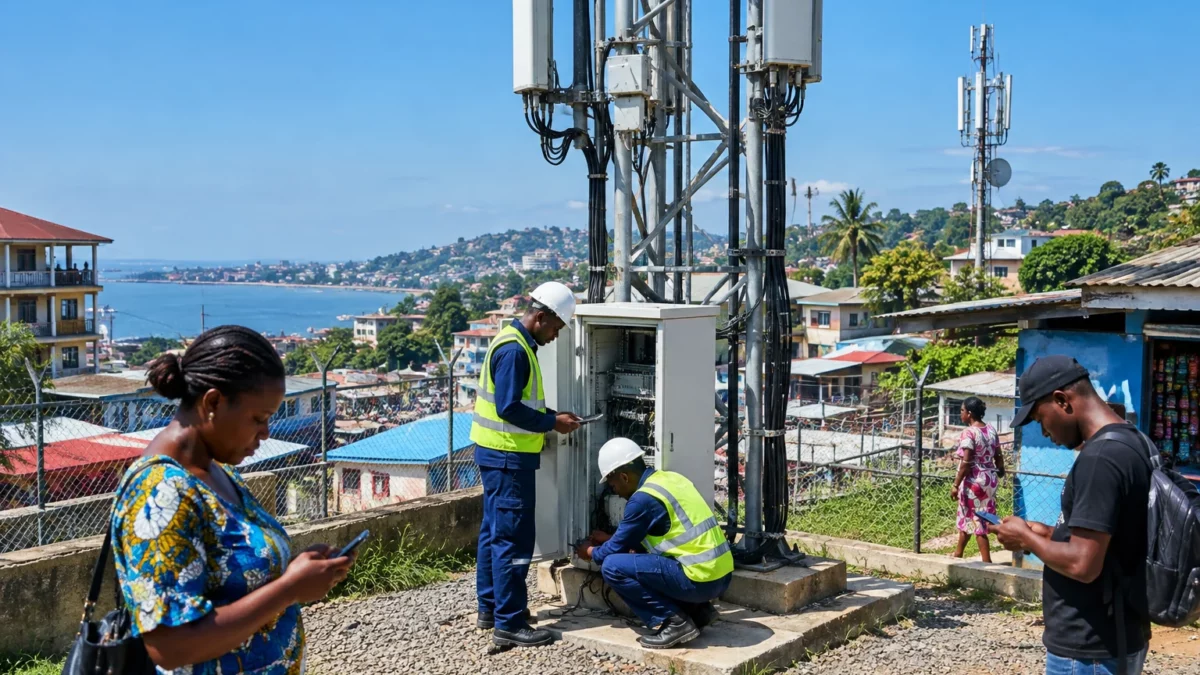
For a state-owned telecommunications company, returning to its home market is sometimes only a first step. In Sierra Leone, Sierratel now wants to test a lighter model abroad: selling mobile services using networks already deployed by other operators.
A national relaunch takes on a regional dimension
Sierra Leone is seeking to strengthen its place in a regional economy where telecommunications support trade, payments and access to digital services. Freetown hosted an ECOWAS ministerial meeting in March 2026, devoted to digital co-operation and common rules for the sector. The region remains diverse, however: companies seeking to expand there must contend with separate national authorities and laws.
Sierratel, a state-owned operator that had long struggled, resumed mobile services on 5 May 2026 as a mobile virtual network operator, or MVNO. This model allows it to sell services without owning its own radio network. In Sierra Leone, the company relies on infrastructure provided by Africell, its private-sector partner. The government presents this arrangement as a relaunch of the state-owned company, not a privatisation.
On 19 November, Sierra Leone’s Ministry of Communication, Technology and Innovation announced a proposed joint venture between the state and Africell, called Sierratel International. The announcement was made at the end of the West Africa Integration and Investment Summit 2026, held in Lungi from 16 to 18 November. The project must still clear the necessary commercial and regulatory hurdles.
Expansion subject to each country’s rules
According to information shared about the project, the company is seeking MVNO licences in markets where Africell is already established: Angola, The Gambia and the Democratic Republic of the Congo (DRC). This presence could provide access to existing networks. It does not, however, constitute authorisation to operate or guarantee that regulators will approve the applications.
Regulations vary from one country to another. In the DRC, the Regulatory Authority for Posts and Telecommunications requires, among other things, that an applicant company be incorporated under Congolese law. In Angola, regulator INACOM oversees access to the telecommunications market and recognises the MVNO model. In The Gambia, the PURA authority provides for a ten-year MVNO licence, with annual fees of 10 million dalasis. These examples show that expansion will depend as much on applications filed and local agreements as on the partnership announced in Lungi.
The announced division of responsibilities puts Africell at the centre of investment and operations. The Sierra Leonean government is to support market access and engagement with regulators. The ministry also says the state could hold a stake in the joint venture. However, in its announcement it did not publicly specify the shareholding split or the timetable for licence applications.
For subscribers, competition remains the key question
The virtual model lowers the cost of entry: Sierratel International would not have to build a network of antenna sites everywhere. But there is a trade-off. The company would depend on its host operator for coverage, available capacity and part of the quality of service. Commercial negotiations between the partners will therefore affect costs and the new company’s room for manoeuvre.
To win subscribers, the Sierratel brand will have to offer something distinct from Africell and other operators in the market. Prices, connection reliability, payment services and customer service will matter more than the brand name alone. The impact will not be the same for everyone: urban customers, small businesses and residents in less well-served areas have different uses and coverage needs.
In Sierra Leone, Sierratel’s return also gives the state a commercial stake in the sector, while leaving a private operator responsible for the announced investment and operations. How risks are shared will therefore be decisive. Public returns will depend on the revenues actually generated, the expenditure incurred and the terms of the agreement between the partners.
A test for Africa’s digital integration
Sierratel International illustrates one way of seeking a regional presence without replicating everywhere the costly model of an operator that owns its infrastructure. But commercial integration does not remove regulatory borders. The project will have to adapt its structure and applications to the requirements of each market, including beyond ECOWAS, since Angola and the DRC are in Central and Southern Africa.
The next concrete step will be to learn the final agreements, which countries have been selected and which licence applications have been filed. For Sierra Leoneans, the stakes will not be measured solely by the expansion of a national brand. They will also depend on the alliance’s ability to generate revenue for the state and improve competition without making the operator wholly dependent on its partner’s network.