Algeria
 Egypt
 Libya
 Morocco
 Sudan
 Tunisia
 Benin
 Burkina Faso
 Cabo Verde
 Côte d'Ivoire
 Ghana
 Guinea
 Guinea-Bissau
 Liberia
 Mali
 Mauritania
 Niger
 Nigeria
 Senegal
 Sierra Leone
 The Gambia
 Togo
 Cameroon
 Central African Republic
 Chad
 DR Congo
 Equatorial Guinea
 Gabon
 Republic of the Congo
 São Tomé and Príncipe
 Burundi
 Comoros
 Djibouti
 Eritrea
 Ethiopia
 Kenya
 Madagascar
 Malawi
 Mauritius
 Mozambique
 Rwanda
 Seychelles
 Somalia
 South Sudan
 Tanzania
 Uganda
 Angola
 Botswana
 Eswatini
 Lesotho
 Namibia
 Zambia
 Zimbabwe
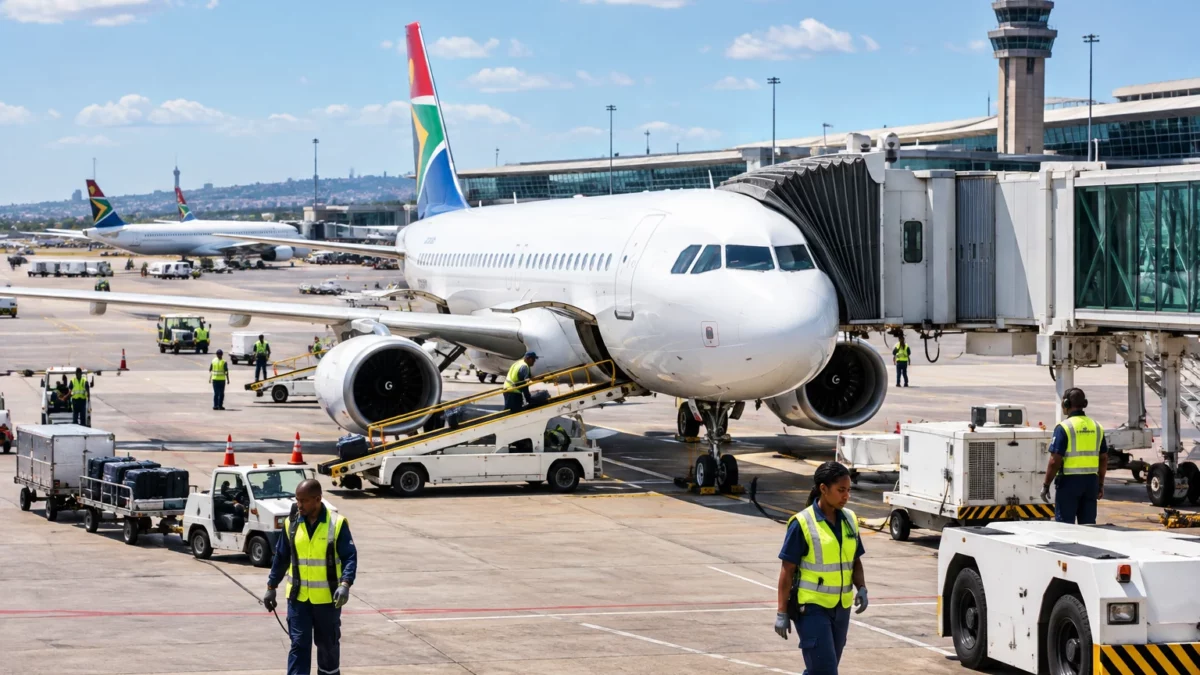
For South African Airways (SAA), every additional aircraft represents more than transport capacity: it determines whether routes can be opened, regional destinations served and revenue generated. But uncertainty over deliveries and costs is prompting the state-owned carrier to reconsider the pace of its expansion.
An airline still rebuilding
SAA’s trajectory remains marked by a court-supervised restructuring and the suspension of its flights. The airline resumed operations in September 2021, after a period when its survival was in doubt. Since then, it has been gradually rebuilding its network and resources in a sector where buying or leasing aircraft requires substantial financial commitments.
This restart is taking place in a wider South African context. Pretoria is seeking to preserve a national carrier capable of connecting the country to regional and international markets. In Southern Africa, these links also matter for business travel, tourism and freight. The SADC, the region’s economic community, is an essential arena for this ambition, although SAA faces competing airlines and established networks there.
The airline is not starting from scratch, however: it has a network of routes and agreements with other carriers. But its ability to expand that network depends directly on the number of aircraft available, their cost and the reliability of their delivery.
Fleet renewal plan put on hold
On 18 November 2026, SAA commercial director Tebogo Tsimane announced the suspension of the request-for-proposals process sent to manufacturers. The plan covered 28 next-generation aircraft: 16 wide-bodies, intended in particular for long-haul routes, and 12 narrow-bodies, better suited to many regional services. Deliveries were envisaged from 2032.
Tsimane cited several factors: geopolitical tensions, changing network requirements and manufacturers’ delivery times. The conflict in the Middle East was among the factors that led the airline to review its forecasts. The pause does not therefore necessarily mean that all fleet renewal has been abandoned. It suspends a long-term process while SAA reassesses the aircraft it may need and the timetable for acquiring them.
For now, the response is to extend the lease agreements for the existing fleet. According to information provided by the airline and corroborated by several specialist media outlets, it operates 19 aircraft: 15 leased Airbus A320-200s and two leased A330-300s, as well as two A340-300s that it owns. The leases for four A320s are due to expire between November 2026 and February 2027.
Renewing the leases can prevent a sharp drop in capacity. It does not, however, resolve the question of long-term costs, or that of the aircraft’s age and availability. SAA presents this option as a continuity measure, not as its definitive model.
The network depends on aircraft and finances
Fleet decisions determine which destinations an airline can serve and how frequently it can fly. SAA says it wants to develop its regional network and is considering new routes. But its commercial director has explained that the company does not currently have the capacity to operate a daily service to Mumbai on terms it considers economically viable.
The airline is also considering expanding its freight operations, including the possible acquisition of cargo aircraft. Here too, the plan depends on access to additional resources. In the meantime, SAA can buy freight capacity from other airlines on routes it does not serve itself.
This caution comes after significant expansion ambitions. The airline had envisaged growing its fleet and routes in the years following 2024. But development announcements alone cannot guarantee sustainable expansion: aircraft, fuel, crews, maintenance and ground operations must also be funded.
Cash-flow pressures reported in recent months add another constraint. Fuel costs are weighing on expenditure, while delays or staggered salary payments have been reported. These issues should be distinguished from fleet plans: they do not in themselves prove that renewal is impossible, but they underline that aircraft availability is only part of the problem.
A governance challenge for the state shareholder
The search for an equity partner also remains on the agenda. In August 2026, South Africa’s Cabinet approved a new open and competitive process to identify a strategic partner. The move follows the failure, in March 2024, of the proposed partnership with Takatso Aviation. The stated aim is to find an investor, but the terms and timetable still need to be clarified.
For the state, the challenge is to support a national airline without relying indefinitely on public resources to fund its development. For SAA, a partner could bring capital or expertise, but its arrival would not automatically guarantee aircraft or profitable new routes. The terms of the agreement and the division of responsibilities will therefore be decisive.
The consequences differ among stakeholders. Travellers in major cities could benefit from more frequent services if the fleet grows. Passengers on regional routes depend on reliable services and affordable fares. Exporting and importing businesses need regular freight capacity. For employees, the airline’s financial stability and governance matter as much as growth announcements.
What to watch in Southern Africa
The pause in the 28-aircraft plan illustrates a practical trade-off: SAA wants to grow, but is seeking to avoid committing to a fleet when the timetable, financing and use remain uncertain. Extending leases can preserve operations in the short term. It postpones, however, the decision on how to modernise the aircraft sustainably.
At regional level, the issue concerns South Africa’s position in links between neighbouring countries and with international markets. A more stable airline could strengthen connections within the SADC. Conversely, persistent constraints would limit frequencies and leave more room for competing carriers. The issue is not simply the size of the fleet, but the ability to maintain a useful and economically viable network.
The next indicators will be the length of lease extensions, decisions on proposed routes and progress in the search for a strategic partner. They will show whether SAA turns its ambitions into actual capacity, without confusing announced growth with a consolidated financial recovery.
Information on the suspension of the process and fleet composition has been cross-checked against separate publications, including NewsAero on the pause in fleet renewal and Moneyweb on statements by SAA management.