
 Algeria
 Egypt
 Libya
 Morocco
 Sudan
 Tunisia
 Benin
 Burkina Faso
 Cabo Verde
 Côte d'Ivoire
 Ghana
 Guinea
 Guinea-Bissau
 Liberia
 Mali
 Mauritania
 Niger
 Nigeria
 Sierra Leone
 The Gambia
 Togo
 Cameroon
 Central African Republic
 Chad
 DR Congo
 Equatorial Guinea
 Gabon
 Republic of the Congo
 São Tomé and Príncipe
 Burundi
 Comoros
 Djibouti
 Eritrea
 Ethiopia
 Kenya
 Madagascar
 Malawi
 Mauritius
 Mozambique
 Rwanda
 Seychelles
 Somalia
 South Sudan
 Tanzania
 Uganda
 Angola
 Botswana
 Eswatini
 Lesotho
 Namibia
 South Africa
 Zambia
 Zimbabwe
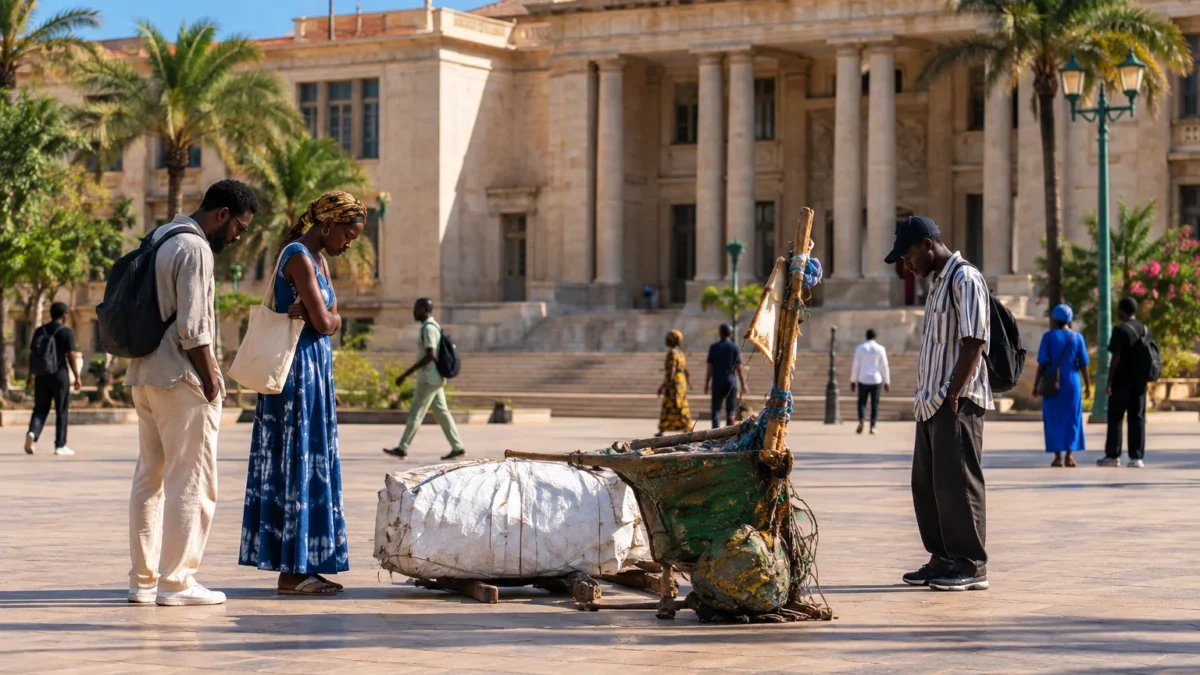
In Dakar, contemporary art does more than fill exhibition halls. It also raises a practical question: how can artworks be created, passed on and circulated in a world beset by shocks? The 16th Biennale of Contemporary African Art puts this question at the heart of its programme, which runs from 19 November to 19 December 2026.
A Senegalese gathering, a many-voiced scene
The Biennale, often known as Dak’Art, is held every two years in the Senegalese capital. It brings together artists from the continent and its diasporas, as well as professionals, cultural institutions and audiences from different backgrounds. The event is not limited to the official exhibition: an “OFF” programme stages events in cultural venues and independent spaces, in Dakar and across the regions.
This decentralised dimension matters. It allows creative work to move beyond circuits reserved for major galleries and international visitors. It does not, by itself, guarantee equal access for all: transport, interpretation, opening hours and the resources available to venues remain decisive for Senegalese audiences, particularly outside Dakar.
The event follows a 2024 edition that was postponed by several months. This precedent is a reminder that staging a major cultural event also depends on administrative decisions, funding and the teams’ ability to maintain artworks and partnerships. For artists and local organisations, continuity matters as much as the fanfare of the opening.
Making fragility a starting point
The artistic director of this edition is Morad Montazami. Its theme, “(Anti)fragility: arts of repair and strategies of the counter-blow”, proposes viewing fragility not as a weakness to be concealed, but as an experience from which new forms, connections and responses can be built.
The word “antifragility”, borrowed from the vocabulary of thinker Nassim Nicholas Taleb, here refers to the ability to change through contact with uncertainty. Applied to art, the idea opens up several possibilities: repairing without erasing traces, passing on knowledge, bringing generations into dialogue or devising collective practices. It does not mean that crises are beneficial in themselves. Rather, it invites us to consider what artists make of them and the resources they draw on.
The official programme brings together 54 entries in the international exhibition and 21 in the design section, a total of 75 artistic proposals announced by the organisers. The route is centred in particular on the former Palais de Justice, at Cap Manuel, and the National Gallery of Art. Exhibitions, meetings and performances showcase different disciplines and approaches, rather than a single definition of contemporary African art.
The official selection does not, however, sum up all the creative work taking place in Senegal. The “OFF” offers another space for galleries, studios, associations and independent initiatives. This coexistence enriches the Biennale, but also raises questions about visibility: resources and media attention are not always shared equally between major institutions and smaller organisations.
Beyond the artworks, the question of resources
A biennale creates opportunities to meet and attracts visitors. But its impact is also measured by what remains after it closes: artists’ pay, the preservation of artworks, training, commissions, archives and lasting ties between cultural venues. Creative work can gain visibility without its makers automatically benefiting from a stable market or better professional protection.
For artists, international circulation can open up opportunities for work and collaboration. For audiences, the challenge is different: gaining access to artworks, understanding artistic approaches and finding cultural offerings beyond the month of the Biennale. Organisers and public authorities therefore need to balance international reach with local roots, without reducing success to visitor numbers or the presence of foreign visitors.
At the official opening, President Bassirou Diomaye Faye called for the emergence of a continental African art market and a greater role for the African Union. This proposal brings to the fore a familiar challenge for art scenes: artworks and artists often move through fragmented circuits, while infrastructure, funding and buyers are unevenly distributed. A common market would require concrete mechanisms, particularly for mobility, professional exchanges and the protection of creators.
A regional reach to be built
Senegal hosts the Biennale within ECOWAS, the Economic Community of West African States. The regional organisation does not run the event, but the movement of artists, artworks and audiences depends in part on exchanges between neighbouring countries: transport, visas, cultural partnerships and production resources. The Biennale can serve as a meeting place for these networks, but cannot by itself remove the obstacles holding them back.
At continental level, Dak’Art gives visibility to practices that cannot be confined to a single identity or history. Dialogue with the diasporas broadens the frame further: it connects different experiences and memories without conflating them. It is also a space in which the capacity of African institutions to set cultural priorities and provide lasting support for their art scenes is at stake.
The Biennale runs until 19 December 2026. The next things to watch are visitor numbers at the various venues, the effective place given to artists and local organisations, and what becomes of the president’s call for a continental market. How these commitments are translated into action after the event closes will show whether it has left behind anything more than a month of exhibitions in Dakar.



