Algeria
 Egypt
 Libya
 Morocco
 Sudan
 Tunisia
 Benin
 Burkina Faso
 Cabo Verde
 Côte d'Ivoire
 Ghana
 Guinea
 Guinea-Bissau
 Liberia
 Mali
 Mauritania
 Niger
 Nigeria
 Senegal
 Sierra Leone
 The Gambia
 Togo
 Cameroon
 Central African Republic
 Chad
 DR Congo
 Equatorial Guinea
 Gabon
 Republic of the Congo
 São Tomé and Príncipe
 Burundi
 Comoros
 Djibouti
 Eritrea
 Ethiopia
 Madagascar
 Malawi
 Mauritius
 Mozambique
 Rwanda
 Seychelles
 Somalia
 South Sudan
 Tanzania
 Uganda
 Angola
 Botswana
 Eswatini
 Lesotho
 Namibia
 South Africa
 Zambia
 Zimbabwe
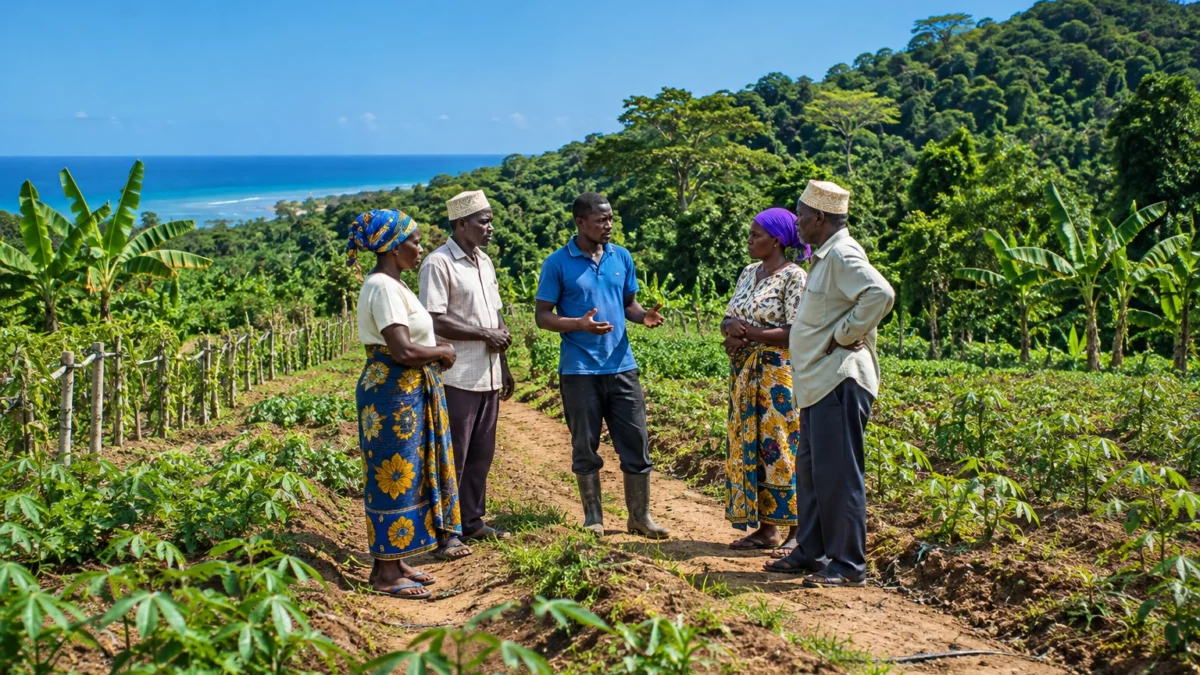
At Mrima Hill, in the coastal county of Kwale, the coveted minerals are not the only factor at stake. The project also affects farmland and a forest sacred to Digo residents. For Kenya, the challenge is therefore twofold: to attract mining investment and show that development can respect local rights.
On 19 November 2026, Nairobi announced the preferred companies for three strategic mineral projects. This step does not yet grant the right to extract. It opens a period of consultations, approvals and exploration on which what happens next will depend.
A modest sector, high ambitions
Kenya’s mining industry remains limited compared with the sectors that underpin the national economy. The ministry estimates that it accounts for around 1% of gross domestic product. In its draft mining and mineral beneficiation policy, the government aims for a 10% contribution by 2030. This is an ambition, not a confirmed forecast.
Current production is based in particular on soda ash, titanium minerals, gold and gemstones. The authorities want to broaden this base and encourage processing locally. In other words, the challenge is not simply to extract more, but to retain a greater share of the value in Kenya through processing, jobs and public revenues.
This approach aligns with a regional priority. The East African Community (EAC) is also seeking to develop extractive industries and mineral processing. If several countries coordinate their expertise, infrastructure and markets, the region can move beyond the role of a mere raw-material supplier. But project announcements alone will not create an industrial chain: capital, technical capacity, energy and markets are needed.
Three projects selected, no mines authorised
Kenya’s Ministry of Mining said it had issued notices of intention to award for three assets. At Mrima Hill, the American consortium Frontier Minerals, comprising Frontier Minerals LLC, Bunker Hill Mining Corp., ReElement Technologies and American Resources Corporation, has been selected as the preferred bidder for niobium and rare earths.
For copper at Kamacabi, in Tharaka Nithi County, and chromite at Kang’ura, in Samburu County, the ministry named a joint venture between Chinese groups Fangda Special Steel Technology and Sinohydro. Two other sites did not receive compliant bids at this stage: manganese at Lali Hills and coltan at Kiritiri.
The administrative wording matters here. A notice of intention to award is neither a prospecting permit nor an exploitation licence. The companies must still engage with the communities concerned, landowners and local authorities, and then submit permit applications. These applications will have to be reviewed by the relevant bodies before any work on the ground is authorised.
The selection of American and Chinese partners comes as both powers seek to secure their supplies of minerals. But the outcome of the process does not mean that Kenya has already struck a balance between foreign interests. Financial terms, work programmes and commitments to local processing are not all public. Their publication and oversight will be crucial to assessing the expected benefits.
Consultations will be decisive at Mrima Hill
The Mrima Hill site is particularly sensitive. The sacred forest there was designated a national monument in 1992. Residents and Digo representatives are concerned about the project’s possible effects on their land, farming activities and this place of memory. These concerns are not a detail to be dealt with after decisions have been made: they go to the very conditions for a sustainable and legitimate project.
A legal precedent reinforces the need for caution. An earlier attempt to mine the site by Cortec Mining Kenya led to an environmental dispute. According to available reports, the Kenyan environmental authority rejected the study associated with the project in 2013. The dispute then continued before an international arbitration tribunal, which concluded that the licence should not have been granted without environmental approval. This precedent shows that permits and protections for the site can matter as much as its geological potential.
Mrima Hill is also the only one of the three selected projects for which a resource estimate has been published. The ministry’s tender document cites 5.8 million tonnes of indicated resources grading 1.41% Nb₂O₅, as well as 48.7 million tonnes grading 4.4% total rare earth oxides. These figures prove neither that a mine would be profitable nor how much could be extracted. They will need to be updated and confirmed by technical and environmental studies.
Previous exploration work has been carried out at Kamacabi and Kang’ura, but it has not produced comparable resource estimates. Their economic potential therefore remains to be assessed. This difference is a reminder that selecting investors can launch exploration, but guarantees neither a viable discovery nor commercial production.
Local value will be measured over time
For residents living near the sites, the possible effects can take very concrete forms: access to land, compensation terms, employment, business for local companies, and the protection of water and natural areas. Public gains, meanwhile, will depend on tax rules, royalties and the state’s ability to monitor commitments. These benefits are not automatically shared between the capital, mining regions and the population.
The government presents local processing as a priority. The mining policy under preparation aims to strengthen mineral beneficiation in Kenya, in line with continental industrial development goals. It remains to be seen whether future agreements will require verifiable steps: publication of planned investments, training, Kenyan jobs and a timetable for processing locally.
The next phase will therefore reveal more than just the names of the investors. It will show how the rules are applied, whether communities have enough information to take part in consultations and whether studies confirm the deposits’ potential. For Kenya and the EAC alike, the central question is one of sharing: who controls the resources, who bears the risks and where is value created?