Algeria
 Egypt
 Libya
 Morocco
 Sudan
 Tunisia
 Benin
 Burkina Faso
 Cabo Verde
 Côte d'Ivoire
 Ghana
 Guinea
 Guinea-Bissau
 Liberia
 Mali
 Mauritania
 Niger
 Nigeria
 Senegal
 Sierra Leone
 The Gambia
 Togo
 Cameroon
 Central African Republic
 Chad
 DR Congo
 Equatorial Guinea
 Republic of the Congo
 São Tomé and Príncipe
 Burundi
 Comoros
 Djibouti
 Eritrea
 Ethiopia
 Kenya
 Madagascar
 Malawi
 Mauritius
 Mozambique
 Rwanda
 Seychelles
 Somalia
 South Sudan
 Tanzania
 Uganda
 Angola
 Botswana
 Eswatini
 Lesotho
 Namibia
 South Africa
 Zambia
 Zimbabwe
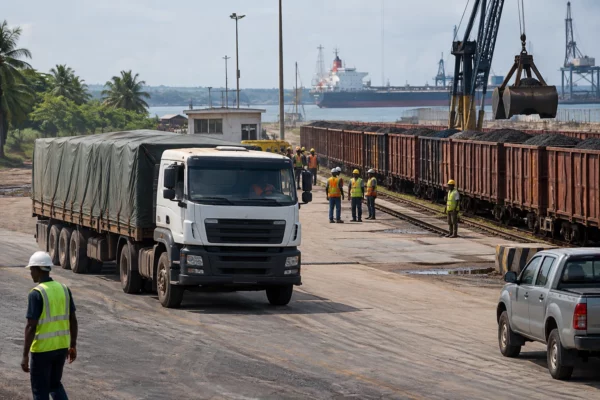
A port cannot create a mining economy on its own. It also needs exploited deposits, railways, commercial outlets and sufficient volumes. In Mayumba, in Nyanga province, Gabon is putting the project back on the table with a concrete first step: updating the studies before deciding what comes next.
Studies before any construction decision
On 21 September 2026, Gabon’s Ministry of Transport issued a call for expressions of interest to shortlist consultants tasked with reviewing the port’s technical studies. Gabonese media reported the deadline and procedure. The aim is to assess the project’s specifications, whose design and ambitions have evolved over the decades. Gabonreview and EcoMatin have also reported the revival of the studies.
The move does not mean that financing has been secured or that construction is starting. It is intended to clarify the cost, capacity, necessary connections and business model. These details will determine whether the project can move from ambition to viable investment.
Meanwhile, Libreville is continuing its discussions with Abu Dhabi Ports Group. Gabon’s Ministry of Transport confirmed in July 2026 that talks were under way on several projects, including Mayumba. The cooperation builds on a memorandum of understanding signed in February. At this stage, public announcements establish that discussions and cooperation commitments exist, not that a final construction or operating agreement has been concluded. Gabon’s Ministry of Transport sets out the framework for these discussions.
A corridor to connect with southern resources
The idea of a deep-water port at Mayumba dates back several decades. The National Growth and Development Plan (PNCD) 2026-2030 envisages a multimodal hub, meaning one connected to several forms of transport, with terminals for minerals and industrial products. The planning document refers to vessels of more than 200,000 tonnes deadweight and up to 120 million tonnes of freight a year. These are projected targets, not capacities already built or guaranteed. The PNCD’s operational framework also provides for railway lines linking mining basins to Mayumba.
The project is presented as a possible outlet for iron ore from Baniaka and other resources in southern Gabon, notably timber and potash. But the route, rail investment and mine development schedules still need to be aligned. Without reliable connections between production sites, processing facilities and the quay, a high-capacity port would remain underused.
This question has taken on new significance with Kobe-Kobe. On 8 June 2026, President Brice Clotaire Oligui Nguema launched work on the site’s mineral port, intended in particular to support the development of the Belinga iron ore deposit. The project includes a dedicated corridor combining a port, railway and energy infrastructure. Gabon’s presidency confirmed the start of work.
Mayumba and Kobe-Kobe are therefore not necessarily competing gateways for the same cargoes. Their complementarity will depend on where the mines are located, rail capacity, export contracts and any processing activities in Gabon. The national strategy still needs to clarify how flows will be divided, particularly for Belinga ore, now linked to the Kobe-Kobe corridor.
The test of profitability and local benefits
For the state, the challenge is to diversify an economy still heavily dependent on commodities and improve the movement of products to markets. For mining companies, the promise is more direct logistics. For Nyanga’s residents, benefits will depend on more than export volumes: accessible jobs, contracts for Gabonese companies, roads, services and the management of environmental impacts will also matter.
The risks are just as tangible. A port, railway and their equipment come at a high cost. If promised volumes are slow to materialise, the financial burden could exceed expected revenues. The studies will therefore need to test projected capacity against credible traffic forecasts, rather than treating planning targets as demand already secured.
The project also raises questions about development. Construction could transform local activities and put pressure on coastal environments. Technical, economic and environmental studies will need to help assess these effects and determine the measures required. The outcome matters to investors, but also to local authorities and workers who may be directly affected.
Significance beyond Nyanga
The project forms part of an ambition to integrate economies in Central Africa. Gabon belongs to the Economic and Monetary Community of Central Africa (CEMAC), which brings together six countries in a common market and monetary cooperation. A Gabonese port could strengthen regional trade, provided cross-border links, customs procedures and logistics services are in place. CEMAC identifies integration as one of its objectives.
The next milestone, then, is less about announcing a partnership than about the quality of the studies and the decisions that follow: estimated cost, financing, operator, rail connections and forecast traffic. For Mayumba, progress will be measured when these elements have been established and commitments formalised in contracts. Until then, the port remains a strategic project in preparation, not yet a new export route.