
 Algeria
 Egypt
 Libya
 Morocco
 Sudan
 Tunisia
 Benin
 Burkina Faso
 Cabo Verde
 Côte d'Ivoire
 Ghana
 Guinea
 Guinea-Bissau
 Liberia
 Mali
 Mauritania
 Niger
 Senegal
 Sierra Leone
 The Gambia
 Togo
 Cameroon
 Central African Republic
 Chad
 DR Congo
 Equatorial Guinea
 Gabon
 Republic of the Congo
 São Tomé and Príncipe
 Burundi
 Comoros
 Djibouti
 Eritrea
 Ethiopia
 Kenya
 Madagascar
 Malawi
 Mauritius
 Mozambique
 Rwanda
 Seychelles
 Somalia
 South Sudan
 Tanzania
 Uganda
 Angola
 Botswana
 Eswatini
 Lesotho
 Namibia
 South Africa
 Zambia
 Zimbabwe
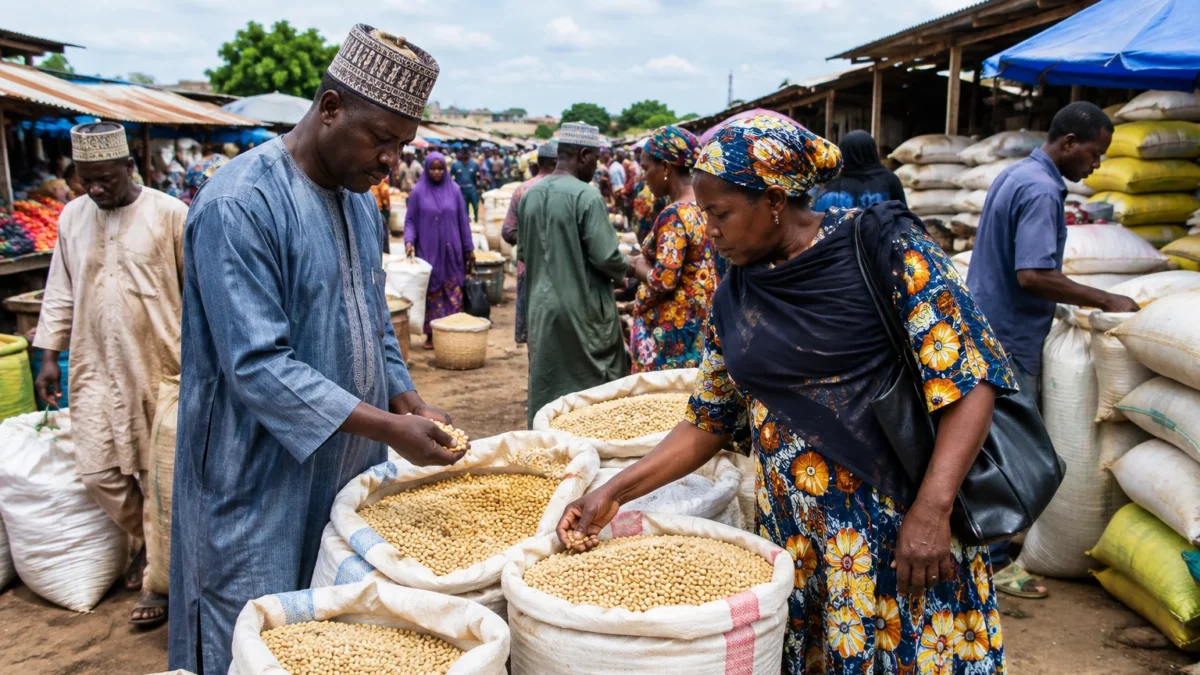
In Nigeria, producing more soybeans does not automatically guarantee stable prices or secure supplies for factories. The next harvest could increase, but farmers, international buyers and local processors are already competing for the crop.
A forecast yet to be confirmed in the field
AFEX, a private agricultural commodities exchange licensed in Nigeria, forecasts a harvest of 1.67 million tonnes for the 2026/2027 season. Presented in Abuja on 11 November, the estimate would represent an 11.3% increase on the 1.5 million tonnes attributed to the previous season.
The expected rise would mainly come from an expansion in cultivated areas. Farms already in operation are said to have enlarged their plots, while new producers are joining the sector. AFEX also describes soybeans as an attractive commercial option as cereal prices fluctuate and diseases affect some other crops.
This is a forecast, however, not a harvest result. Agricultural estimates vary according to the periods covered, survey methods and the organisations compiling them. The 2024 annual report of the National Agricultural Productivity Survey put production at about 948,000 tonnes that year. Nigeria’s Ministry of Information, meanwhile, reported annual production of about 1.35 million tonnes in July 2025. These figures do not necessarily measure the same season, but they are a reminder that the series should be compared with caution.
A sector caught between industrial demand and foreign markets
Soybeans serve several purposes: they provide protein for animal feed, are used to make oils and supply the food-processing industry. The Nigerian government estimates that domestic demand exceeds 2.7 million tonnes a year, far above the production figure it cited in 2025. If that gap is confirmed, the expected increase alone would not be enough to meet the needs of factories and consumers.
Export buyers are adding to competitive pressure. According to a market bulletin cited in late October, large volumes from the new harvest reached markets in the north in the first week of the month. Prices are reported to have initially fallen by about 40% in several markets, before recovering from the second week, particularly as Chinese buyers arrived. These movements, reported by an agricultural market-monitoring service, are not a national price series and should be read as local indications.
Available export figures require the same caution. Export Ready Africa estimates that 334,787 tonnes of soybean seeds were shipped between October 2025 and September 2026, worth $167.6 million. The platform draws on pre-inspection records and is not a substitute for official statistics. By comparison, World Bank customs data based on Comtrade record 73,111 tonnes exported by Nigeria in 2025. The periods and sources differ, so the figures are not directly comparable, but the gap highlights the importance of consolidating trade monitoring.
Gains are not automatically shared
For producers, stronger demand can open up markets and make soybeans more attractive than some competing crops. But a larger harvest can also push farm-gate prices down when supplies arrive in concentrated volumes and storage or transport capacity is lacking. Incomes will therefore depend as much on yields and input costs as on the ability to sell at the right time.
The effects also vary among stakeholders. Farmers far from markets have less scope to choose their buyer, while traders and processors near logistics hubs can access volumes more easily. For Nigerian processors, direct export purchases can make supplies more expensive or uncertain. Conversely, a better-organised supply could feed factories, support poultry and fish feed production, and reduce reliance on imported raw materials.
The government launched a national strategy to expand soybean production in 2025. Its challenge is not simply to increase cultivated areas. It also involves improving seeds, collection, storage, financing and local processing. Without these links in the chain, increased volumes may benefit intermediaries or buyers able to export first, without durably increasing the value created in farming regions.
A Nigerian issue with implications beyond its borders
Nigeria is a major soybean supplier in West Africa, where the crop grows alongside oilseeds such as groundnuts and sesame. The sector is part of a regional trading area shaped by ECOWAS, the Economic Community of West African States. Cross-border flows, price differences and access to infrastructure influence the choices of producers and buyers, even when the harvest is destined for the Nigerian market.
For the region, higher Nigerian production could increase the availability of beans and processed products. It could also intensify competition with neighbouring producers and attract more international buyers. The outcome will depend on trade rules, logistics costs and the ability of West African processors to handle a share of the harvest locally.
The next indicators to watch are measured harvests, price movements in northern markets and the publication of comparable official export data. The gap between production announcements and available statistics shows that transparent figures matter as much as forecasts. They will determine whether expected growth translates into farm incomes, supplies for factories and added value in Nigeria.



