Algeria
 Egypt
 Libya
 Morocco
 Sudan
 Tunisia
 Benin
 Burkina Faso
 Cabo Verde
 Côte d'Ivoire
 Ghana
 Guinea
 Guinea-Bissau
 Liberia
 Mali
 Mauritania
 Niger
 Nigeria
 Senegal
 Sierra Leone
 The Gambia
 Cameroon
 Central African Republic
 Chad
 DR Congo
 Equatorial Guinea
 Gabon
 Republic of the Congo
 São Tomé and Príncipe
 Burundi
 Comoros
 Djibouti
 Eritrea
 Ethiopia
 Kenya
 Madagascar
 Malawi
 Mauritius
 Mozambique
 Rwanda
 Seychelles
 Somalia
 South Sudan
 Tanzania
 Uganda
 Angola
 Botswana
 Eswatini
 Lesotho
 Namibia
 South Africa
 Zambia
 Zimbabwe
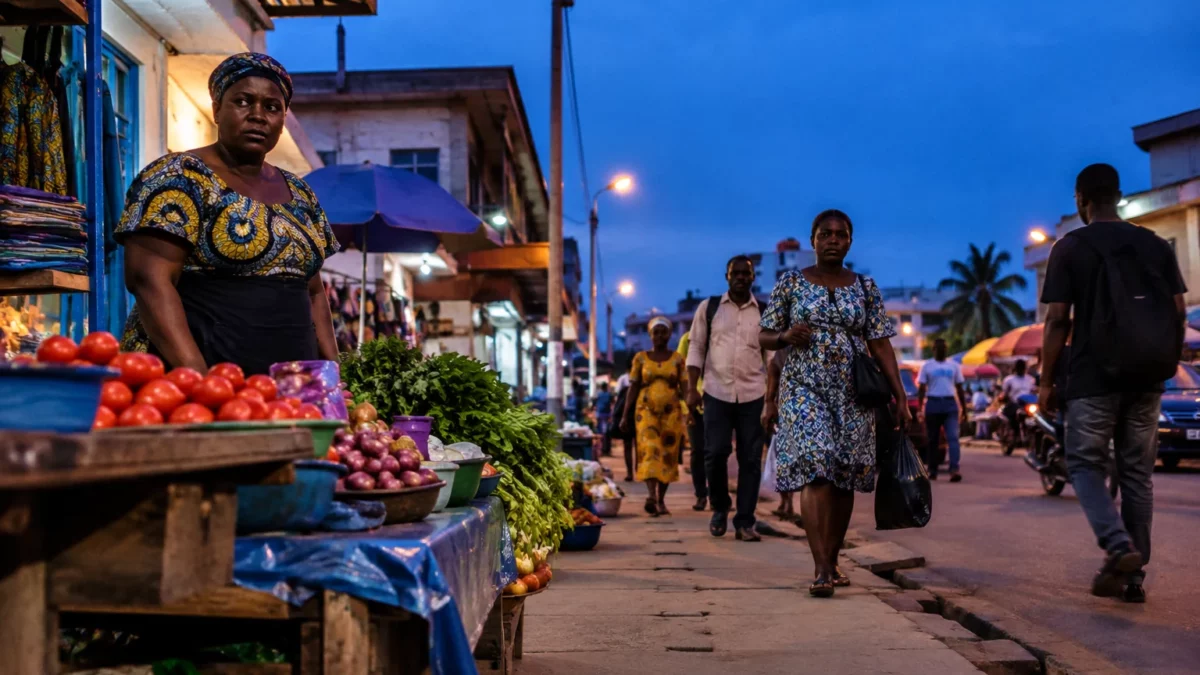
In Lomé, the issue is not simply who must leave the pavements. It is also about the time allowed, how the decision is enforced and what will happen to the small businesses that depend on these locations.
The timetable is now at the centre of tensions. The Autonomous District of Greater Lomé (DAGL), the authority that co-ordinates public action across the urban area, has set 20 November 2026 as the deadline for voluntarily vacating occupied public spaces without authorisation. Forced operations are due to begin on 21 November, according to a clarification by the committee responsible for the operation. Yet, on the eve of the deadline, traders say they have already suffered demolitions.
A timetable contested in several neighbourhoods
The clearance operation concerns public roads and their surroundings in Greater Lomé. The ad hoc committee sets the timetable, while municipal technical services are to carry out the work on the ground. The authorities justify such operations on the grounds that pavements need to be cleared and traffic made easier.
But in the neighbourhoods of Agoè, Casablanca and Attikoumé, occupants have reported demolitions before the announced date. A former student, whose account is included in the available information, says people came to tear down structures while the voluntary departure period was still running. This account could not be independently confirmed and should therefore be distinguished from the official timetable.
The implementation committee later clarified that 20 November remained the deadline for voluntary departure and that forced demolitions were not to begin until 21 November. This clarification confirms the announced deadline, but does not in itself establish what happened in each neighbourhood before it was issued.
The Martin Luther King Movement (MMLK), led by Pastor Edoh Komi, does not dispute the principle of freeing spaces intended for pedestrians and traffic. It criticises the alleged brutality of some operations and calls for greater consideration for those affected. The movement has also called for an extension until 31 January 2027, citing difficulties in finding commercial premises and the approach of the year-end holidays.
The street as a space for movement and a place of work
For residents, clear pavements can make walking easier and some routes more accessible. Vendors occupying public spaces, however, risk losing their pitches and part of their income. In the informal economy, a stall or small structure may be a household’s main means of making a living. A rapid demolition can therefore have immediate effects, even when the occupation is unauthorised.
The public decision thus brings two realities into conflict: the right to move through a shared space and the economic dependence of people who work there. The consequences are not the same for everyone. Pedestrians and motorists may benefit from clear routes; the traders concerned bear the direct cost of moving or losing equipment. Customers, suppliers and families connected to these businesses may also be affected.
At this stage, no commercial relocation solution is officially mentioned in the material consulted. The absence of an announcement does not prove that no measures exist, but it leaves an essential question unanswered: where will vendors be able to continue their businesses after leaving? The MMLK is calling for a postponement and a more gradual implementation. The disagreement is therefore as much about social arrangements as it is about the objective of clearing the roads.
A local operation amid political tensions
The controversy comes as several issues are fuelling public debate in Togo. Organisations grouped under the name “Manifeste Génération Togo” have called for activities to be suspended on 20 November. Their mobilisation links the clearances to other demands, including constitutional reform, restrictions on freedoms and higher fuel prices.
The announced day of action is a political call; it is not in itself proof of widespread support for its demands. It nevertheless shows how a municipal decision can become part of broader national debates. For traders, the immediate issue is their business and equipment. For the organisations mobilising, the operation has also become a focus for opposition to the authorities’ actions.
Togo is a member of the Economic Community of West African States (ECOWAS), which brings together countries in West Africa. Urban clearances do not fall directly under the remit of this regional organisation. Their significance nevertheless extends beyond Lomé: West African cities must balance mobility, pedestrian safety, the organisation of public space and the place of street trading, although the responses differ from one country to another.
21 November, the next date to watch
The announced date for the start of forced operations is 21 November 2026, after the voluntary departure deadline of 20 November. It remains to be seen how the committee and municipal services will apply this timetable, whether appeals or relocation options will be offered, and how complaints about early demolitions will be handled.
The decisive issue, then, is not so much the announcement of a deadline as whether it is respected on the ground. In Lomé, the operation’s credibility will depend on consistency between the timetable communicated, the actions of municipal teams and the response to people whose structures have already been affected. The debate is about public space; it also turns on the authorities’ ability to make their decision predictable and limit its impact on livelihoods.
For updates from the committee and local reactions, see Actu Lomé’s update on the timetable for the operations, the report by the Togolese Press Agency and the position of the Martin Luther King Movement.