Algeria
 Egypt
 Libya
 Morocco
 Sudan
 Tunisia
 Benin
 Burkina Faso
 Cabo Verde
 Côte d'Ivoire
 Ghana
 Guinea
 Guinea-Bissau
 Liberia
 Mali
 Mauritania
 Niger
 Nigeria
 Senegal
 Sierra Leone
 The Gambia
 Togo
 Cameroon
 Central African Republic
 Chad
 DR Congo
 Equatorial Guinea
 Gabon
 Republic of the Congo
 São Tomé and Príncipe
 Burundi
 Comoros
 Djibouti
 Eritrea
 Ethiopia
 Madagascar
 Malawi
 Mauritius
 Mozambique
 Rwanda
 Seychelles
 Somalia
 South Sudan
 Tanzania
 Uganda
 Angola
 Botswana
 Eswatini
 Lesotho
 Namibia
 South Africa
 Zambia
 Zimbabwe
A new outlet alone cannot shield an industry from shocks in global trade. But for Kenyan tea producers, selling more effectively in Central Asia could reduce dependence on routes and buyers most exposed to disruption.
In Nairobi, discussions with Kazakhstan concern the creation of a platform for tea and coffee. The stakes go beyond selling leaves: the aim is also to facilitate packaging and distribution and, ultimately, access to neighbouring markets.
A fast-growing market, but still concentrated
Kazakhstan is already an important buyer of Kenyan tea. Data for 2025 from the international trade database WITS, which draws on customs statistics, indicate exports of about 24,442 tonnes, worth $68 million. These figures are in line with those published by the Tea Board of Kenya, the public body responsible for the sector. According to the board, the value of sales to Kazakhstan rose sharply compared with 2024.
The country is therefore among the main outlets for Kenyan tea. However, most purchases in Central Asia remain concentrated in this one market. In 2025, sales to Uzbekistan amounted to about 2,655 tonnes, according to the Tea Board. Volumes destined for Kyrgyzstan were much lower. In other words, the region offers a path to growth, but not yet a diversified trading network.
A distribution platform could change the scale of this opportunity. Kazakh authorities raised the prospect in September of creating a regional centre for Kenyan tea and coffee. On 16 November, the Kazakh embassy in Nairobi again cited the project as one of the avenues for economic co-operation between the two countries. Discussions reported on 18 November between ambassador Barlybay Sadykov and Tea Board chief executive Willy Mutai are part of this effort.
From export to processing
The proposed project would not be limited to transporting consignments. It could include packaging and distribution, using infrastructure in Nairobi and at the port of Mombasa for transport. The precise share of processing to be carried out in Kazakhstan, the funding and the operational timetable remain to be specified.
This detail matters. Kenya produces and exports tea on a large scale, but a trading platform does not automatically guarantee that producers or local businesses will capture more value. The outcome will depend on contracts, investment and the role given to sorting, packaging or processing activities. For producers, co-operatives and traders, access to a new buyer could create opportunities; how the gains will be shared has yet to be established.
The choice of Kazakhstan also has a logistical dimension. The country can serve as a gateway to Central Asian markets, but this role will depend on the practical organisation of transport and trade rules. Mombasa already links Kenyan exports to international shipping routes. Nairobi, meanwhile, is home to institutions and services that support trade. The project therefore seeks to connect existing infrastructure rather than announce a new route that is already operational.
Trade route vulnerability in the background
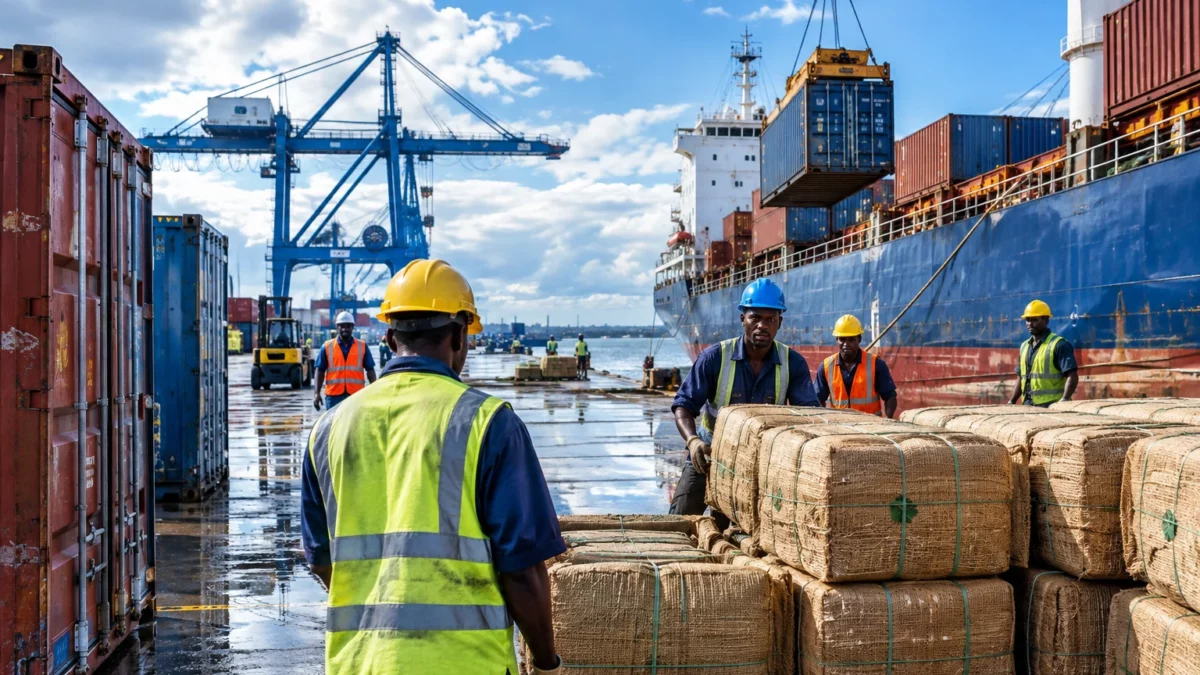
The search for new outlets comes after major disruption to transport to the Middle East. In late March and early April 2026, Kenyan and international media reported that several thousand tonnes of tea were stranded in Mombasa. Estimates varied according to the date and the sources cited: the regional tea traders’ association referred to about eight million kilograms in early April, while other reports gave different volumes. These stocks and the weekly losses cited by industry professionals should therefore be understood as attributed estimates, not a definitive tally.
These difficulties illustrate the vulnerability of an export-oriented industry. When ships are delayed or routes disrupted, the consequences do not stop at the docks: they can affect sales, payments and the incomes of those in the supply chain. Producers, particularly those reliant on a limited number of buyers or marketing channels, do not necessarily have the same room for manoeuvre as large exporting companies.
Diversification does not mean abandoning traditional markets. Rather, it aims to prevent a shock on one route or in one region from blocking too large a share of sales. Available figures nevertheless show that Kazakhstan is already an established market: the goal is to consolidate this presence and broaden outlets around it.
A test for trade between East Africa and Central Asia
For Kenya, a member of the East African Community (EAC), this initiative forms part of a broader trade diversification strategy. It links an East African economy oriented towards the Indian Ocean with a landlocked Central Asian partner, where overland infrastructure and transit agreements are decisive. The project’s regional reach will therefore depend as much on trade agreements as on the ability to move products beyond Kazakhstan.
The next step will be to turn announcements into verifiable arrangements: a timetable, operators, investment, volumes covered and real access to neighbouring markets. Without these details, the centre remains a co-operation project, not a new commercial infrastructure in operation. For Kenyan producers, the decisive question will be whether this opening leads to more regular sales and a fairer distribution of value across the industry.
Cross-checking sources: 2025 customs data on Kenyan tea exports, 2025 indicators from the Tea Board of Kenya, Kazakh embassy in Nairobi statement of 17 September 2026, Kazakh embassy statement of 16 November 2026, The Star on trade disruptions linked to the Middle East conflict and eNCA on stocks stranded at the port of Mombasa.