Algeria
 Egypt
 Libya
 Morocco
 Sudan
 Tunisia
 Benin
 Burkina Faso
 Cabo Verde
 Côte d'Ivoire
 Ghana
 Guinea
 Guinea-Bissau
 Liberia
 Mali
 Mauritania
 Niger
 Nigeria
 Senegal
 Sierra Leone
 The Gambia
 Togo
 Cameroon
 Central African Republic
 Chad
 DR Congo
 Equatorial Guinea
 Gabon
 Republic of the Congo
 São Tomé and Príncipe
 Burundi
 Comoros
 Djibouti
 Eritrea
 Ethiopia
 Kenya
 Madagascar
 Malawi
 Mozambique
 Rwanda
 Seychelles
 Somalia
 South Sudan
 Tanzania
 Uganda
 Angola
 Botswana
 Eswatini
 Lesotho
 Namibia
 South Africa
 Zambia
 Zimbabwe
Sovereignty over the Chagos Islands lies at the heart of an agreement that has been signed but not yet implemented. For Mauritius, the issue goes beyond the Diego Garcia military base: it is a question of whether Port Louis will take part in decisions concerning a territory it claims as its own, and when Chagossian residents might be able to consider returning.
A signed agreement, with ratification still pending
The dispute is part of a long history of unfinished decolonisation. In 1965, three years before Mauritius gained independence, the United Kingdom detached the Chagos Archipelago from Mauritian territory. The British authorities subsequently forcibly displaced the Chagossians, whose descendants live mainly in Mauritius, Seychelles and the United Kingdom.
In 2019, the International Court of Justice found that Mauritius’s decolonisation had not been lawfully completed. That same year, the United Nations General Assembly called on the United Kingdom to end its administration of the archipelago. These decisions strengthened Mauritius’s position, although the court’s opinion was advisory. The African Union has also followed the case as a matter of decolonisation and territorial integrity.
On 22 May 2025, Mauritius and the United Kingdom signed an agreement recognising Mauritian sovereignty over the entire Chagos Archipelago, including Diego Garcia. The text nevertheless provides for the US-UK military base on Diego Garcia to remain under an initial 99-year lease. It also gives Mauritius the option of organising a resettlement programme on the other islands, in accordance with its laws. The text of the Chagos agreement thus distinguishes the question of sovereignty from the operation of the base.
Port Louis demands a place in the talks
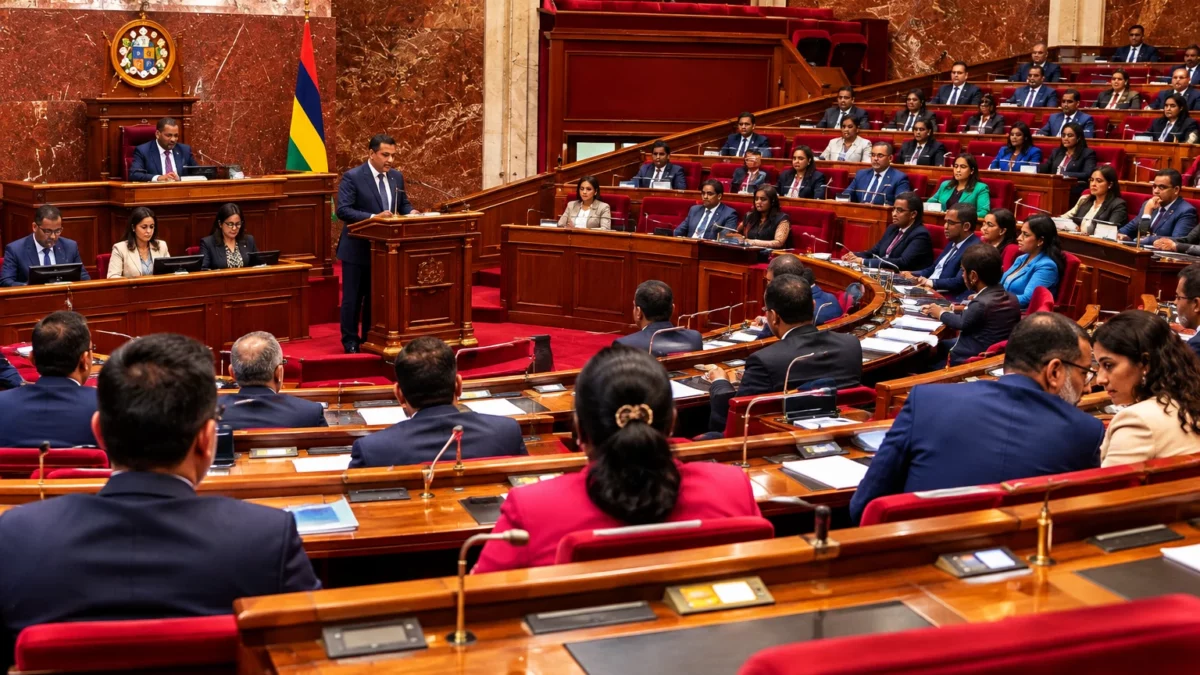
On 18 November 2026, Prime Minister Navinchandra Ramgoolam updated the National Assembly on ratification. He recalled that it still depended on the United Kingdom and that the treaty had not entered into force. According to the Mauritian government’s information service, London suspended consideration of the bill required to implement it in April 2026, after failing to reach agreement with Washington on updating the arrangements governing the base.
The disagreement is therefore over military arrangements, but it is delaying the territorial agreement as a whole. Ramgoolam argues that any discussions about Diego Garcia must include Mauritius and respect its sovereignty. His government continues to prioritise diplomacy. It has, however, said it has considered legal options if the deadlock persists.
The prime minister has called for a clear roadmap by December 2026. This is a political target announced by Port Louis, not a guaranteed date for ratification. The Mauritian government says it wants to secure an outcome to the process before that deadline and has not ruled out taking the matter to court again if there is no progress.
The case has seen several diplomatic exchanges in recent months. The Mauritian government says Ramgoolam discussed the agreement with his British counterpart on 21 September, then met the British national security adviser in London on 2 October 2026. It also refers to discussions on the sidelines of the Commonwealth Heads of Government Meeting. The Mauritius Broadcasting Corporation reported that London had committed to working with Mauritius and the United States towards ratification.
A matter of sovereignty and regional security
Diego Garcia holds strategic importance in the Indian Ocean. The base serves US and British forces in operations across several regions. Washington and London want to preserve its operation; Port Louis says this need cannot justify negotiations that exclude the state expected to exercise sovereignty over the archipelago.
How the three governments resolve this tension will be watched well beyond Mauritius. The country is a member of the Southern African Development Community, SADC, a regional bloc that also includes several Indian Ocean littoral states. The case has also engaged the African Union and UN bodies, where the decolonisation of the Chagos Islands has already been the subject of decisions and resolutions. This is therefore not merely a military arrangement between two powers: the role accorded to Mauritius puts the principles of sovereignty and the negotiated settlement of disputes to the test.
For Mauritians, the uncertainty concerns the implementation of the agreement and their government’s ability to influence decisions linked to Diego Garcia. For the Chagossians, the question of return remains distinct and essential: the signing of the treaty does not, in itself, constitute resettlement. That will depend on the measures taken by Mauritius and the practical conditions on the islands concerned.
The deadlock also affects relations between Port Louis, London and Washington. If these capitals agree on military guarantees without involving Mauritius, they risk undermining the process’s political acceptance on the island. Conversely, Mauritius’s participation in the discussions will not automatically resolve disagreements over the base, but it would address the government’s central demand: no decision on the future of the Chagos Islands should be made without the country claiming sovereignty over them.
December, the next diplomatic deadline
What happens next will depend first on discussions between the three states and on the United Kingdom’s ability to resume the ratification process. The Mauritian government is awaiting a roadmap by the end of December 2026. If there is no progress, it could turn its threat of legal action into a formal move. The deadline will provide an initial indication of whether the continued operation of the military base, Mauritian sovereignty and Chagossian aspirations can be reconciled.