
 Algeria
 Egypt
 Libya
 Morocco
 Sudan
 Tunisia
 Benin
 Burkina Faso
 Cabo Verde
 Côte d'Ivoire
 Ghana
 Guinea
 Guinea-Bissau
 Liberia
 Mali
 Mauritania
 Niger
 Senegal
 Sierra Leone
 The Gambia
 Togo
 Cameroon
 Central African Republic
 Chad
 DR Congo
 Equatorial Guinea
 Gabon
 Republic of the Congo
 São Tomé and Príncipe
 Burundi
 Comoros
 Djibouti
 Eritrea
 Ethiopia
 Kenya
 Madagascar
 Malawi
 Mauritius
 Mozambique
 Rwanda
 Seychelles
 Somalia
 South Sudan
 Tanzania
 Uganda
 Angola
 Botswana
 Eswatini
 Lesotho
 Namibia
 South Africa
 Zambia
 Zimbabwe
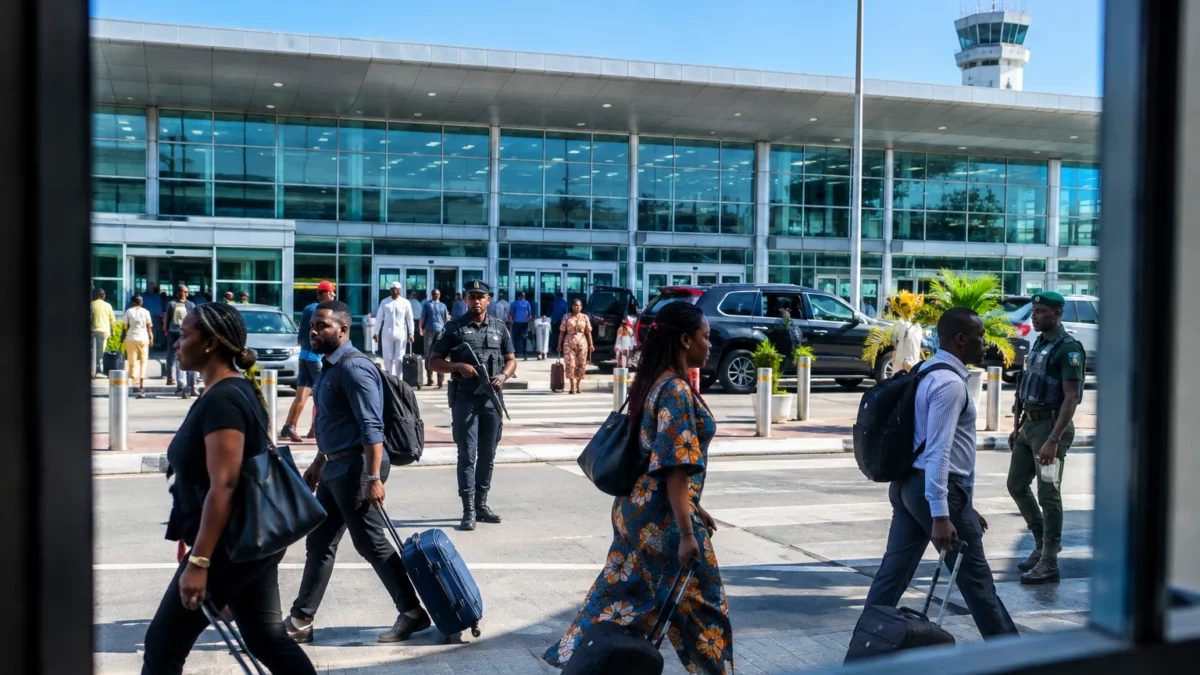
A suspected route between Lagos, northern Nigeria and Europe is a reminder that cocaine trafficking does not stop at national borders. It also highlights the role of couriers, often exposed to immediate risks, in networks whose organisers are harder to reach.
Operation carried out between Lagos and Kano
The National Drug Law Enforcement Agency (NDLEA), Nigeria’s federal agency responsible for combating drugs, announced on 17 November that eight suspects had been arrested in Lagos and Kano. The arrests took place on 30 and 31 October, according to the agency. It says the suspects were carrying cocaine concealed inside their bodies.
The operation reportedly began in Lagos with the arrest of Okwudiba Ifeanyichukwu Damian, 57, at a hotel. The NDLEA says he expelled 74 pellets, weighing 1.65kg. The following day, four other men were arrested at the domestic terminal of Murtala Muhammed Airport as they were about to board a flight to Kano.
According to figures released by the agency and reported by Nigerian media outlet Premium Times, the five suspects arrested in Lagos expelled a total of 399 pellets, or 8.655kg. In Kano, three more people were intercepted at Mallam Aminu Kano International Airport. Body scanners reportedly detected pellets. The NDLEA says it recovered 235 pellets, weighing 5.14kg, from them.
In total, the agency reported 634 pellets and 13.795kg of cocaine. Nigerian media have also reported the detailed breakdown and the suspects’ identities. At this stage, these are arrests and police allegations; they do not amount to judicial convictions.
A corridor linking several countries
According to the NDLEA, the suspects allegedly planned to travel by road from Kano, cross Niger and then reach Libya, before continuing to their final destination in Europe. This suspected route crosses several border areas and should not be taken as proof that the entire network has been identified or dismantled.
The alleged plan, however, follows a corridor that has already been documented. An INTERPOL assessment of cocaine trafficking in West and North Africa discusses a seizure of 214.64kg in Niger in January 2022. Investigators at the time described a route starting in Nigeria, passing through Niger and heading towards Libya. The report states that onward transport to Europe was a hypothesis reported by the Nigerien authorities.
The United Nations Office on Drugs and Crime report on trafficking in the Sahel places these movements within a broader regional system. The Sahel can serve as a transit zone between West Africa, North Africa and European markets. This does not mean that all routes are overland: the report also notes the importance of sea and air transport.
The regional institutional context also matters. Niger withdrew from the Economic Community of West African States (ECOWAS), the regional integration organisation, on 29 January 2025. This political change does not prove that co-operation against trafficking has ceased. It does, however, underline the practical importance of co-ordination between neighbouring states, particularly for intelligence-sharing and cross-border investigations.
Couriers arrested, organisers still to be identified
The alleged method of operation puts couriers directly at risk. Swallowing cocaine pellets can cause severe poisoning or even death if a package ruptures. The eight suspects were reportedly kept under observation during their detention. The publicly available information reviewed does not specify the formal charges against each of them or the next steps in the judicial process.
The arrests also demonstrate the complementary role of checks, according to the authorities: surveillance in Lagos, intervention at the airport, intelligence-sharing and then body scans in Kano. But couriers are only one link in the chain. The investigation will have to establish who recruited those arrested, financed the journey, supplied the cocaine and organised the stages beyond Nigeria. In its account, the NDLEA has not made public evidence establishing that the suspected network’s organisers have been identified.
The impact is not limited to the travellers arrested. For the authorities, the case raises questions about the security of airports and land borders. For people in the regions crossed, it also concerns criminal networks’ ability to exploit ordinary travel and trade. The available evidence does not, however, allow the local scale of this trafficking or its effects on communities in Kano or border areas to be measured.
NDLEA chairman Mohamed Buba Marwa presented the arrests as a warning to traffickers, saying that “there is no safe route out of Nigeria”. The statement reflects the agency’s position. On its own, it does not make it possible to assess the network’s size or the operation’s lasting effectiveness.
A test for West African co-operation
For Nigeria, whose capital is Abuja, the case is a reminder that combating drugs is not just a matter of checks in major urban centres. It also depends on the flow of information between states and the ability to track supply chains beyond the arrest of couriers. The case links Lagos, a major economic centre, with Kano, a hub in the north of the country, and then with neighbouring countries and Libya.
Across West Africa, Niger’s withdrawal from ECOWAS makes the question of co-operation mechanisms between member and non-member countries all the more pressing. Bilateral exchanges remain essential in the fight against networks that operate across political borders. The case is also a reminder that regional routes are not solely a security issue: they affect travel, trade and people’s livelihoods.
What happens next will depend on judicial proceedings and the results of the investigation into the suspected organisers. In particular, it will be important to establish whether Nigerian authorities can document the planned stages in Niger and Libya, and whether further arrests follow. For now, the publicly established facts concern eight arrests in Nigeria and the quantities the NDLEA says it recovered.



