Algeria
 Egypt
 Libya
 Morocco
 Sudan
 Tunisia
 Benin
 Burkina Faso
 Cabo Verde
 Côte d'Ivoire
 Ghana
 Guinea
 Guinea-Bissau
 Liberia
 Mali
 Mauritania
 Niger
 Nigeria
 Senegal
 Sierra Leone
 The Gambia
 Togo
 Cameroon
 Central African Republic
 Chad
 DR Congo
 Equatorial Guinea
 Gabon
 Republic of the Congo
 São Tomé and Príncipe
 Burundi
 Comoros
 Djibouti
 Eritrea
 Ethiopia
 Kenya
 Madagascar
 Malawi
 Mauritius
 Mozambique
 Rwanda
 Seychelles
 Somalia
 South Sudan
 Tanzania
 Uganda
 Angola
 Botswana
 Eswatini
 Lesotho
 Namibia
 South Africa
 Zimbabwe
To reach annual copper production of three million tonnes by 2031, Zambia cannot rely solely on expanding its existing mines. It also needs to discover the deposits that will supply the next generation of projects. That is the purpose of the state-owned company ZCCM-IH’s decade-long exploration plan.
New data to guide exploration
Mining carries significant weight in Zambia’s economy, but the potential of its subsurface is unevenly documented. Old maps and incomplete geological coverage make it harder to identify new deposits. For the authorities, improving this knowledge is a necessary step before deciding where to drill and invest.
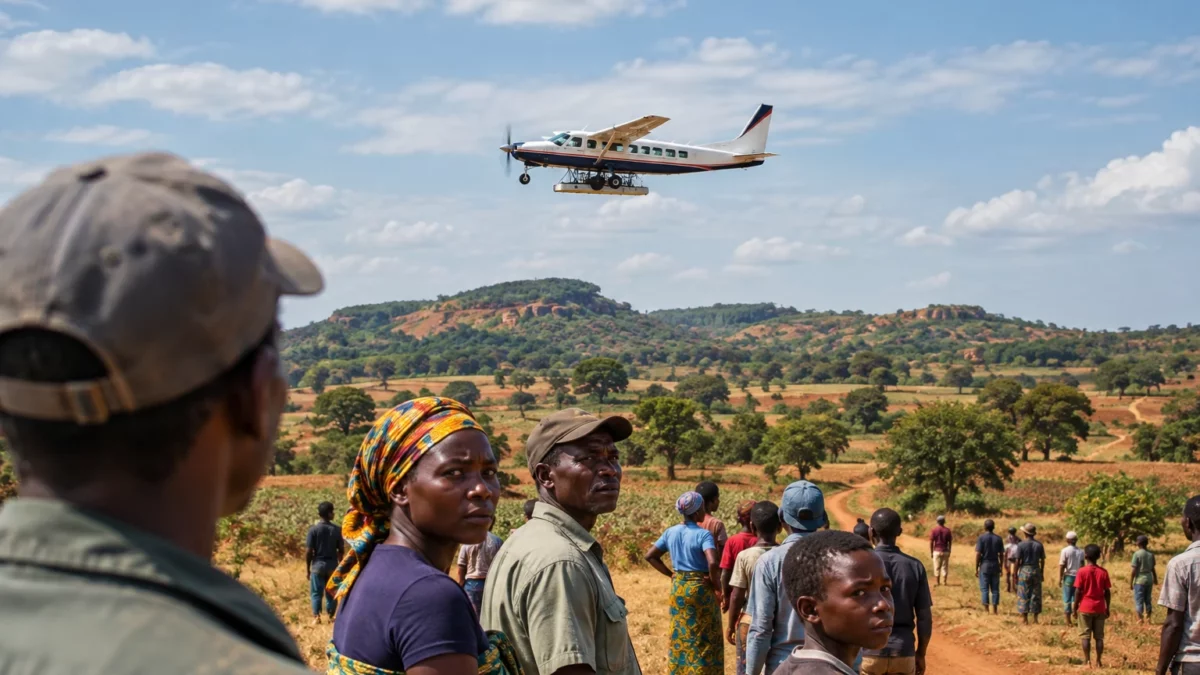
In 2024, the government launched a nationwide airborne geophysical survey, entrusted to Xcalibur Smart Mapping. The aircraft-mounted equipment measures variations in the properties of rocks. The data help geologists identify areas that warrant ground checks, but do not in themselves prove that an economically viable deposit exists.
By September 2026, the survey was more than 94% complete, according to information attributed to the Geological Survey Department of Zambia and reported by several local media outlets. The government has also begun digitising maps and reports that had previously been kept on paper. Access to this data and the rules governing its release will matter as much as its collection: geologists, investors and affected communities need information they can use and understand.
A $704.3 million plan over ten years
Presented on 16 November 2026, ZCCM-IH’s 2026–2035 strategic plan provides for $704.3 million for exploration, according to the company’s document. The state-owned holding company has stakes in several mining businesses and is seeking to strengthen its role in future projects. Its exploration budget forms part of a broader investment strategy worth about $2.7 billion over ten years.
The company intends to use the airborne survey’s findings to select areas for exploration and apply for new permits. It is also preparing work on land where it already holds rights. At Rufunsa, in Lusaka Province, a programme envisages up to 10,000 metres of cumulative drilling by the end of 2028. The site is one of seven priority projects, alongside gold exploration at Kikonge and copper and cobalt exploration in the North-West.
These drilling programmes do not guarantee the discovery of a mine. Their first purpose is to assess the presence, extent and grade of mineralised rock. At Rufunsa, ZCCM-IH is targeting an initial resource estimate between 2029 and 2031. A feasibility study could then determine whether mining is technically and economically viable.
State participation: opportunity and risk
The government wants to use certain state-held permits as contributions to partnerships with private companies. These partners would fund the additional, more costly work needed to confirm and then develop a deposit. Lusaka is seeking to increase public participation in mining, estimated at about 20% in the information provided by the authorities and the company.
The arrangement could give the state a greater role in projects and future revenues. But exploration remains a risky activity: spending may yield no commercially viable discovery. A valuation of a portfolio announced by a state-owned company is therefore a projection, not guaranteed income. How costs, risks, information and benefits are shared with partners will be crucial.
The benefits will not be distributed evenly everywhere. Investment and mining jobs are concentrated in project areas, while decisions on permits and revenues are also made in Lusaka. Small local businesses could benefit from demand for services, but their access will depend on available skills, contracts and infrastructure. Communities near sites, meanwhile, will have an interest in understanding the potential effects on water, land and local livelihoods before work begins.
Copper alone will not deliver the 2031 promise
Zambia produced about 890,000 tonnes of copper in 2025, according to figures cited in the mining compact published with the World Bank and data reported by the specialist press. The target of three million tonnes a year by 2031 therefore implies a substantial increase. Expansions at existing mines and known new projects are expected to contribute, but discoveries are needed to sustain production over the longer term.
Global demand for copper, driven in part by electricity networks, adds to the appeal of this strategy. However, competition for capital, access to energy and infrastructure, and local processing will also determine how much value is retained in the country. Producing more does not automatically mean creating as many jobs or public revenues: tax terms, local suppliers and the ability to process some of the minerals domestically also matter.
The issue extends beyond Zambia’s borders. The Democratic Republic of the Congo is also carrying out mapping work, while Tanzania is developing its mining exploration capabilities. These initiatives are part of a wider context in which several southern African countries are seeking a better understanding of their resources and greater influence in mineral supply chains. Zambia is a member of SADC, the Southern African Development Community, which can provide a framework for regional cooperation on infrastructure and trade.
The next steps are practical: complete the airborne survey, clarify access to the data, fund ground checks and publish verifiable drilling results. Only then can the announced $704.3 million be translated into new knowledge and, potentially, mining projects. For now, the plan sets out an ambition and the resources to pursue it; it does not predetermine either discoveries or their profitability.