Algeria
 Egypt
 Libya
 Morocco
 Sudan
 Tunisia
 Benin
 Burkina Faso
 Cabo Verde
 Côte d'Ivoire
 Ghana
 Guinea
 Guinea-Bissau
 Liberia
 Mali
 Mauritania
 Niger
 Nigeria
 Senegal
 Sierra Leone
 The Gambia
 Togo
 Central African Republic
 Chad
 DR Congo
 Equatorial Guinea
 Gabon
 Republic of the Congo
 São Tomé and Príncipe
 Burundi
 Comoros
 Djibouti
 Eritrea
 Ethiopia
 Kenya
 Madagascar
 Malawi
 Mauritius
 Mozambique
 Rwanda
 Seychelles
 Somalia
 South Sudan
 Tanzania
 Uganda
 Angola
 Botswana
 Eswatini
 Lesotho
 Namibia
 South Africa
 Zambia
 Zimbabwe
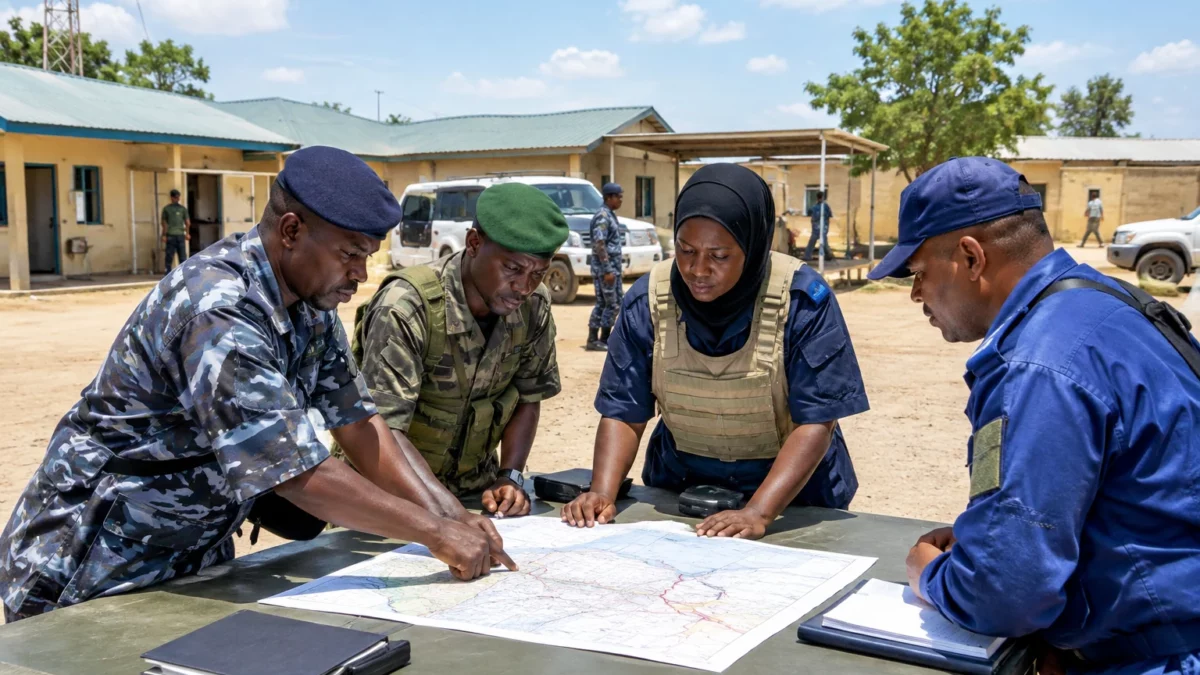
A border should not become an escape route for armed groups. But allowing soldiers to cross it, even by a few kilometres, raises another question: who commands the operation, and under what rules? That is the issue raised by a security announcement made in Abuja on 16 November.
A region where armed groups move between countries
In north-east Nigeria, violence linked to Boko Haram and its breakaway faction, the Islamic State West Africa Province (ISWAP), unfolds across a border region that extends into Cameroon, Niger and Chad. Armed groups can exploit hard-to-reach areas and administrative boundaries to move around or evade national forces.
Regional cooperation is already in place. The Multinational Joint Task Force (MNJTF), established by countries in the Lake Chad Basin, includes contingents from Nigeria, Cameroon, Niger and Chad, among others. Its mandate targets armed groups and aims to stabilise affected areas. The African Union has regularly called for stronger coordination and intelligence-sharing between these states. The official overview of the Multinational Joint Task Force traces its development and lists its contributing countries.
Such cooperation does not, however, eliminate political differences or practical difficulties. Joint operations require reliable communications, common rules and a clear chain of command. Without these, a cross-border intervention can complicate relations between armies rather than improve them.
What Nigeria’s defence minister announced
Nigeria’s Defence Minister, Christopher Musa, said in Abuja on 16 November that Nigeria had reached an agreement with Cameroon, Niger and Chad on a right of hot pursuit limited to five kilometres beyond the borders. According to his account, Nigerian soldiers could continue pursuing armed fighters who take refuge in this strip of neighbouring territory.
The statement was reported by several media outlets, including Reuters and Benin Web TV. However, the text of the arrangement has not been made public. The three neighbouring governments have not, in the information available, set out its terms. The minister’s announcement should therefore be distinguished from the publication of a formal agreement and its effective implementation.
Several questions remain open: must local authorities give their consent before each entry? Can forces only pursue, or can they also carry out a planned operation? Who investigates in the event of damage or an arrest? The announced five-kilometre limit does not answer these questions. The reported wording also does not specify whether the rule applies reciprocally to Cameroonian, Nigerien and Chadian forces.
An operational gain, subject to conditions
For Abuja, the potential benefit is direct. If armed groups can no longer rely on crossing a border immediately to break off a pursuit, the Nigerian army could reduce some of their opportunities to escape. People in border areas could also benefit from better coordination, provided operations do not expose them to gunfire, arbitrary arrests or forced displacement.
But the same measure could be viewed differently on the other side of the border. Cameroon’s authorities must protect their territory and people while also facing incursions by armed groups coming from Nigeria. Bilateral defence cooperation has already been strengthened: Cameroon’s Ministry of Defence announced the signing of a protocol with Nigeria in Yaoundé on 16 June 2026. This precedent points to a willingness to engage, but does not in itself establish the rules for the new right of hot pursuit.
Local communities are affected by more than military operations. Markets, family travel, farming and cross-border trade depend on routes that are often used every day. Effective coordination can improve security without disrupting these activities; poorly defined controls, by contrast, risk penalising residents more than armed networks.
Transparency also matters for accountability. Public procedures, contacts between commands and complaint mechanisms would help distinguish an authorised pursuit from a contested incursion. Without verifiable safeguards, neighbouring governments may hesitate to co-operate, even when they share the same security objective.
The MNJTF remains the regional framework to watch
If confirmed and clarified, the new arrangement would add to an established regional framework. It would not replace the MNJTF, which organises cooperation among several countries and military sectors. In 2026, the African Union welcomed the continuation of joint operations and stressed coordination among contributing countries. The communiqué of the African Union Peace and Security Council also highlights the challenges of stabilisation and the return of displaced people.
The decisive issue, then, will be less the announced distance than the safeguards that accompany it: confirmation by the capitals concerned, an accessible legal framework, clarified reciprocity and cooperation with local authorities. For Nigeria, whose capital is Abuja, the challenge is to pursue armed groups without undermining relations with its neighbours. For the region, it is to turn an announcement into a coordinated, accountable mechanism compatible with the protection of civilians.