Algeria
 Egypt
 Libya
 Morocco
 Sudan
 Tunisia
 Benin
 Burkina Faso
 Cabo Verde
 Côte d'Ivoire
 Ghana
 Guinea
 Guinea-Bissau
 Liberia
 Mali
 Mauritania
 Niger
 Nigeria
 Senegal
 Sierra Leone
 The Gambia
 Togo
 Cameroon
 Central African Republic
 Chad
 DR Congo
 Equatorial Guinea
 Gabon
 Republic of the Congo
 São Tomé and Príncipe
 Burundi
 Comoros
 Eritrea
 Ethiopia
 Kenya
 Madagascar
 Malawi
 Mauritius
 Mozambique
 Rwanda
 Seychelles
 Somalia
 South Sudan
 Tanzania
 Uganda
 Angola
 Botswana
 Eswatini
 Lesotho
 Namibia
 South Africa
 Zambia
 Zimbabwe

A submarine cable can carry data without that data being stored or processed in the country it crosses. Djibouti wants to go a step further: turning its position as a digital hub into local activity, and discussing possible support for its data centres with Qatar.
A regional hub seeking to retain more value
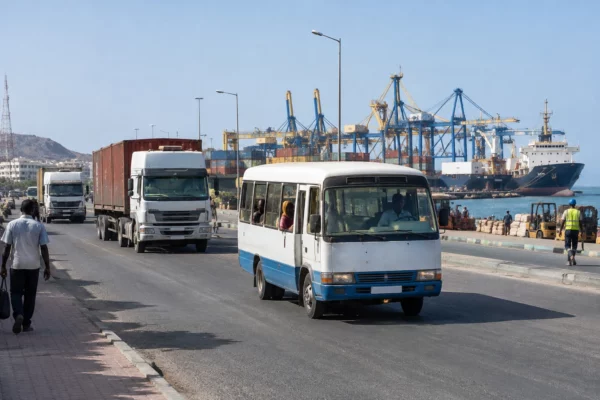
Djibouti connects networks across Africa, Europe and Asia. Eight submarine cables are operational there, according to a diagnostic published in September 2026 by the World Bank Group. But transit infrastructure alone is not enough to create a local digital sector: hosting, data storage and processing capacity are also needed.
This ambition also concerns neighbouring countries. Djibouti is a member of the Intergovernmental Authority on Development (IGAD), a regional organisation in the Horn of Africa. Nearby hosting capacity can serve businesses and public administrations in the region, provided that costs, reliability and access rules are competitive.
The need appears immediate. The diagnostic estimates that Djibouti’s two main facilities are nearing full capacity. It also identifies potential investment of $160 million to $240 million in the sector over five years, associated with 700 to 1,300 direct, indirect and induced jobs. These are estimates linked to possible reforms, not investments already committed.
Political discussions, not yet an announced project
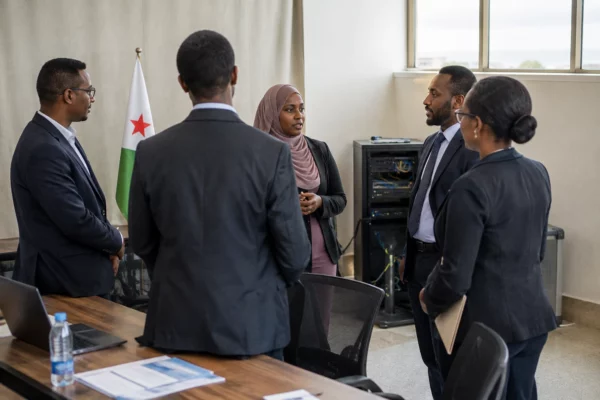
On 13 November 2026, in Doha, Djibouti’s Minister for Communication, responsible for posts and telecommunications, Mohamed Abdoulkader Moussa Helem, met his Qatari counterpart, Mohammed bin Ali bin Mohammed Al Mannai. The discussion took place on the sidelines of the International Telecommunication Union’s Plenipotentiary Conference. The two officials discussed the development of data centres and capacity-building, the Djibouti Information Agency reports.
No partnership terms, funding or construction timetable were made public in the report. The meeting therefore opens a diplomatic avenue; it does not confirm a project. For Djibouti, the challenge will be to specify what it is seeking: investment, operational expertise, cloud services for public administrations or technician training.
Qatar could contribute several types of expertise. In 2025, Syntys, the digital infrastructure subsidiary of the Ooredoo group, operated 13 data centres in Qatar, Kuwait and Tunisia, with installed capacity of about 25 megawatts. Ooredoo has announced an investment programme worth $1 billion and a medium-term target of 120 megawatts. These figures come from the company’s annual report: they describe its operations, but do not indicate a commitment in Djibouti.
The emirate also has financing capacity. In September 2025, the Qatari sovereign wealth fund QIA and asset manager Blue Owl reached an agreement to launch a digital infrastructure platform, announcing more than $3 billion in initial assets. Here, too, nothing in the published agreement links the platform to a project in Djibouti. It illustrates potential financial capacity, without implying an investment decision.
Local conditions will matter as much as capital
A data centre is more than a building full of servers. It must operate without interruption, have a stable electricity supply and be connected to networks at sustainable prices. Yet the World Bank diagnostic identifies licensing procedures in Djibouti that are difficult to interpret, an operating framework that needs clarification and limited flexibility in securing electricity supplies.
Market access is just as central. Djibouti Telecom remains dominant in the provision of wholesale internet capacity, and access to cable landing stations remains restricted. According to the diagnostic, capacity prices are at least twice as high as in Mombasa, Kenya. In these circumstances, building new facilities does not, by itself, guarantee cheaper or more accessible digital services.
The World Bank recommends implementing regulations for the Digital Code adopted in 2025, particularly on licensing, interconnection and cable access. It also recommends making it easier for centres to source electricity directly from private renewable power producers. These measures could determine whether announced projects become bankable and whether several operators can genuinely enter the market.
Any benefits would not automatically be shared among all stakeholders. Public administrations and large businesses could gain local data storage capacity. Djiboutian digital service providers, meanwhile, would need affordable access to infrastructure to develop their services. The jobs announced would also depend on the training available and the share of operations entrusted to local teams.
What happens next will depend on rules and delivery
For IGAD and the Horn of Africa, the stakes extend beyond bilateral relations with Qatar: additional hosting capacity could support regional digital exchanges, but infrastructure concentration and prices could also limit the benefits. Djibouti will therefore have to balance foreign investment, open access and control over its digital priorities.
The next indicators will be tangible: publication of regulations implementing the Digital Code, changes to cable access, secure electricity supplies and the actual launch of local projects. The Doha meeting is a signal of cooperation. Turning that signal into useful capacity will now depend on regulatory decisions and verifiable commitments.