Algeria
 Egypt
 Libya
 Morocco
 Sudan
 Tunisia
 Benin
 Burkina Faso
 Cabo Verde
 Côte d'Ivoire
 Ghana
 Guinea
 Guinea-Bissau
 Liberia
 Mali
 Mauritania
 Niger
 Nigeria
 Senegal
 Sierra Leone
 The Gambia
 Togo
 Cameroon
 Central African Republic
 Chad
 DR Congo
 Equatorial Guinea
 Gabon
 Republic of the Congo
 São Tomé and Príncipe
 Burundi
 Comoros
 Eritrea
 Ethiopia
 Kenya
 Madagascar
 Malawi
 Mauritius
 Mozambique
 Rwanda
 Seychelles
 Somalia
 South Sudan
 Tanzania
 Uganda
 Angola
 Botswana
 Eswatini
 Lesotho
 Namibia
 South Africa
 Zambia
 Zimbabwe
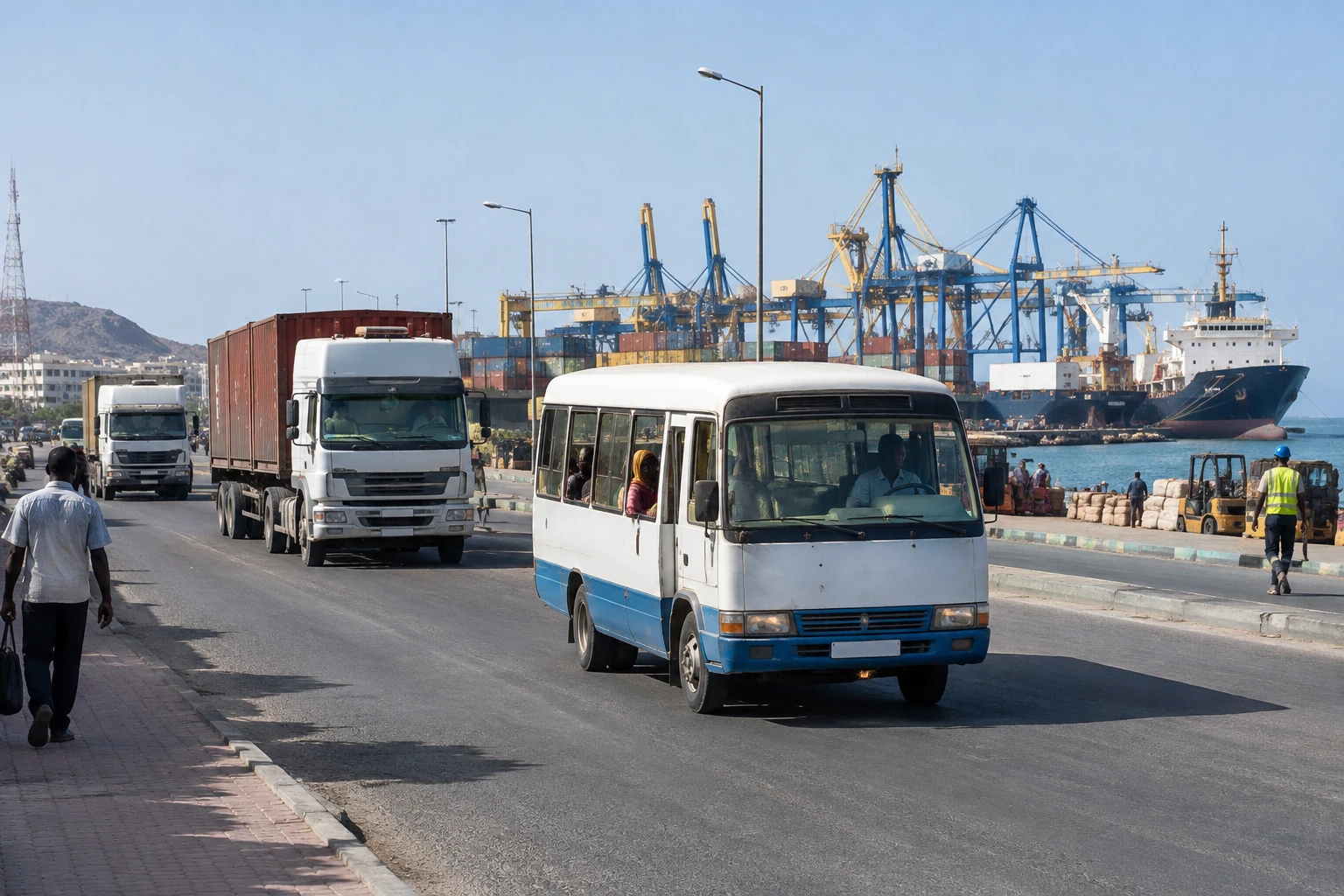
In Djibouti, the security of a maritime route is also measured on land: in port activity, transit to Ethiopia and the cost of imported goods. That is why tensions in the Red Sea directly affect Djiboutians, far beyond the ships passing through the Bab el-Mandeb Strait.
A vital corridor for Djibouti and Ethiopia
Located at the southern entrance to the Red Sea, Djibouti links the Indian Ocean to the Suez Canal and the trade routes between Asia, Europe and the Middle East. Its port and logistics services also play an essential role for neighbouring landlocked Ethiopia. The railway linking Djibouti to Addis Ababa, which began commercial operations in 2018, completes this land and sea corridor. The Djibouti Ports and Free Zones Authority says it connects the port terminals to the Ethiopian capital.
This position brings Djibouti revenue and an important diplomatic role. It also exposes its economy to disruption in shipping. When shipowners avoid the Red Sea and the Suez Canal, they may reroute their vessels around the Cape of Good Hope. Journeys become longer, costs rise and the flows supplying ports and regional supply chains can shift. Disruptions therefore have different effects: port operators feel the impact on their business, while companies and households may face the consequences of delays or higher costs.
The regional context is already tense. Attacks on ships and clashes in Yemen have undermined shipping in the Red Sea in recent years. The UN says global maritime trade remains under pressure, while diversions have disrupted routes and schedules. The United Nations Conference on Trade and Development noted, in particular, that traffic through the Suez Canal was still far below its 2023 level in May 2025.
A diplomatic communiqué, not a military announcement
In Beijing on 21 October 2026, Chinese Foreign Minister Wang Yi met his Djiboutian counterpart, Abdoulkader Houssein Omar. The two officials issued a joint communiqué on stability in the Horn of Africa and the security of maritime routes in the Red Sea and the Gulf of Aden. The text calls for freedom of navigation to be upheld and for the right of merchant ships to sail in accordance with international law to be respected. Chinese diplomacy presented the discussions the following day. The Chinese foreign ministry’s press conference transcript also refers to economic risks and threats from piracy and terrorism.
The two governments say they do not want tensions in the Middle East to spread further into the Horn of Africa. They favour dialogue and diplomacy. The communiqué also states that the region must not become a theatre for geopolitical rivalry. Its significance is notable, but its statements amount neither to a detailed maritime security plan nor to an announcement of an additional naval deployment.
This caution reflects a relationship in which interests are both economic and strategic. China has built infrastructure and opened its first overseas military base in Djibouti in 2017. Several other powers also have military facilities there. The presence of these actors underscores the importance of the area, but does not mean their objectives are identical. For Beijing and Djibouti alike, protecting commercial shipping matters; for Djibouti, preserving the stability of its corridor with Ethiopia is also a national economic concern.
Somaliland: sovereignty at the heart of the balance
The communiqué also addresses the status of Somaliland, a territory that declared independence from Somalia in 1991 but has not received widespread international recognition. China and Djibouti reaffirm their support for Somalia’s sovereignty and territorial integrity, and oppose recognition of Somaliland as an independent state. This reflects a diplomatic position on borders and sovereignty in a region where questions of port access and foreign presence weigh on relations between neighbours.
The issue goes beyond relations between Beijing and Djibouti. Somalia, Ethiopia and other countries in the Horn are concerned by the security of trade and regional balances. Djibouti is a member of the Intergovernmental Authority on Development, or IGAD, a co-operation organisation for countries in the Horn of Africa and East Africa. IGAD provides a regional forum where issues of security, co-operation and sovereignty can be discussed, even though the Sino-Djiboutian communiqué is a bilateral initiative.
The practical effects remain to be seen
For the Djiboutian authorities, the challenge is to defend freedom of movement without turning the country into a theatre of confrontation between powers. For carriers and businesses, the priority is predictability of routes. For residents, the effects may be less visible, but are felt through prices, product availability and activity linked to ports and transit.
The communiqué therefore sets out a diplomatic position without guaranteeing a rapid improvement in security in the Red Sea. What happens next will depend on the course of regional conflicts, the decisions of shipping companies and the ability of littoral states to co-ordinate their responses. For Djibouti, stability in the Bab el-Mandeb is not merely a geopolitical question: it affects the day-to-day functioning of its economy and its ties with Ethiopia.