Algeria
 Egypt
 Libya
 Morocco
 Sudan
 Tunisia
 Benin
 Burkina Faso
 Cabo Verde
 Côte d'Ivoire
 Ghana
 Guinea
 Guinea-Bissau
 Liberia
 Mali
 Mauritania
 Niger
 Nigeria
 Senegal
 Sierra Leone
 The Gambia
 Togo
 Cameroon
 Central African Republic
 Chad
 DR Congo
 Equatorial Guinea
 Gabon
 Republic of the Congo
 São Tomé and Príncipe
 Burundi
 Comoros
 Djibouti
 Eritrea
 Ethiopia
 Madagascar
 Malawi
 Mauritius
 Mozambique
 Rwanda
 Seychelles
 Somalia
 South Sudan
 Tanzania
 Uganda
 Angola
 Botswana
 Eswatini
 Lesotho
 Namibia
 South Africa
 Zambia
 Zimbabwe
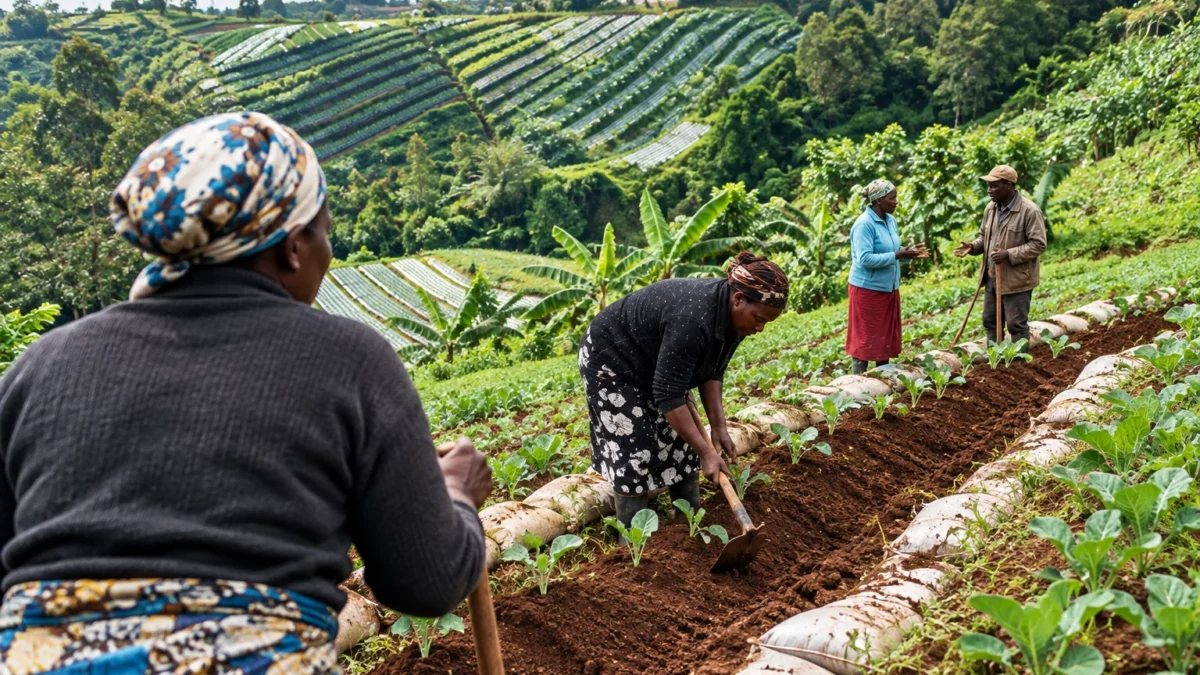
For Kenyan farmers, rain threatens more than just a harvest. In a matter of hours, it can wash away the fertile soil that supports crops for years. In the central highlands, farmers are already reinforcing their plots as forecasts point to above-average rainfall in many areas.
Plots weakened by the 2024 rains
In Limuru, in Kiambu County, Elizabeth Itotia farms two hectares of sloping land. During the heavy rains of 2024, some of the topsoil — the uppermost layer of soil, richest in organic matter — was washed away. Cabbages, spinach and potatoes were affected. The losses were estimated at around 200,000 Kenyan shillings, or nearly $1,500, according to reports on her case.
She now digs trenches and places sand-filled bags in them to slow the flow of water. Bamboo and Napier grass, whose roots help hold the soil in place, complement these measures. They do not eliminate the risk, but can slow runoff before it erodes the fields.
In Karatina, in Nyeri County, coffee farmer Moses Muhoro is also trying to retain the soil. The 2024 floods exposed a less fertile layer on his farm. His coffee output is said to have subsequently fallen to about 30% of the previous year’s yield, according to an account of his experience.
These measures are confined to individual farms. Their effectiveness also depends on maintaining ditches, the condition of neighbouring slopes and how water is drained beyond a plot. They nevertheless represent a practical adaptation: preserving soil fertility rather than relying solely on repairs after damage has been done.
A real risk, but uneven rainfall
Kenya generally has two rainy seasons: the “long rains”, from March to May, and the “short rains”, from October to December. The El Niño phenomenon refers to periodic warming of surface waters in the equatorial Pacific. It can alter rainfall patterns in East Africa, but does not on its own determine the weather in every region.
The Kenya Meteorological Department forecasts above-average rainfall in many counties in November 2026 and over the November-to-January period. Kiambu and Nyeri are among the areas concerned. The official bulletin also advises monitoring conditions as the season unfolds: a seasonal forecast indicates a trend, not the location or day of every intense rainfall event. The Kenyan weather bulletin for November 2026 highlights the geographical distribution of expected rainfall.
At regional level, the IGAD Climate Prediction and Applications Centre, the East African intergovernmental authority, has also flagged an increased risk of above-average rainfall in several countries in the region for October to December 2026. Conditions nevertheless vary from one area to another. Seasonal forecasts should therefore be supplemented with local, up-to-date bulletins. The regional crop monitoring and early warning report highlights this range of risks.
From soil to food security
The stakes go beyond losses on a single farm. Maize, a staple food in Kenya, is planted during the long rains and harvested around the start of the short rains. If showers persist, drying the cobs can become more difficult. Poorly managed moisture encourages mould growth, which can produce aflatoxins — toxic substances that may contaminate food.
The effects would not be the same for everyone. A small farm that loses its fertile soil may see its income and food reserves dwindle. Coffee producers, meanwhile, also depend on the quality and volume of a crop grown for sale. Further along the supply chain, traders, processors and households may feel the consequences of a damaged harvest or disrupted supplies. Informal networks, which play an important role in local food trade, often have fewer resources to absorb a shock.
Agricultural preparedness therefore also depends on public services. Weather information must reach farmers in accessible formats and languages. Extension services can help them choose practices suited to their soils, while county authorities have a role in drainage and managing exposed areas. Without coordination beyond individual plots, measures taken by farmers risk shifting water elsewhere rather than reducing damage across the catchment.
Preparation to monitor across East Africa
The Kenyan government has urged preparations for the 2026 rainy season and coordination between national and county administrations, according to the public Kenya News Agency. For Nairobi, Kenya’s capital, as well as the central agricultural areas, the challenge is to turn a forecast into practical decisions: maintaining drains, issuing local alerts and protecting livelihoods. Kenyan authorities are emphasising advance preparation.
The 2024 precedent is a reminder that intense rains can strike after a period of drought and complicate recovery for households and farms alike. It does not justify presenting every El Niño event as a certain disaster. Rather, it underscores the importance of monitoring alerts, protecting soils and keeping roads and drainage infrastructure in good condition.
For neighbouring countries, whose farming systems and river basins are sometimes connected, coordinating weather data and preventive measures matters as much as the national response. In Kenya, the next bulletins from the Meteorological Department, their distribution across the counties and actual rainfall patterns will show whether the precautions taken on farms match the conditions observed.