Algeria
 Egypt
 Libya
 Morocco
 Sudan
 Tunisia
 Benin
 Burkina Faso
 Cabo Verde
 Côte d'Ivoire
 Ghana
 Guinea
 Guinea-Bissau
 Liberia
 Mali
 Mauritania
 Niger
 Nigeria
 Senegal
 Sierra Leone
 The Gambia
 Togo
 Cameroon
 Central African Republic
 Chad
 DR Congo
 Equatorial Guinea
 Republic of the Congo
 São Tomé and Príncipe
 Burundi
 Comoros
 Djibouti
 Eritrea
 Ethiopia
 Kenya
 Madagascar
 Malawi
 Mauritius
 Mozambique
 Rwanda
 Seychelles
 Somalia
 South Sudan
 Tanzania
 Uganda
 Angola
 Botswana
 Eswatini
 Lesotho
 Namibia
 South Africa
 Zambia
 Zimbabwe
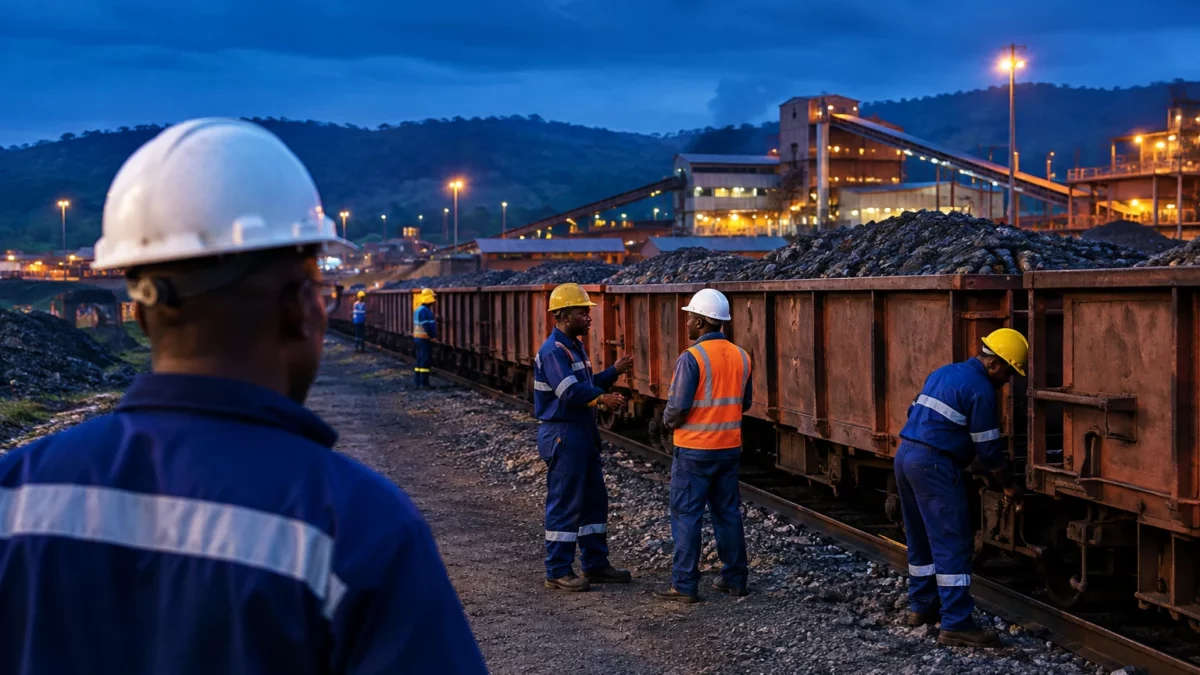
In Gabon, the financial strength of a mining group is also measured by the regularity of the trains linking manganese mines to the port of Owendo. Eramet plans to raise nearly €500 million to ease its debt burden. The operation therefore has an indirect bearing on its Gabon operations, even though none of the funds announced is earmarked for them directly.
A mining company at the heart of Gabon’s priorities
In Moanda, in Haut-Ogooué, subsidiary Comilog operates one of the country’s main manganese deposits. The transport of ore depends largely on the Transgabonais railway, operated by Setrag, another group subsidiary. The mine, railway and port facilities thus form a chain whose capacity affects export volumes and local economic activity.
This dependence gives Eramet’s projects in Gabon particular significance. The group plans to invest around €100 million in 2027 to modernise its logistics in Gabon. According to the outlook published by the company, the funding is intended to support ore transport and infrastructure improvements. The livelihoods of employees and communities concerned also depend on the continuity of this chain, while mining revenues play an important role in the national economy.
Libreville is also pressing for more manganese to be processed locally, rather than limiting activity to mining and exporting the ore. A protocol agreed in July 2026 between the Gabonese authorities and Eramet provides for the study of industrial scenarios. Their implementation, however, remains contingent on profitability and access to competitively priced energy. The debate is therefore about investment as much as the share of value, jobs and expertise that could remain in Gabon.
Capital increase to reduce debt
On 13 November 2026, Eramet announced the launch of a capital increase of around €500 million. A capital increase involves issuing new shares to provide a company with equity. In this case, the group plans to use all the funds raised to reduce its debt and strengthen its balance sheet.
The new shares are being offered at €14.49. Existing shareholders have preferential subscription rights, allowing them to take part in the operation and preserve their stake in the company. The French state, already a shareholder through the Agence des participations de l’État, has committed to subscribe for around €322 million, or nearly 64% of the amount sought.
This support is expected to increase the state’s stake and make it Eramet’s largest shareholder, ahead of the Duval family’s Sorame-CEIR holding company. It reflects France’s desire to retain influence over a group active in mineral extraction and processing. For producer countries, however, this strategic priority also raises questions about the sharing of decisions and the benefits generated by resources extracted on their territory.
The group reported net debt of close to €1.9 billion at the end of June 2026. Net debt is borrowings minus available cash. Reducing it should improve financial ratios and help Eramet meet its commitments to its banks. The subscription period is scheduled to run from 18 to 27 November. The group expects to announce the results on 2 December, followed by settlement and delivery of the new shares on 4 December.
Indirect effects on African operations
The fundraising is not a dedicated allocation for Comilog, the Transgabonais railway or processing projects in Gabon. Its potential effect is broader: a less strained balance sheet could give the group more room to maintain operations and finance investments already planned. Conversely, the recapitalisation alone does not guarantee that the announced projects will go ahead. Their timing will also depend on costs, industrial performance and energy conditions.
The Senegalese case illustrates the constraints the group faces on the continent. Eramet Grande Côte, which mines mineral sands, was affected by a fire on 22 February 2026 at a processing facility. After a partial restart, the company is targeting a return to full capacity in the first quarter of 2027. It then expects annual production of around 900,000 tonnes of mineral sands concentrate. This recovery remains a target announced by the group, not a result already achieved.
In Senegal as in Gabon, financial decisions taken at the headquarters of an international group can therefore affect local industrial schedules. The effects are not the same for everyone: the company is seeking to preserve its capacity to invest, while governments expect revenues, jobs and more local processing. Workers and businesses that depend on the mine, railway or processing sites are directly exposed to disruptions and changes in operating pace.
A negotiating issue for Central Africa
Gabon is placing these discussions within the framework of CEMAC, the Economic and Monetary Community of Central Africa, which brings together six countries in the sub-region. CEMAC is not a decision-maker in Eramet’s capital increase. It does, however, provide a regional forum in which issues such as infrastructure, the movement of goods and the processing of resources extend beyond national borders.
For Libreville, the challenge is to align the continuity of mining investment with goals for diversification and local value creation. The manganese protocol opens the way to studies, not yet to a plant or a funding guarantee. The next steps to watch are therefore the delivery of the logistics investments planned for 2027, progress on the industrial studies and decisions taken after Eramet’s subscription period closes.
At the continental level, the operation highlights a central tension in the mining sector: capital and decision-making can be concentrated far from the countries where resources are found, while the industrial consequences play out locally. The recapitalisation could stabilise an operator that is important to Gabonese manganese. For Gabonese people, the decisive question will be whether that stability also supports verifiable commitments on transport, processing and economic activity in Gabon.