Algeria
 Egypt
 Libya
 Morocco
 Sudan
 Tunisia
 Benin
 Burkina Faso
 Cabo Verde
 Côte d'Ivoire
 Ghana
 Guinea
 Guinea-Bissau
 Liberia
 Mali
 Mauritania
 Niger
 Nigeria
 Senegal
 Sierra Leone
 The Gambia
 Togo
 Central African Republic
 Chad
 DR Congo
 Equatorial Guinea
 Gabon
 Republic of the Congo
 São Tomé and Príncipe
 Burundi
 Comoros
 Djibouti
 Eritrea
 Ethiopia
 Kenya
 Madagascar
 Malawi
 Mauritius
 Mozambique
 Rwanda
 Seychelles
 Somalia
 South Sudan
 Tanzania
 Uganda
 Angola
 Botswana
 Eswatini
 Lesotho
 Namibia
 South Africa
 Zambia
 Zimbabwe
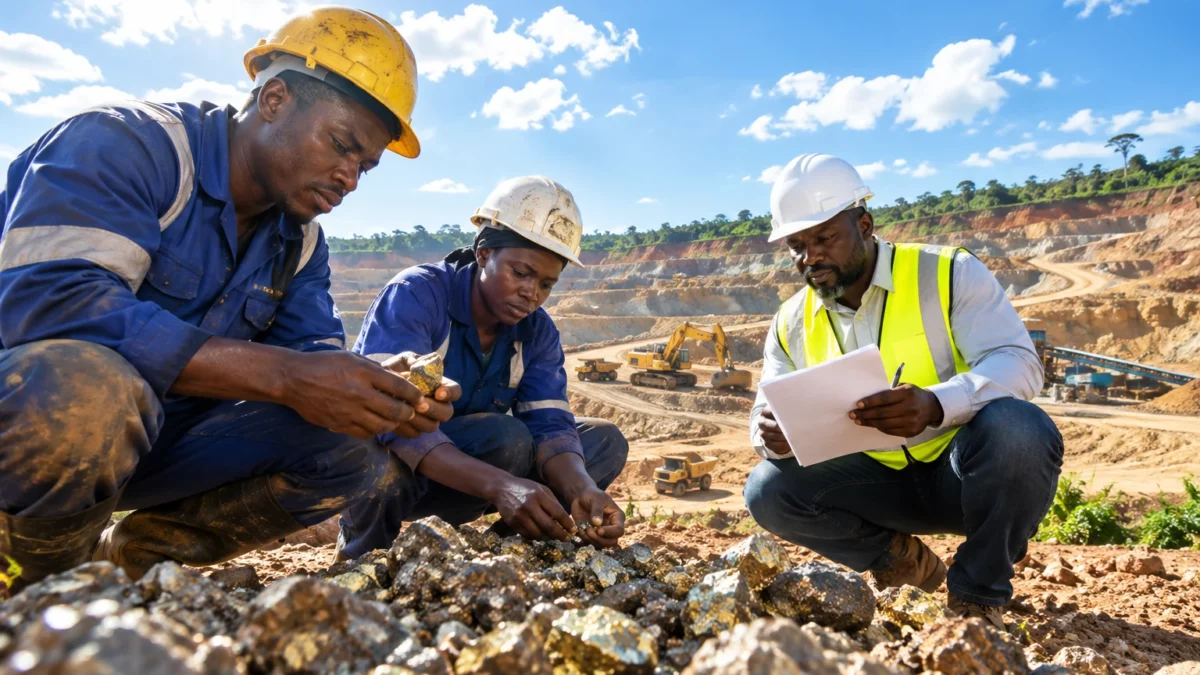
The minerals that power batteries, digital networks and some defence industries can also finance opaque networks. For Central African countries, the challenge is therefore not simply to extract more: it is to know who controls revenues, infrastructure and the processing of resources.
A report by the Global Initiative Against Transnational Organized Crime (GI-TOC) on these supply chains is due to be presented on Monday 16 November in Douala, Cameroon. The information made public refers to networks linked to state officials as well as international rivalries. These specific allegations nevertheless need to be examined against the full report and independent sources: they cannot be treated here as established facts.
Resources at the heart of several economies
Central Africa is not a uniform mining region. The Democratic Republic of the Congo (DRC), whose capital is Kinshasa, dominates global cobalt production and is one of the leading copper producers. Chad, Cameroon and other countries in the region have different resources and mining projects, governed by distinct national frameworks.
At the regional level, the Central African Economic and Monetary Community (CEMAC) includes Cameroon, Chad, Gabon, Equatorial Guinea, the Central African Republic and the Republic of the Congo, whose capital is Brazzaville. The DRC is not a member. This distinction matters: mining rules, institutions and trading networks do not overlap from one country to another.
Global demand is increasing interest in these resources. Copper and cobalt are used in batteries and electrical equipment; other minerals are used in industrial and digital applications. But having deposits does not guarantee control over prices or a large share of the value created. A recent OECD analysis notes that African exports of critical minerals remain largely unprocessed or semi-processed.
Revenue oversight, a domestic challenge
Information released about the GI-TOC report cites the case of antimony in Chad. Its co-author, Zobel Behalal, says the study identifies discrepancies between figures attributed to the National Institute of Statistics and those of the government on production, as well as alleged links between politically exposed persons and military actors.
In the absence of the full document and independent confirmation of these details, they must remain attributed to their author. A statistical discrepancy alone does not prove embezzlement. It nevertheless raises a practical question: do public authorities have reliable data on permits, extracted volumes, exports and tax revenues?
The answer matters for public budgets as much as for mining areas. Better traceability can help the state collect the revenues due and curb clandestine outflows. It does not, by itself, guarantee that revenues will fund public services or benefit communities near mining sites. For artisanal workers and small local businesses, poorly designed controls can also make it harder to access the formal market.
Lobito, infrastructure and a balance of power
The Lobito Corridor illustrates another dimension of the issue. This logistics link connects Angola’s port of Lobito to copper- and cobalt-producing areas in the DRC and Zambia. The United States, the European Union, African financial institutions and other partners support its development. The project meets transport needs, but it is also part of the competition to secure supplies.
The corridor does not directly involve Cameroon. It could, however, influence trade routes and investment in Central and Southern Africa. For producer countries, a faster link to a port could cut some costs. But the impact on local economies will also depend on the jobs created, procurement from local companies, access to the railway and the transparency of contracts.
The material provided also attributes to the GI-TOC the claim that services linked to Russia carried out operations to discredit the project. This sensitive allegation has not been corroborated by a second independent source in the material reviewed. It therefore cannot be presented as an established fact. It nevertheless serves as a reminder that mining infrastructure has become a focus of rivalry, in which public narratives can accompany economic interests.
Turning extraction into industrial capacity
For Cameroon, a CEMAC country whose capital is Yaoundé, the debate also concerns how to strengthen the institutions, skills and infrastructure needed by the extractive sector. The challenge goes beyond tackling crime. It includes the quality of statistics, oversight of concessions, tax collection and the ability to process more raw materials on the continent.
Across Africa, the African Continental Free Trade Area (AfCFTA), which aims to facilitate trade between African countries, offers a possible framework for building regional value chains. Compatible rules, connected infrastructure and co-operation against illicit flows could support this ambition. Without co-ordination, each country risks negotiating alone with major buyers and groups able to shift their investments.
The significance of the announcement will now depend on the full report: its data, methodology and the evidence that would allow the cases cited to be verified. Central African governments face a twofold challenge: to curb embezzlement and opaque networks while negotiating partnerships that leave more revenue, expertise and industrial activity in the region. Underground wealth becomes an economic lever only when the rules and benefits are also visible above ground.