Algeria
 Egypt
 Libya
 Morocco
 Sudan
 Tunisia
 Benin
 Burkina Faso
 Cabo Verde
 Côte d'Ivoire
 Ghana
 Guinea
 Guinea-Bissau
 Liberia
 Mali
 Mauritania
 Niger
 Nigeria
 Senegal
 Sierra Leone
 The Gambia
 Togo
 Cameroon
 Central African Republic
 Chad
 DR Congo
 Equatorial Guinea
 Gabon
 Republic of the Congo
 São Tomé and Príncipe
 Burundi
 Comoros
 Djibouti
 Eritrea
 Ethiopia
 Kenya
 Madagascar
 Malawi
 Mauritius
 Mozambique
 Rwanda
 Seychelles
 Somalia
 South Sudan
 Tanzania
 Uganda
 Angola
 Botswana
 Eswatini
 Lesotho
 Namibia
 South Africa
 Zambia
 Zimbabwe
A site inscribed on the World Heritage List gains visibility. But recognition does not automatically protect either places or the communities that bring them to life. For African countries, the challenge is therefore to raise the profile of their heritage while retaining control over its documentation, conservation and promotion.
An imbalance African states are seeking to address
The Africa region accounts for about 9% of properties on UNESCO’s World Heritage List, according to the World Heritage Centre. This under-representation contrasts with the continent’s diversity of cultural and natural heritage. It affects both states that have no inscribed properties and those that need to strengthen the management of sites already recognised.
Inscription is not a simple administrative request. A state must first draw up an inventory of the properties it wishes to put forward, then demonstrate their “outstanding universal value” and present a credible conservation plan. This work requires specialist teams, funding and sustained co-ordination between government departments, researchers and local communities.
The issue is already on the continental agenda. UNESCO’s Regional Action Plan for Africa covers the period 2021-2027. It notably aims to strengthen the skills and institutions of African heritage professionals and enhance their role. The African World Heritage Fund, based in South Africa, also contributes to training and the preparation of nominations.
Chinese funding and training in Quanzhou
The new programme is backed by a $1m contribution from the municipality of Quanzhou, in China’s Fujian province. UNESCO and the city signed the funding agreement on 11 March 2025. Set to run for three years, the initiative combines training, mentoring and support for nomination dossiers.
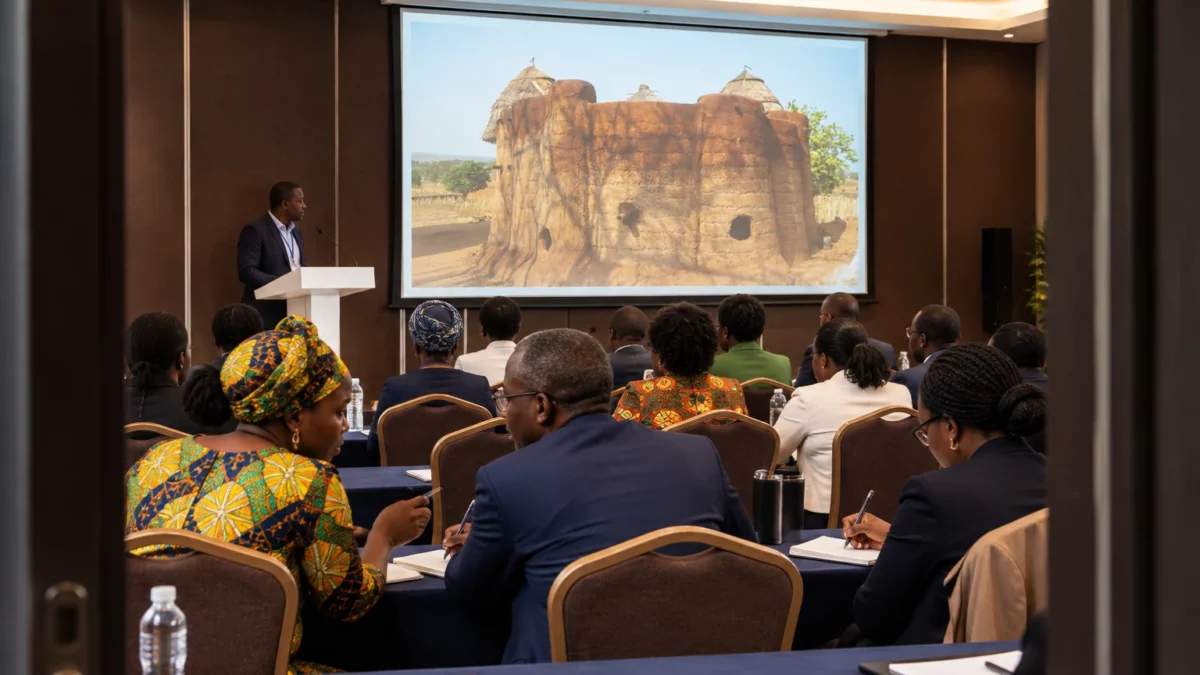
From 20 to 25 October 2026, Quanzhou hosted 26 heritage professionals from 17 African countries. Organised by the World Heritage Centre, the Fujian authorities and the municipality, the workshop covered nominations, conservation, monitoring and site management. The programme is aimed both at teams preparing dossiers and at those responsible for protecting properties after inscription.
Co-operation did not begin with this funding. According to the World Heritage Centre, Chinese funding has supported activities in more than 15 African countries. It has contributed, among other things, to preparing the transboundary extension of Koutammakou, the Land of the Batammariba, shared by Togo and Benin and inscribed on the List in 2023.
That same year, Rwanda secured the inscription of Nyungwe National Park and four memorial sites to the genocide against the Tutsi: Nyamata, Murambi, Gisozi and Bisesero. These inscriptions are decisions made by the World Heritage Committee. Chinese support for preparing nominations does not, however, mean that Beijing decides on inscription: that responsibility lies with the Committee, following expert assessment and examination of the dossiers.
Recognition does not replace on-the-ground management
For national administrations, a nomination can help to organise inventories, train specialists and attract funding. For the cities and regions concerned, the label can raise visibility and support tourism. But the benefits are neither immediate nor guaranteed. They depend on infrastructure, management choices and the role given to residents in decision-making.
Conservation also raises practical questions: who maintains the site, who supervises visitors and who benefits from the income generated? A plan drawn up without local communities risks restricting their access or activities. Their participation, by contrast, can bring in knowledge and practices essential to the long-term protection of places.
Inscription is not an end in itself. UNESCO says that several African properties are on its List of World Heritage in Danger. International recognition must therefore be accompanied by recurring resources, monitoring arrangements and policies capable of responding to the pressures specific to each site. Training on how to prepare dossiers cannot, on its own, meet these needs.
A useful partnership, with influence at stake
For China, the programme extends cultural co-operation with UNESCO that began in 2014. It gives Quanzhou, itself inscribed on the World Heritage List in 2021, an opportunity to share its experience and expand exchanges with African institutions. Like any international funding, it is also part of a relationship involving influence. This merits scrutiny without reducing the partnership to a political operation or presenting aid as inherently altruistic.
African states are not mere beneficiaries. They choose the properties put forward, provide the dossiers and remain responsible for their management. The challenge is to mobilise external expertise and resources without depending on a single partner, while strengthening national institutions and African networks of specialists.
Progress will be measured less by the number of training sessions than by their effects: robust dossiers, better-equipped local teams and sites that are effectively protected. At the continental level, the challenge is also to secure recognition for heritage often absent from global narratives, without separating its promotion from the priorities and rights of the populations concerned.