Algeria
 Egypt
 Libya
 Morocco
 Sudan
 Tunisia
 Benin
 Burkina Faso
 Cabo Verde
 Côte d'Ivoire
 Ghana
 Guinea
 Guinea-Bissau
 Liberia
 Mali
 Mauritania
 Niger
 Nigeria
 Senegal
 Sierra Leone
 The Gambia
 Togo
 Cameroon
 Central African Republic
 Chad
 DR Congo
 Equatorial Guinea
 Gabon
 Republic of the Congo
 São Tomé and Príncipe
 Burundi
 Comoros
 Djibouti
 Eritrea
 Kenya
 Madagascar
 Malawi
 Mauritius
 Mozambique
 Rwanda
 Seychelles
 Somalia
 South Sudan
 Tanzania
 Uganda
 Angola
 Botswana
 Eswatini
 Lesotho
 Namibia
 South Africa
 Zambia
 Zimbabwe
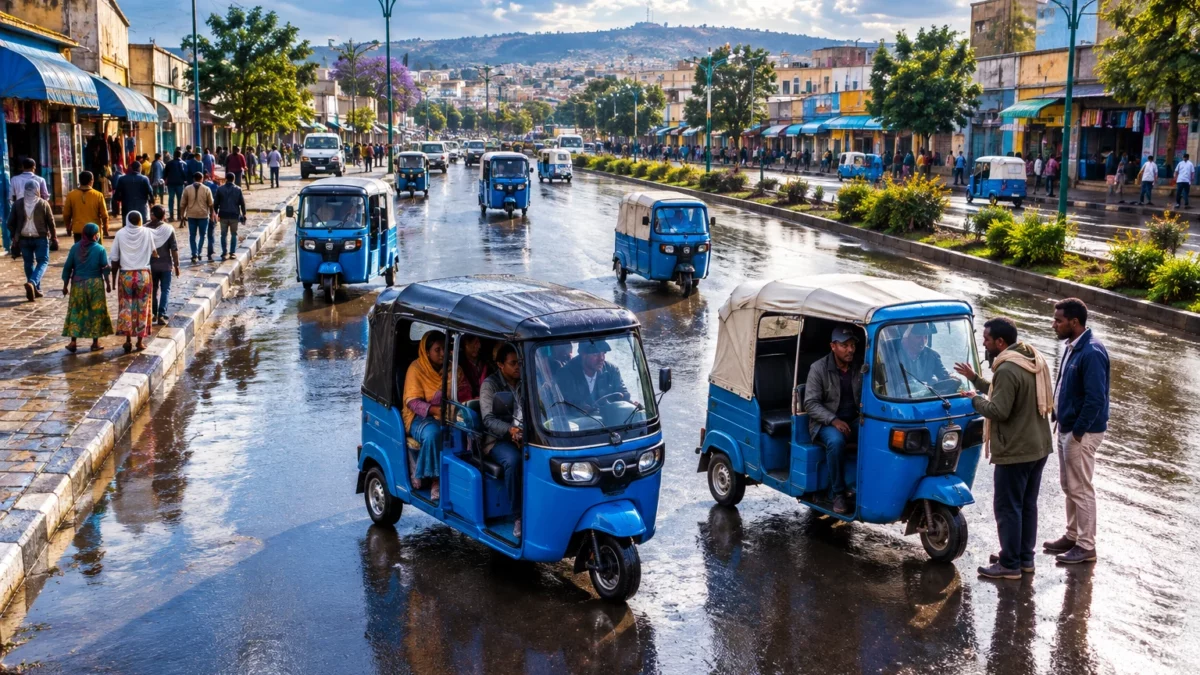
In Mekele, the shift to electric tuk-tuks is about more than a technological choice. When petrol is scarce or sold at high prices, it reshapes travel and drivers’ earnings. But the vehicle that shields its owners from the fuel pump remains beyond the reach of many workers.
In Tigray, a shortage that extends beyond Mekele’s streets
The Tigray region, in northern Ethiopia, is still dealing with the consequences of the 2020–2022 war. The cessation of hostilities agreement signed in Pretoria in November 2022 ended the main fighting between the federal government and the Tigray People’s Liberation Front (TPLF). It did not resolve all political tensions or the challenges of reconstruction.
Supply restrictions and fuel shortages have repeatedly hampered transport and humanitarian operations in the north of the country. In March 2025, Ethiopian media outlet The Reporter Ethiopia reported that Tigrayan officials were denouncing a drop in federal deliveries. The federal government has disputed similar accusations, according to an account published by the same outlet in 2026. The causes and responsibility therefore cannot be presented as independently established.
The context has a regional dimension. Ethiopia is a member of the Intergovernmental Authority on Development (IGAD), an organisation in the Horn of Africa, and hosts the African Union headquarters in Addis Ababa. Stability in Tigray thus affects relations between federal and regional authorities, as well as transport and aid routes in a region marked by border tensions and population displacement.
Small electric vehicles gain ground
In Mekele, three-wheeled vehicles, known as “bajaj” in Ethiopia, have become a visible response to the difficulty of finding petrol. Some drivers and passengers are turning to electric models, often imported from China. Their quiet motors are changing the feel of the streets, but above all the day-to-day economics of each trip.
In accounts gathered locally, Moges, an 18-year-old driver, estimates that he paid about 600,000 birr for his vehicle, and says some models cost up to one million. He compares this cost with the high price of petrol sold outside regular supply channels. In his experience, a full charge costs him less than buying fuel for his former vehicle. These figures reflect local accounts; they are not an official survey of prices in Mekele.
For drivers, the advantage is immediate when fuel is scarce. An electric vehicle saves them from searching for petrol sold by the litre, sometimes in bottles along the streets. Passengers, meanwhile, can make a trip at the same fare and, according to one driver interviewed, enjoy a more comfortable ride. However, electricity is not always available without interruption.
The transition is also creating a divide among drivers. Ashenafi, who owns a petrol-powered bajaj, says customers are increasingly choosing electric vehicles. He says he sometimes waits without finding a passenger. In his estimation, the resale value of his vehicle remains far below the purchase price of an electric model. He therefore cannot easily switch vehicles, even though petrol is expensive.
An economy tested by batteries and power cuts
The move to electric power does not eliminate constraints; it shifts them. In Mekele, drivers often charge their vehicles at home or in some garages, as there are no dedicated charging stations. A charge can take six to ten hours, depending on the model, and longer when power cuts interrupt the process.
Maintenance poses another challenge. Spare parts and specialist repairers are not always available. Some buyers are unsure how long batteries will last and fear they will be unable to afford replacements. A vehicle can therefore reduce immediate transport costs while exposing its owner to a major expense later on.
Poor roads can also increase battery use. Moges estimates that a charge could cover up to 150 kilometres in good conditions, but less on the roads he uses. This range, like the prices and charging costs reported by drivers, depends on the model and the vehicle’s condition. It should not be taken as a guaranteed performance for all bajaj vehicles.
Nationwide, this local uptake is part of a broader Ethiopian policy to reduce fuel imports and develop electric vehicles. In 2024, Ethiopia banned the import of new petrol or diesel vehicles. The strategy may boost demand for electric vehicles, but it does not replace a reliable charging network or affordable spare parts. The Associated Press has also documented maintenance and supply difficulties faced by electric vehicle users in the country.
A tangible change, but an uneven one
In Mekele, electrification is helping some drivers continue working despite the shortage. However, it does not benefit everyone to the same extent. Drivers with the necessary capital can buy a vehicle and reduce their dependence on petrol. Those who make a living from their petrol-powered bajaj risk losing customers without having the means to keep up.
The question therefore goes beyond the choice of motor. It concerns access to credit, vehicle prices, the quality of the electricity grid and the availability of spare parts. It also affects essential activities: when fuel is scarce, public transport, deliveries and public services can face delays. Available information points to these difficulties but does not make it possible to measure their current scale precisely in every city or district of Tigray.
The contrast is stark between Ethiopia’s national ambition to become a major electric vehicle market and the material reality of a city where power cuts make charging difficult. For the region, the immediate challenge is to keep people and economic activity moving without widening inequalities among workers. What happens next will depend as much on the reliability of fuel supplies as on electricity, infrastructure and repair costs.