Algeria
 Egypt
 Libya
 Morocco
 Sudan
 Tunisia
 Benin
 Burkina Faso
 Cabo Verde
 Côte d'Ivoire
 Ghana
 Guinea
 Guinea-Bissau
 Liberia
 Mali
 Mauritania
 Niger
 Nigeria
 Senegal
 Sierra Leone
 The Gambia
 Togo
 Cameroon
 Central African Republic
 Chad
 DR Congo
 Equatorial Guinea
 Gabon
 Republic of the Congo
 São Tomé and Príncipe
 Burundi
 Comoros
 Djibouti
 Eritrea
 Kenya
 Madagascar
 Malawi
 Mauritius
 Mozambique
 Rwanda
 Seychelles
 Somalia
 South Sudan
 Tanzania
 Uganda
 Angola
 Botswana
 Eswatini
 Lesotho
 Namibia
 South Africa
 Zambia
 Zimbabwe
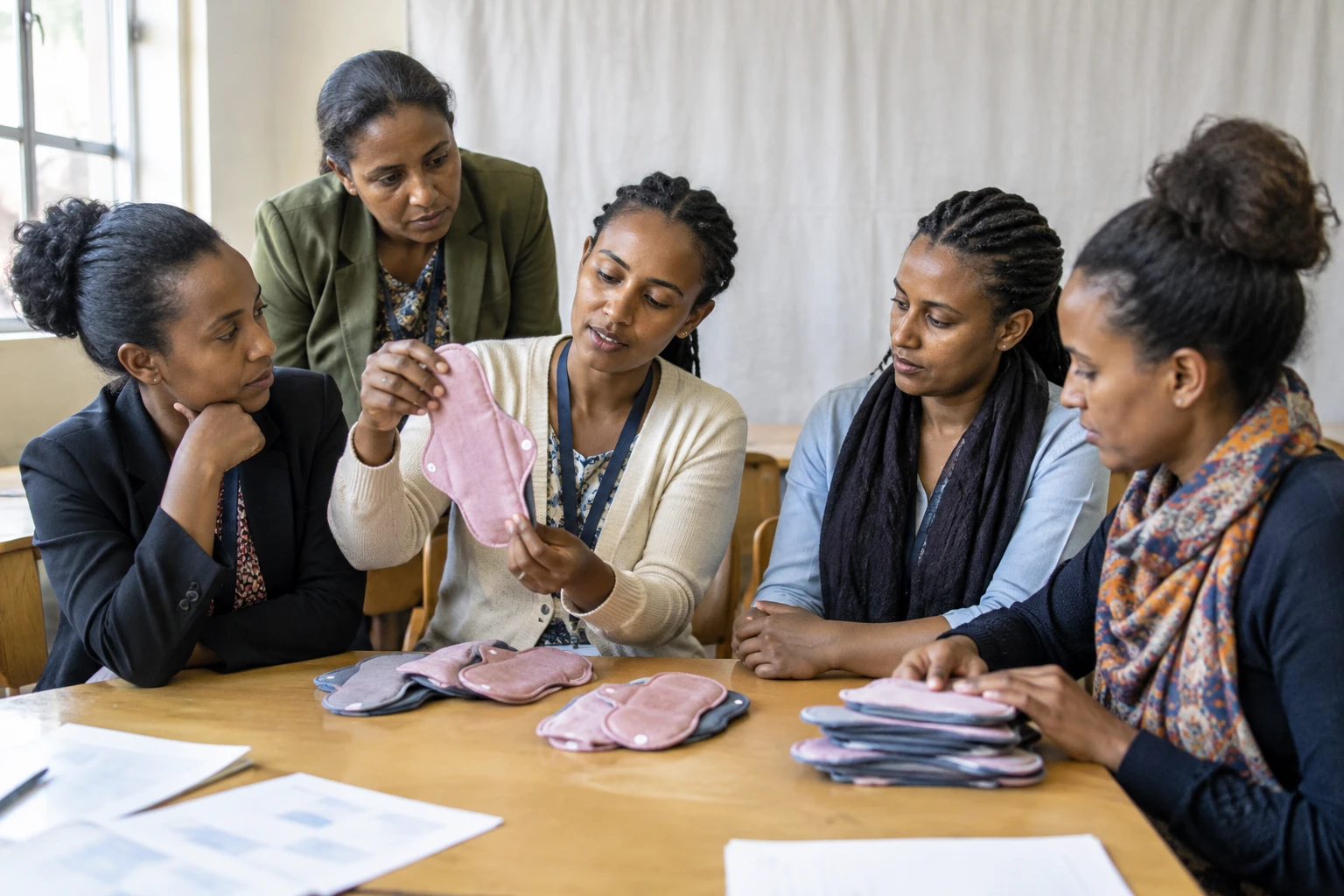
In Addis Ababa, a pad sewn in a workshop can address two very tangible obstacles: the cost of menstrual products and the difficulty of talking about them. But access to a reusable product alone is not enough to ensure that every girl can manage her period in suitable conditions.
A local response to an access challenge
In Ethiopia, menstruation affects health, schooling and participation in work. The cost of disposable products can weigh on family budgets. At the same time, a lack of information and feelings of shame sometimes prevent adolescent girls from asking for help or discussing their needs.
A survey published in 2017 by UNICEF Ethiopia, conducted with Ethiopian research teams, documented knowledge, attitudes and practices related to menstrual hygiene. A Johns Hopkins University study, cited in information available about the initiative, indicated that 28% of Ethiopian respondents had everything they needed during their periods. This figure dates from 2017: it describes a situation measured at the time, not a current estimate.
The issue is also of interest to health, education and manufacturing stakeholders. A programme focused on the menstrual products market in Ethiopia brought together CARE Ethiopia and the Ethiopian Textile and Fashion Institute at Bahir Dar University. Its stated aim was to support research into locally available materials, product manufacturing and awareness-raising. This work is a reminder that access depends on supply, price, information and hygiene conditions alike.
Making and distributing products in Addis Ababa
In the centre of the capital, a dozen workers make washable cotton pads. Hanan Ahmed, a 41-year-old Ethiopian entrepreneur, founded Han’s With Care in 2021. The company says it can produce up to 1,000 reusable pads a day, which can be reused for up to two years, according to information reported about its work.
Distribution relies in part on partners that fund the products and provide them free of charge to pupils or communities. This arrangement makes it possible to reach beneficiaries without asking them to buy the products directly. However, it means access depends on donations, partnerships and their continuity. Manufacturing capacity alone therefore does not indicate how many pads regularly reach those who need them.
The founder’s experience informs her commitment, but does not by itself sum up the experiences of Ethiopian women. As a teenager, Hanan Ahmed sometimes missed a week or two of school because of heavy periods and fear of leaks. Today, she wants to combine the provision of menstrual products with more open discussions about menstruation.
At a school in Addis Ababa, a recent distribution was accompanied by awareness-raising activities. A teacher quoted in the information gathered said pupils no longer missed classes because of their periods. This testimony describes that school and this initiative; on its own, it cannot measure changes in absences across the country as a whole.
The product does not solve everything
A reusable product can reduce the need to buy disposable products regularly. But users must be able to wash it, dry it in a protected place and store it in suitable conditions. Access to water, private toilets and practical information therefore matters just as much as manufacturing.
The initiative also addresses an economic issue. Manufacturing in Addis Ababa creates local activity and employs women. However, production concentrated in the capital does not guarantee equitable distribution across urban neighbourhoods, small towns and rural areas. Partnerships with schools or companies can extend coverage, but their reach needs to be assessed over time.
Social taboos are another obstacle. Hanan Ahmed says that in some rural communities, menstruation can still lead to shame or exclusion. This reality should not be generalised to all Ethiopian communities. Rather, it highlights the importance of information tailored to local contexts and developed with families, teachers and health professionals.
Ethiopian authorities have a complementary role to play alongside businesses and associations: incorporating menstrual hygiene into school and health services, improving access to water and facilities, and monitoring needs beyond one-off projects. The founder says she would like greater public support. The available information does not establish any official partnership with the authorities.
An issue that extends beyond borders
For Ethiopia, an East African country, the issue also arises at the level of the Horn of Africa. IGAD, a regional co-operation organisation, brings together states facing health, education and access-to-services challenges, although national policies and living conditions differ. A local initiative therefore cannot be presented as a model that can automatically be replicated: production chains, infrastructure and social norms vary from one country to another.
The reach of Han’s With Care will be measured less by its production volume alone than by the regularity of distributions, their extension beyond the capital and beneficiaries’ ability to wash and dry the pads properly. The available data do not yet make it possible to establish a national impact on school attendance or health.
The company’s story nonetheless highlights an important connection: local production, access and open discussion of menstruation need to advance together. In Ethiopia, as elsewhere in the region, the next challenge will be to turn useful initiatives into lasting arrangements that are accessible and suited to the realities of schools and rural communities.