Algeria
 Egypt
 Libya
 Morocco
 Sudan
 Tunisia
 Benin
 Burkina Faso
 Cabo Verde
 Côte d'Ivoire
 Ghana
 Guinea
 Guinea-Bissau
 Liberia
 Mali
 Mauritania
 Niger
 Nigeria
 Senegal
 Sierra Leone
 The Gambia
 Togo
 Cameroon
 Central African Republic
 Chad
 DR Congo
 Gabon
 Republic of the Congo
 São Tomé and Príncipe
 Burundi
 Comoros
 Djibouti
 Eritrea
 Ethiopia
 Kenya
 Madagascar
 Malawi
 Mauritius
 Mozambique
 Rwanda
 Seychelles
 Somalia
 South Sudan
 Tanzania
 Uganda
 Angola
 Botswana
 Eswatini
 Lesotho
 Namibia
 South Africa
 Zambia
 Zimbabwe
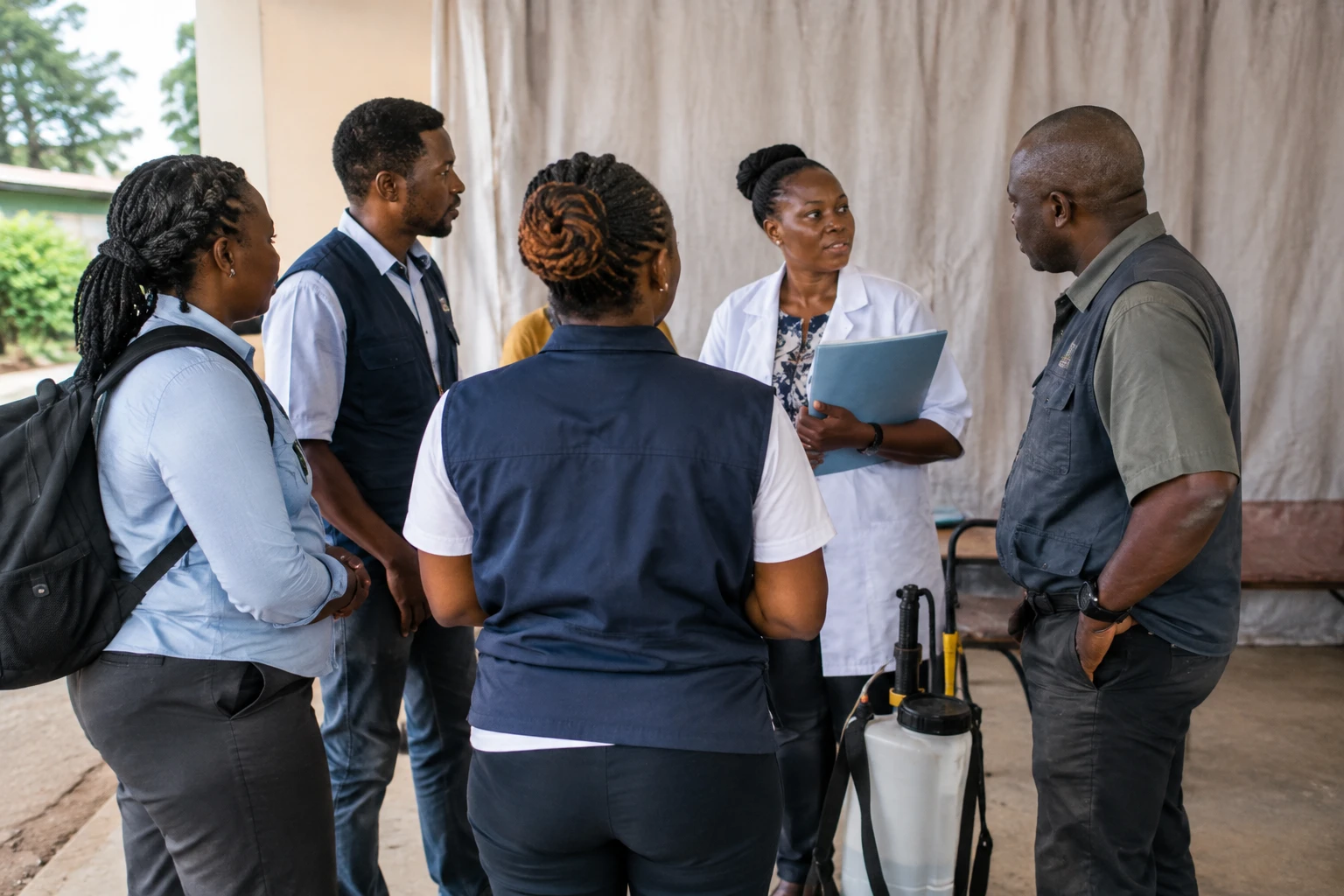
In Malabo, the fight against malaria is not being waged only in health centres. It also depends on the ability to reach every neighbourhood, protect children and sustain prevention over time. Equatorial Guinea is now aiming to eliminate the disease by 2030, but experience on Bioko island shows both what sustained interventions can achieve and what remains to be demonstrated on the mainland.
From Bioko to the mainland
Equatorial Guinea is a member of the Economic and Monetary Community of Central Africa (CEMAC), which brings together six countries for economic and monetary cooperation. But malaria does not stop at the organisation’s borders. The country’s mainland borders Cameroon and Gabon, where transmission remains high. Population movements and conditions favourable to mosquitoes therefore make surveillance beyond national borders necessary.
A malaria control programme has been running on Bioko island, where Malabo is located, since 2004. It combines, among other measures, indoor insecticide spraying, case surveillance and larval control. This long-term effort has contributed to a sharp decline in the disease. According to Equatorial Guinea’s authorities, the proportion of children aged 2 to 14 affected fell from 45% in 2004 to 6% in 2026. This official assessment highlights progress, but does not mean transmission has disappeared.
The challenge now is to extend interventions beyond the island. The government has begun spraying operations in Malabo and wants to deploy additional tools across the country. Bioko’s success provides a foundation, not a guarantee of results elsewhere: the mainland is larger, its population more dispersed and exchanges with neighbouring countries harder to control.
Vaccination, spraying and surveillance
The announced strategy combines several approaches rather than relying on a single solution. Vaccinating children with the R21 malaria vaccine is part of the programme. The authorities have cited a target of 300,000 children, while the WHO recommends malaria vaccines as a complementary tool in areas of transmission. Vaccination does not replace bed nets, rapid diagnosis or treatment for people who are ill.
Indoor spraying is intended to reduce the presence of mosquitoes in homes. Its effectiveness, however, depends on the actual coverage of houses, residents’ acceptance of the teams and the repetition of operations. Precise data on homes visited and cases detected make it possible to adjust interventions. This is where drones could provide support: identifying areas where mosquitoes congregate and guiding teams. Their purchase has been approved by the authorities, but their practical contribution will still depend on their deployment and the quality of the data collected.
The country is also considering the possibility of using genetically modified mosquitoes. This should not be confused with a measure already being implemented on a large scale. It raises questions of safety, regulation and public acceptance. For now, the programme’s core rests on methods already in use: prevention, screening, treatment and local monitoring of transmission.
A health and economic challenge
Malaria affects households well beyond the episode of illness. It can lead to healthcare costs, lost working days and school absences. Families in rural areas, where access to health facilities can be more difficult, face different obstacles from residents of Malabo. A campaign concentrated in the capital would therefore not be enough to protect the entire population.
The social dimension is particularly important in an economy seeking to reduce its dependence on hydrocarbons. The World Bank estimated that in 2024, 57% of the population lived below its international poverty line, while income from hydrocarbon exports was declining. In this context, public health contributes to economic development, but cannot take its place: accessible healthcare, better-protected homes and more stable incomes remain essential too.
The Bioko programme also highlights a funding challenge. A national campaign requires trained staff, insecticides, vaccines, transport and regular monitoring systems. The authorities will have to account for the continuity of these resources, particularly in localities far from major centres. Without sustained efforts, a temporary fall in cases may be followed by a resurgence.
An ambition to be measured over time
The political goal is clear: to make Equatorial Guinea malaria-free by 2030. WHO certification, however, is based on a specific criterion. A country must demonstrate the absence of local transmission for at least three consecutive years, then submit its surveillance systems and records for assessment. A decline in cases or progress on Bioko is therefore not, on its own, enough to secure this recognition.
The regional dimension is immediate. As long as the disease circulates in Cameroon and Gabon, imported cases remain a risk to Equatorial Guinea’s efforts. Health cooperation, information-sharing and continuity of care across borders will matter as much as new technologies. The challenge across Africa is considerable: the WHO estimates that the continent accounted for 95% of global malaria cases in 2024.
The next indicators to watch are therefore concrete: how many children receive the planned doses, what proportion of homes is actually covered, how cases evolve in mainland regions and whether funding is sustained. The 2030 ambition will be measured not by the announcement of tools, but by whether they are regularly accessible to residents of Bioko and the mainland alike.
WHO malaria profile for Equatorial Guinea · Criteria for malaria elimination certification · Official information on the national programme and its 2030 target · World Bank economic assessment of Equatorial Guinea · Report on the expansion of malaria control