Algeria
 Libya
 Morocco
 Sudan
 Tunisia
 Benin
 Burkina Faso
 Cabo Verde
 Côte d'Ivoire
 Ghana
 Guinea
 Guinea-Bissau
 Liberia
 Mali
 Mauritania
 Niger
 Nigeria
 Senegal
 Sierra Leone
 The Gambia
 Togo
 Cameroon
 Central African Republic
 Chad
 DR Congo
 Equatorial Guinea
 Gabon
 Republic of the Congo
 São Tomé and Príncipe
 Burundi
 Comoros
 Djibouti
 Eritrea
 Ethiopia
 Kenya
 Madagascar
 Malawi
 Mauritius
 Mozambique
 Rwanda
 Seychelles
 Somalia
 South Sudan
 Tanzania
 Uganda
 Angola
 Botswana
 Eswatini
 Lesotho
 Namibia
 South Africa
 Zambia
 Zimbabwe
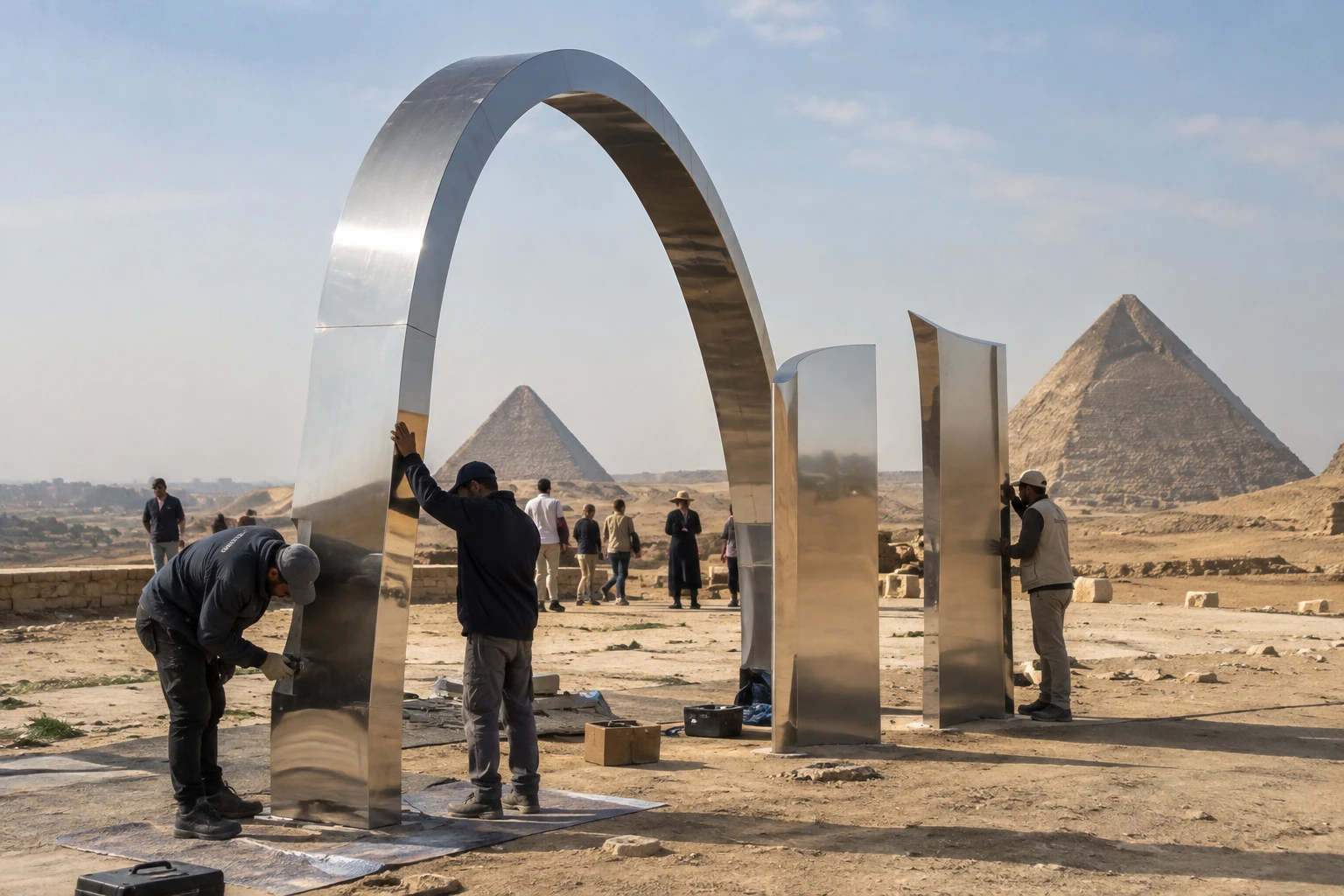
At Giza, the pyramids are more than a backdrop: they impose a scale, a history and a presence on contemporary artists that their works cannot ignore. Since 4 November, an open-air exhibition has invited the public to look at this iconic Egyptian site differently.
A cultural event at the foot of the pyramids
The sixth edition of ‘Forever Is Now’ is being held on the Giza plateau until 28 November 2026. Organised by Art D’Égypte, it brings together artists from Egypt, France, the United States, China and the United Kingdom, among other countries. The site, which is listed as a UNESCO World Heritage site, is thus hosting recent works in direct contact with a major archaeological complex.
The exhibition is part of a movement that began in 2021. It brings contemporary art and ancient heritage together without conflating them. The pyramids do not become mere accessories: they are the starting point for a dialogue about space, memory, nature and form.
This edition puts women artists in the spotlight and explores, in particular, the geometry of the monuments, their alignment with the sky and their ability to endure across the centuries. The initiative is supported by the Egyptian authorities and takes place under the patronage of UNESCO, according to information announced by the organisers and Egyptian institutions.
Works conceived for the site
The installations play with the lines of the plateau and the open perspectives on the monuments. French-British artist Charlotte Colbert presents ‘Possible Landscapes’, a polished steel arch topped by an eye. She describes this motif as a symbol of collective imagination, reinvention and dreaming. Set in the landscape, the work offers a visual passage between the visitor and the pyramids.
Raphaele Shirley, a French-American multimedia artist, has also created a kind of portal. Her panels bring together abstract motifs informed by her research into Egyptian heritage and by signs found in several cultures. Her approach sets local references alongside forms that travel across borders.
French artist Geoffroy Pithon presents ‘Hortus Pictus’, a colourful composition that he likens to an imaginary garden and painted architecture. The work brings out the contrast between its colours and the mineral surroundings. Here, the landscape is not a neutral backdrop: it changes how the installation is perceived and how the public approaches it.
These works reflect a shared artistic constraint: creating close to protected monuments without eclipsing their presence or claiming to sum up their history. The result depends as much on the works as on their location, the light and the movement of visitors across the plateau.
Heritage, creativity and local benefits
For Egypt, the stakes go beyond international visibility. The country is seeking to bring its heritage to life in several ways: archaeological research, museums, tourism and cultural events. The Grand Egyptian Museum, which has opened nearby, is also part of this effort. However, a temporary exhibition and a museum do not serve the same purpose: the former temporarily transforms a historic space, while the latter organises the preservation and display of collections.
The benefits may extend to artists, production teams, guides, businesses and tourism services in Giza and Cairo. They are not automatically shared equally. The benefits depend, in particular, on the jobs created locally, the terms of access to the site and the place given to Egyptian creators in the programme.
This question matters in a country where major heritage sites attract global attention, but local professionals also need places to create, funding and regular audiences. The presence of international artists can open up exchanges. It does not replace the sustainable development of Egypt’s art scenes.
The setting also calls for careful management. Installing works at an archaeological site means protecting the monuments and their surroundings. The partnership with heritage authorities and UNESCO underlines this responsibility. Public engagement remains essential to explain what is an artistic intervention and what belongs to the protected heritage.
A reach beyond Giza
Giza gives the exhibition a resonance that extends beyond Egypt. The site attracts visitors and artists from several regions of the world, while the visual references in the works travel between cultures. For the continent, the event is a reminder that African heritage is not merely a trace of the past: it can also host debates and works created in the present.
This reach should not reduce Africa to a single cultural identity. Egypt is part of North Africa and has ties with the Arab world, the African continent and the Mediterranean. ‘Forever Is Now’ takes place in this plural context, where cultural co-operation can bring different art scenes into dialogue without merging them into a uniform narrative.
Until 28 November, the issues to watch are concrete: attendance at the exhibition, the visibility given to Egyptian artists and the way the works fit into a protected archaeological space. At Giza, the meeting between ancient heritage and contemporary art is thus played out both in the eyes of visitors and in decisions about conservation, programming and local benefits.