Algeria
 Egypt
 Libya
 Morocco
 Sudan
 Tunisia
 Benin
 Burkina Faso
 Cabo Verde
 Côte d'Ivoire
 Ghana
 Guinea
 Guinea-Bissau
 Liberia
 Mali
 Mauritania
 Niger
 Nigeria
 Senegal
 Sierra Leone
 The Gambia
 Togo
 Cameroon
 Central African Republic
 Chad
 DR Congo
 Equatorial Guinea
 Gabon
 Republic of the Congo
 São Tomé and Príncipe
 Burundi
 Comoros
 Djibouti
 Eritrea
 Ethiopia
 Kenya
 Madagascar
 Malawi
 Mauritius
 Mozambique
 Rwanda
 Seychelles
 South Sudan
 Tanzania
 Uganda
 Angola
 Botswana
 Eswatini
 Lesotho
 Namibia
 South Africa
 Zambia
 Zimbabwe
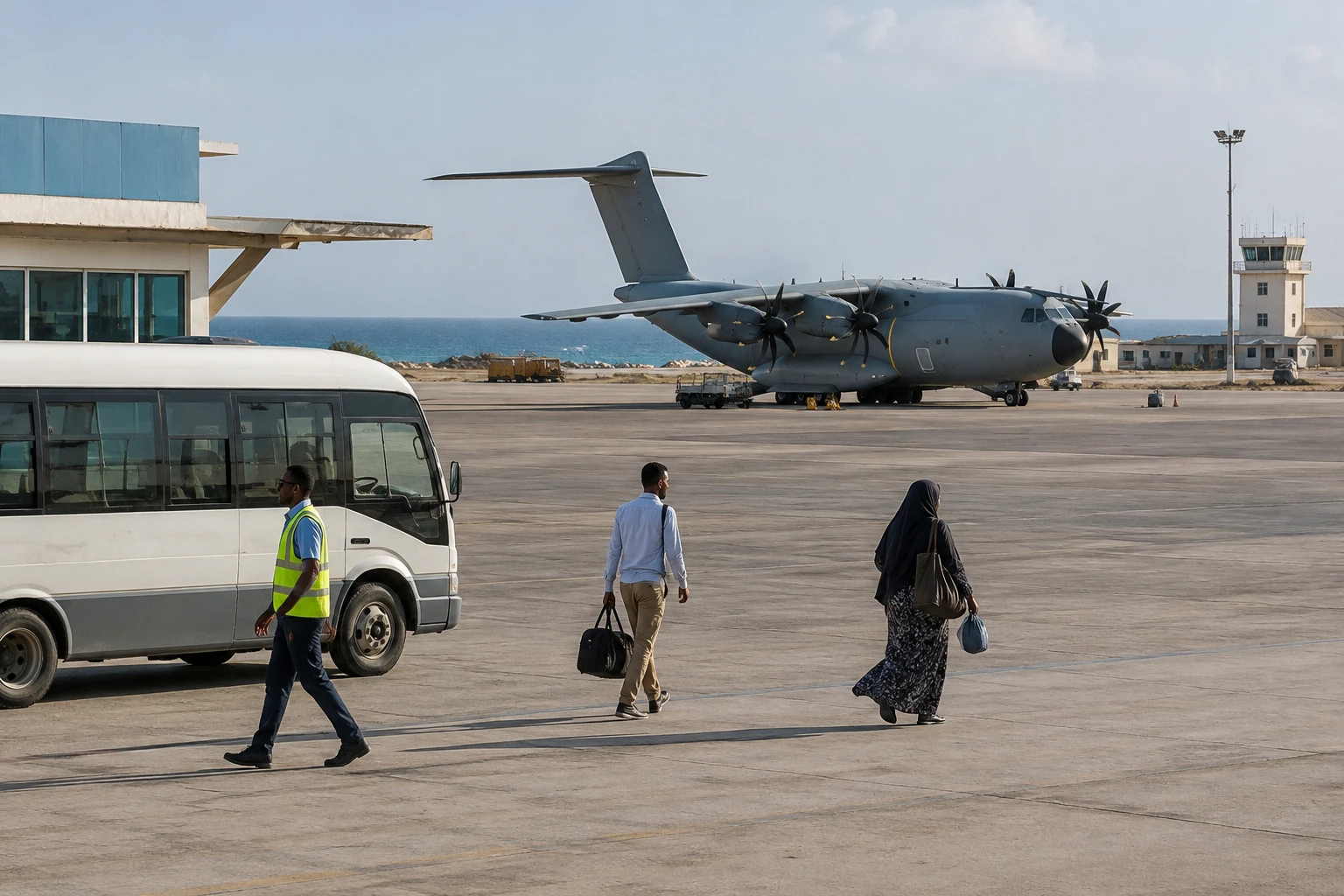
A stop of a few hours in Bosasso is enough to show how air infrastructure in northern Somalia sits at the intersection of local and foreign interests. But an aircraft-tracking trail reveals neither an aircraft’s cargo nor the reason for its visit.
A stop spotted, but still without an official explanation
A short video published on 1 November shows an Airbus A400M Atlas on the tarmac at Bosasso airport, in Puntland, a region administered by the authorities in this part of Somalia. The aircraft’s shape matches that of this military transport plane. Social media posts have suggested a US deployment. The available evidence does not support that interpretation.
Public flight-tracking data link the aircraft to Royal Air Force plane ZM402. They show it departing Nairobi on 31 October, with no destination displayed, then returning towards the Kenyan capital. The trace disappears for part of the journey. The data are consistent with the general route, but do not by themselves prove that the aircraft landed in Bosasso. It is the video, geolocated using visible features of the airport, that supports the claim that it stopped there.
Public flight tracking depends on signals being transmitted and received. An interruption does not reveal why the trace is missing: it does not prove that the crew deliberately switched off a tracking system. The aircraft’s destination and mission therefore remain unknown.
A Royal Air Force spokesperson said it did not comment on the movements of its aircraft. No verified public evidence establishes the nature of the cargo or the purpose of the stop. The aircraft was subsequently tracked between Nairobi, Victoria in the Seychelles, and Akrotiri, a British base in Cyprus. This route is not enough to link the stop in Somalia to any specific operation.
Bosasso, infrastructure at the heart of rivalries
Bosasso is a port on the Gulf of Aden, in Puntland. The airport is therefore located in an area important for air and sea links in the Horn of Africa. Puntland has its own regional institutions, but remains part of Somalia. It should not be confused with Somaliland, a territory that has declared independence without general international recognition.
In recent years, the airport and its surroundings have seen construction work and the presence of foreign military equipment. Reports published in October 2026 describe strikes attributed to the United Arab Emirates in the Galgala area, targeting al-Shabaab fighters, an armed group affiliated with al-Qaeda. Local officials cited by several media outlets said the strikes were launched from Bosasso. These accounts do not support the conclusion that the British A400M was linked to the operations.
The diplomatic context is itself sensitive. In January 2026, Somalia’s federal government cancelled its security and defence agreements with the UAE, according to reports in the Somali press. Yet Emirati strikes were reportedly carried out in Puntland in October. This sequence highlights a possible gap between decisions in Mogadishu and the security ties maintained by regional authorities. The details and effects of this rupture remain to be documented.
The United Kingdom and the UAE, for their part, agreed in April 2026 on a framework for enhanced cooperation, including in defence. This bilateral agreement is set out in an official British statement. It is contextual information, not evidence of coordination between the two countries in Bosasso or an explanation for the stop.
Local effects behind strategic calculations
For Puntland’s authorities, the airport can serve civil transport, commercial exchanges and security operations. For the federal government based in Mogadishu, the presence of foreign actors in a region with extensive autonomy also raises the question of national oversight of military agreements. This institutional tension does not mean that local and federal authorities disagree on every issue, but their interests and levers of influence are not identical.
The consequences also affect residents. Modernised infrastructure can make travel and trade easier. Increased military activity can, at the same time, fuel concerns about security, operational transparency and risks to nearby communities. The available information does not document any direct impact of this stop on civilians.
The regional context also matters. Somalia is a member of the Intergovernmental Authority on Development, IGAD, which brings together countries in the Horn of Africa and works on regional cooperation and security, among other issues. The Gulf of Aden links the region to shipping routes towards the Red Sea and the Bab el-Mandeb Strait. This location attracts external partners, but does not make every aircraft movement a proven regional operation.
What can — and cannot — be concluded
At this stage, verifiable evidence establishes that an A400M was filmed in Bosasso and links its route to that of British ZM402, which left Nairobi on 31 October. It reveals neither the mission nor the cargo, nor any possible exchanges with Puntland authorities or Emirati forces. Caution is therefore warranted in the face of categorical claims circulating online.
What happens next will depend on independent confirmation: an official explanation, more complete flight documents or corroborated testimony. For now, the episode mainly illustrates the opacity surrounding military movements in a region where local powers, Somalia’s federal authority and foreign partnerships overlap. It is this balance of power, rather than speculation about an aircraft’s mission, that gives the stop its significance.
ZM402 flight data can be consulted on the aircraft’s tracking page. Bilateral cooperation is described in the United Kingdom–United Arab Emirates joint statement. For reported strikes in northern Somalia, see the Somali Digest report and the US Africa Command’s account of its own operations, which does not confirm the British stop.