Algeria
 Egypt
 Libya
 Morocco
 Sudan
 Tunisia
 Benin
 Burkina Faso
 Cabo Verde
 Côte d'Ivoire
 Ghana
 Guinea
 Guinea-Bissau
 Liberia
 Mali
 Mauritania
 Niger
 Nigeria
 Senegal
 Sierra Leone
 The Gambia
 Togo
 Cameroon
 Central African Republic
 Chad
 DR Congo
 Equatorial Guinea
 Gabon
 Republic of the Congo
 São Tomé and Príncipe
 Burundi
 Comoros
 Djibouti
 Eritrea
 Ethiopia
 Kenya
 Madagascar
 Malawi
 Mauritius
 Mozambique
 Rwanda
 Seychelles
 Somalia
 South Sudan
 Tanzania
 Uganda
 Angola
 Botswana
 Eswatini
 Lesotho
 Namibia
 South Africa
 Zimbabwe
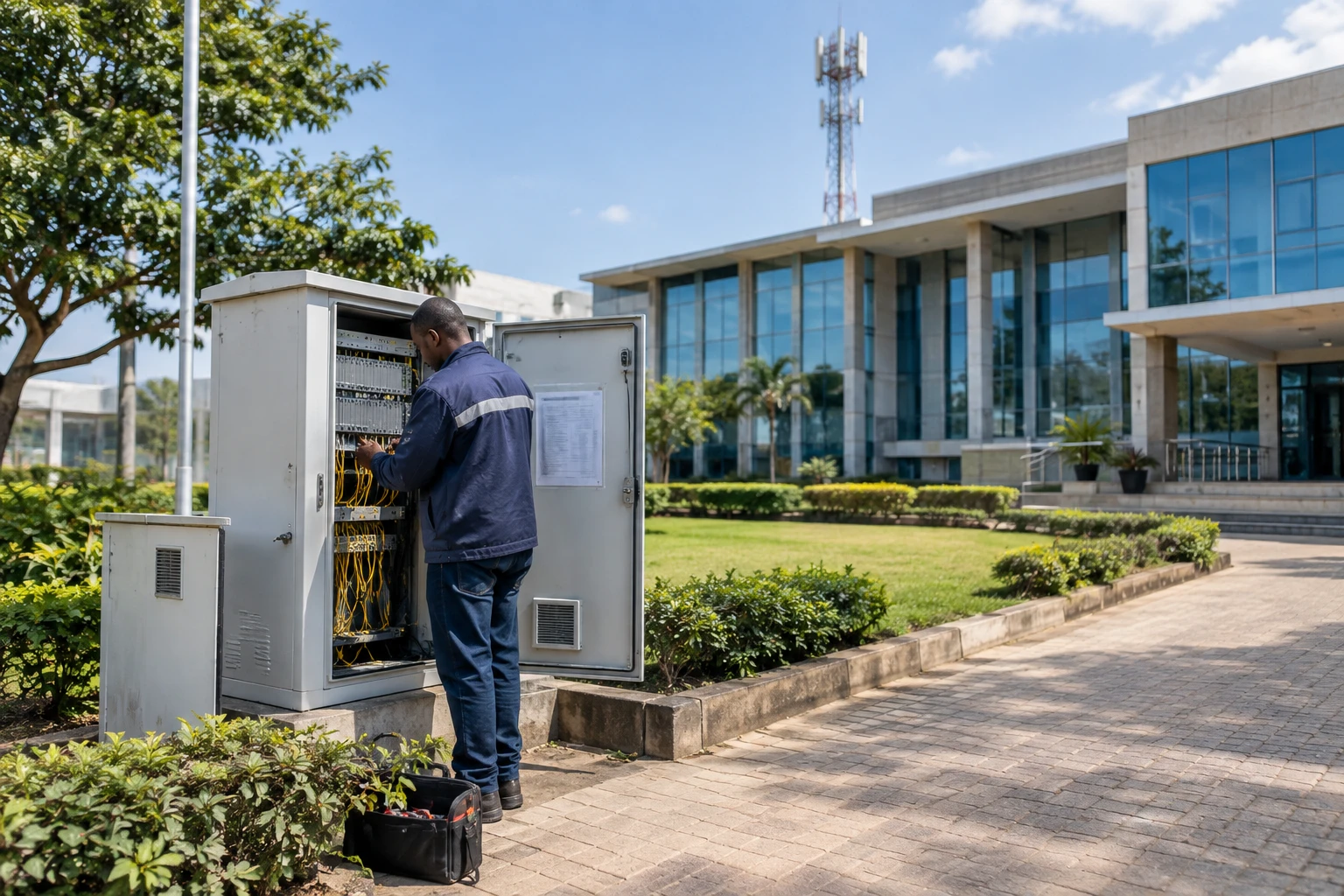
A fibre-optic cable running through a district does not guarantee that a household, school or small business can connect. In Zambia, investment in networks is advancing, but the challenge remains to turn this infrastructure into reliable access, including in rural areas.
A growing network, but use remains limited
Zambia, a landlocked country in southern Africa, connects eight neighbouring countries through its fibre-optic networks. This position could strengthen its role as a regional hub. But extending the backbones — the major links that carry data — does not, on its own, solve problems of local coverage, electricity or the cost of services.
Available figures also call for caution. Estimates published for the end of 2025 indicate that about 67% of Zambians were not using the internet. This measure concerns usage, not simply the availability of a signal. Across the continent, the International Telecommunication Union estimated that 38% of Africa’s population used the internet in 2024, with a substantial gap between urban and rural areas.
The regional context matters. Zambia is a member of SADC, the Southern African Development Community, which brings together states working, among other things, on economic integration and cross-border infrastructure. Stronger digital links can facilitate regional trade, provided networks are accessible and interconnected beyond major urban centres.
German cooperation is one avenue among others
In Lusaka, Minister of Technology and Science Felix C. Mutati has made digital infrastructure a priority for economic transformation. At a Zambia-Germany business forum on 4 and 5 November 2025, he discussed extending mobile and fibre networks, as well as making them resilient to power cuts.
The forum was intended to open discussions between companies and institutions from the two countries. At this stage, public information does not make it possible to conclude that specific contracts have been agreed for the construction or operation of networks. The distinction matters: a business meeting signals interest, but only published agreements will reveal the partners, amounts, timelines and service obligations.
German companies can contribute at several levels: equipment, engineering, management of radio sites, fibre components or maintenance. Any contribution they make will, however, need to fit the priorities set by Zambian authorities and regulators. It does not replace existing operators, public investment or the local expertise needed to maintain networks day to day.
Coverage is not enough without power or connections
The 2024 annual report of Zambia’s regulator, ZICTA, puts the national fibre network at about 39,232 kilometres, up from 31,915 kilometres in 2023. The government later told Parliament it had reached 42,000 kilometres in the first half of 2025. These series are not directly comparable: they come from different periods and reporting methods. Nevertheless, they confirm the rapid expansion of the core infrastructure.
Mobile coverage presents a different picture. A ZICTA analysis cited by a parliamentary committee estimated that 92% of the population was covered, but that coverage extended across only 69.9% of the country’s territory. The same document estimated that 998 additional sites were needed to reach locations with no or poor service. High national coverage can therefore coexist with remote areas where the signal remains weak or absent.
Electricity also undermines service continuity. Mobile base stations and transmission equipment need a stable power supply. But the 2023-2024 drought tested Zambia’s hydropower generation and worsened energy constraints. Batteries, backup generators or hybrid solar installations can limit outages, but they bring installation and maintenance costs. For operators, the issue is therefore not just putting up new masts: they must be able to power them sustainably.
This distinction is felt in everyday life. Formal businesses have greater means to buy backup solutions or subscribe to several connections. Small businesses, schools and rural health services depend more heavily on the quality of the local network. When the connection is unstable, public digital services, payments and access to information become less predictable.
Measuring results beyond kilometres
The next challenge for Lusaka will be to link investment to verifiable results: villages actually connected, service availability, data prices, call quality and access to devices. ZICTA has already reported complaints about dropped calls and unreliable connections in some locations. The number of kilometres of fibre or mobile masts is therefore not enough to measure users’ experience.
External cooperation can bring technology and funding. But its benefits will depend on the rules governing access to infrastructure, cost-sharing and the training of Zambian technicians. It will also be necessary to distinguish projects serving profitable commercial routes from those addressing the less immediately profitable needs of rural areas.
At SADC level, Zambia’s interconnection with its neighbours can support digital trade and data exchange. At African level, the issue is a reminder of a central reality: building backbones is necessary, but digital inclusion also depends on energy, the cost of connectivity, skills and service quality. The next partnership announcements should be judged against these concrete results, rather than simply the number of meetings held or kilometres announced.