Algeria
 Egypt
 Libya
 Morocco
 Sudan
 Tunisia
 Burkina Faso
 Cabo Verde
 Côte d'Ivoire
 Ghana
 Guinea
 Guinea-Bissau
 Liberia
 Mali
 Mauritania
 Niger
 Nigeria
 Senegal
 Sierra Leone
 The Gambia
 Togo
 Cameroon
 Central African Republic
 Chad
 DR Congo
 Equatorial Guinea
 Gabon
 Republic of the Congo
 São Tomé and Príncipe
 Burundi
 Comoros
 Djibouti
 Eritrea
 Ethiopia
 Kenya
 Madagascar
 Malawi
 Mauritius
 Mozambique
 Rwanda
 Seychelles
 Somalia
 South Sudan
 Tanzania
 Uganda
 Angola
 Botswana
 Eswatini
 Lesotho
 Namibia
 South Africa
 Zambia
 Zimbabwe
Training soldiers thousands of miles away is not enough to restore security in Haiti. But for an army still seeking to strengthen its officer corps, Benin’s experience could open a path to practical cooperation, provided the resources and objectives are clarified.
Cooperation between Cotonou and Port-au-Prince already under way
Military ties are not starting from scratch. In January 2025, Benin and Haiti signed a memorandum of understanding providing for cooperation against organised crime. Discussions cover training, the sharing of experience and security assistance. The current visit is part of this bilateral framework.
The context differs greatly from one country to the other. In Benin, the armed forces face a jihadist threat in the north, near the borders with Burkina Faso and Niger. In Haiti, armed groups control roads and neighbourhoods, particularly in the Port-au-Prince metropolitan area. These challenges are not interchangeable, but the two armies can exchange views on training, discipline, logistics and the protection of civilians.
Benin is a member of ECOWAS, the Economic Community of West African States, which brings countries in the region together around economic and political objectives. Haiti, in the Caribbean, is not part of it. Its regional ties include CARICOM. The proposed partnership therefore connects two distinct regional blocs, without replacing the arrangements specific to each.
Officers to train, a promise to clarify
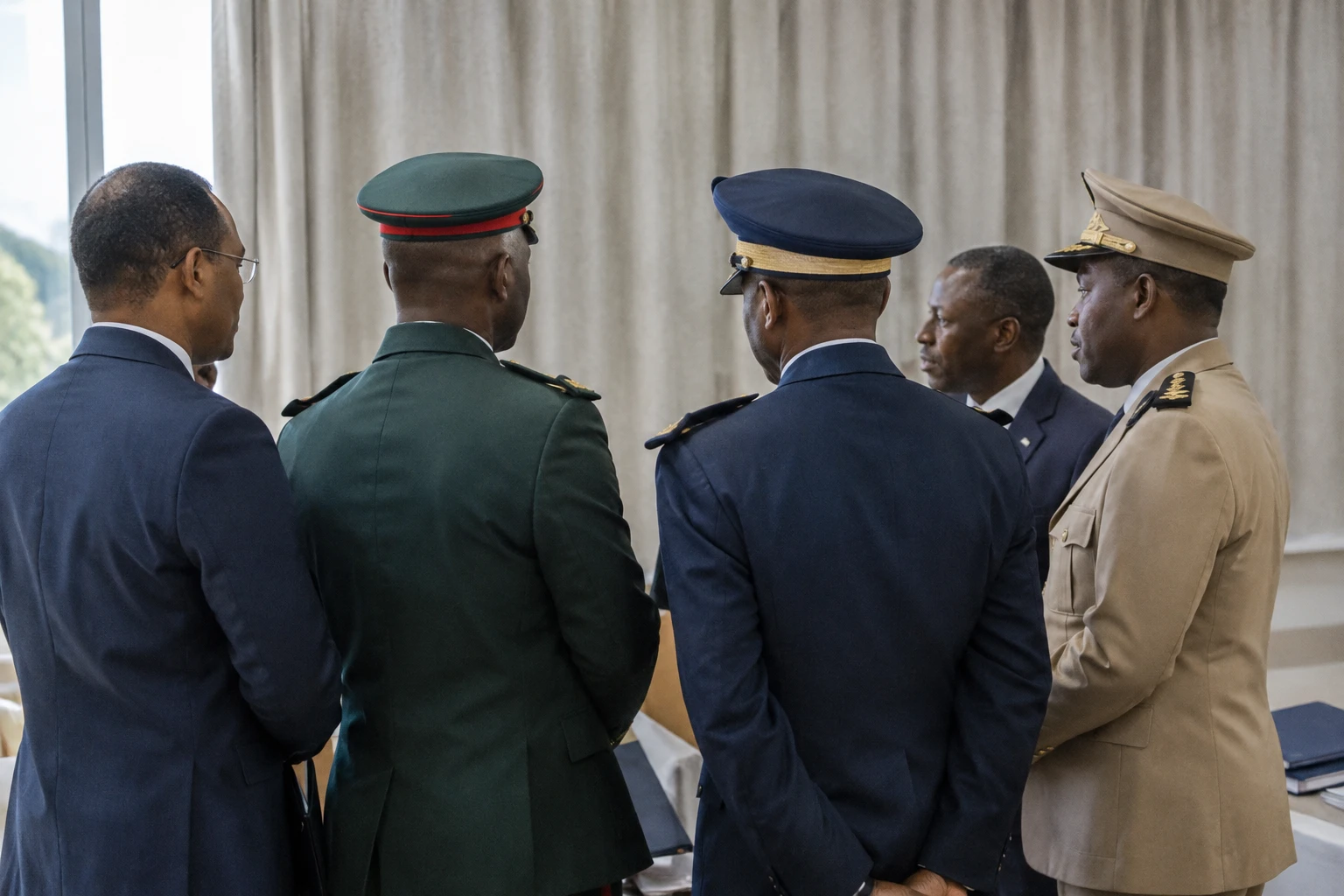
On 3 November 2026, Lieutenant General Derby Guerrier, commander-in-chief of the Haitian Armed Forces, met General Fructueux Gbaguidi, chief of staff of the Beninese Armed Forces, in Cotonou. The Haitian delegation is on a working visit to Benin, with discussions focused on military structures and training.
Guerrier said his army lacked officers and that training an officer took time. He asked Beninese military institutions to host Haitian recruits. Gbaguidi said he was ready to contribute to training, from soldiers to general staff officers. The statement signals political and military willingness, but does not yet specify the number of trainees, the timetable, the funding or the training locations.
The Haitian Armed Forces were re-established in 2017, after being dissolved in 1995. They are still being rebuilt and now support some operations conducted alongside the Haitian National Police. The United Nations Secretary-General’s report published in February 2025 highlights this growing role, in an environment where security institutions lack personnel and resources.
The visit also gave rise to a request with more far-reaching consequences: the participation of Beninese soldiers in an international force in Haiti. Gbaguidi replied that such a decision was for the head of state to make and that he would pass on the request. At this stage, no Beninese deployment has been announced. The distinction matters: training soldiers abroad is not the same as committing troops to an operational theatre.
Training cannot replace security or institutions
In Haiti, armed groups obstruct movement, threaten residents and make it harder to access essential services. Violence affects neighbourhoods under their control first and foremost, but also weighs on travel, economic activity and the work of the authorities. Residents, traders and informal workers bear its direct effects, while institutions seek to establish a lasting presence.
In September 2025, the UN Security Council authorised a Gang Suppression Force, which is to succeed the Multinational Security Support Mission. Its mandate provides for targeted operations and support for Haitian forces. However, this international force cannot, by itself, rebuild the army, strengthen the police and restore public trust. Training offered by Benin could contribute to the long-term effort if it meets needs identified by the Haitian authorities and is accompanied by appropriate resources.
Haitian authorities have also referred to the recent abduction of four Salvadoran military personnel associated with the international force. Reports by several media outlets say they went missing after an attack in the Port-au-Prince region. The episode illustrates the risks faced by deployed personnel. On its own, it does not make it possible to assess the mission’s effectiveness or conclude that a new contingent would be the necessary response.
For Benin, caution is also a practical matter. Any participation in an external operation would have political, logistical and human implications. It would need to be considered by the relevant authorities, within the framework of the international mandate and available capabilities. Haiti’s request is therefore not a deployment decision.
A test for South-South partnerships
The visit highlights cooperation between countries of the Global South, based on a shared history and security interests expressed by both parties. References to the fraternity between Haitians and Beninese give the discussions a symbolic dimension. But this closeness does not remove the need for a precise agreement: programmes, costs, responsibilities and monitoring arrangements will need to be clarified.
For Benin’s armed forces, the exchange could also provide a framework for sharing experience, without equating the fight against armed groups in northern Benin with the Haitian crisis. For Haitian military personnel, the challenge is to turn a training pledge into lasting skills that can strengthen national institutions rather than leave them indefinitely dependent on external partners.
What happens next will depend on decisions still pending: formalising the training, setting its timetable, and the political response to the request to join the international force. In Porto-Novo and Port-au-Prince, the follow-up to these commitments will show whether the visit leads to operational cooperation or remains primarily a diplomatic signal.