Algeria
 Egypt
 Libya
 Morocco
 Sudan
 Tunisia
 Benin
 Burkina Faso
 Cabo Verde
 Côte d'Ivoire
 Ghana
 Guinea
 Guinea-Bissau
 Liberia
 Mali
 Mauritania
 Niger
 Nigeria
 Senegal
 Sierra Leone
 The Gambia
 Cameroon
 Central African Republic
 Chad
 DR Congo
 Equatorial Guinea
 Gabon
 Republic of the Congo
 São Tomé and Príncipe
 Burundi
 Comoros
 Djibouti
 Eritrea
 Ethiopia
 Kenya
 Madagascar
 Malawi
 Mauritius
 Mozambique
 Rwanda
 Seychelles
 Somalia
 South Sudan
 Tanzania
 Uganda
 Angola
 Botswana
 Eswatini
 Lesotho
 Namibia
 South Africa
 Zambia
 Zimbabwe
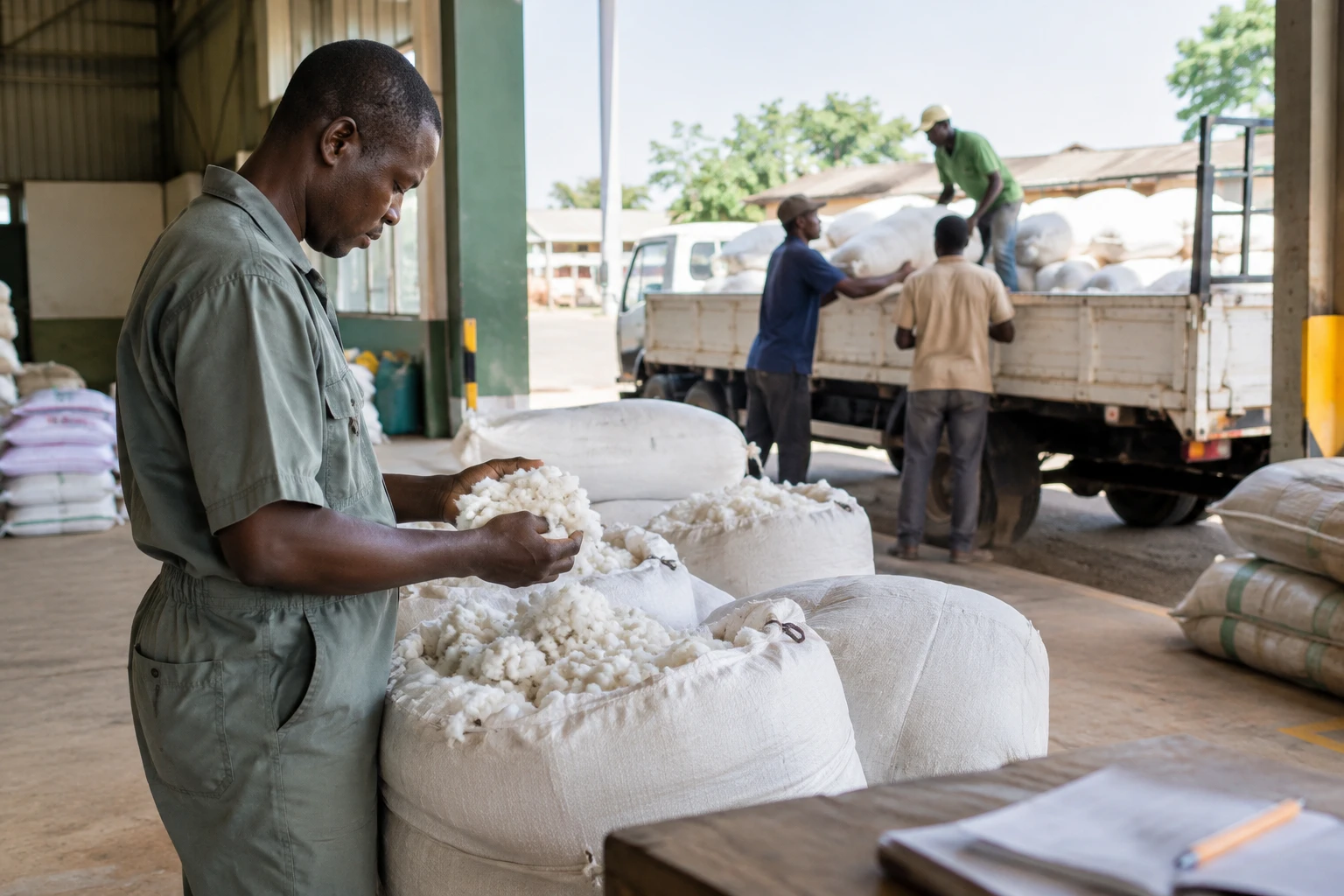
For a cotton farmer, a stable sale price alone is not enough to guarantee a successful season. The cost of seeds, fertilisers and crop treatments also weighs on final income. In Togo, the conditions announced for 2026–2027 aim to preserve this balance as the sector targets a sharp increase in production.
A guaranteed price, with production costs to watch
The Nouvelle Société Cotonnière du Togo (NSCT) and the National Federation of Cotton Producers’ Groups (FNGPC) are keeping the prices paid to producers unchanged. First-choice seed cotton will continue to be bought at 300 FCFA per kilogram, and second-choice cotton at 280 FCFA, according to information made public on 1 November 2026.
Announced prices for the main inputs are also unchanged. A 50 kg bag of NPKSB fertiliser, like a bag of urea, is priced at 14,000 FCFA. Pesticide prices vary according to treatments and formulations: from 3,000 to 4,800 FCFA per hectare for insecticides, and from 2,700 FCFA per litre to 10,000 FCFA per dose for herbicides. The growth regulator is priced at 2,200 FCFA. These are the prices announced for the season; they do not mean that every farm will buy the same combination of products.
The decision to maintain prices comes amid rising input costs on international markets. Keeping prices affordable therefore depends on financial support for the sector. For 2026, the state has earmarked 5.8 billion FCFA to help fund supplies, including 21,000 tonnes of fertiliser. The announced sum gives an indication of the public-sector effort, but the information available here does not specify the exact share allocated to each product or farm.
A genuine recovery, but still a fragile one
The sector enters this season after several difficult years. Figures reported by Togolese media put seed-cotton production at 60,403 tonnes in 2024–2025. For 2025–2026, initial estimates suggested about 80,000 tonnes. The increase is encouraging, but it is not enough to erase accumulated difficulties or guarantee sustained growth.
Recent experience shows that results depend as much on prices as on production conditions. Yields, regular rainfall, pest control and the availability of inputs all affect the harvest. Sector stakeholders have also cited climate risks and input costs as concerns for the new season. Maintaining prices may reduce some uncertainty at planting time, but cannot on its own protect producers from a poor season.
The 2026–2027 season targets 105,000 tonnes from 105,000 hectares, implying a target yield of one tonne per hectare. Yet planted areas had already reached 115,980 hectares by 31 July 2026, or 110.5% of the initial target, according to data attributed to the Regional Programme for Integrated Cotton Production in Africa (PR-PICA). This lead concerns acreage, not the harvest: it therefore does not show that the targeted volume will be reached.
The challenge also lies in the producing regions
In Togo, cotton is grown mainly in rural areas in the centre and north of the country. The effects of a season are not evenly distributed: producers bear the costs and risks directly, while collection, ginning and transport activities depend on the volumes harvested. The NSCT organises several operations across the sector, and the FNGPC represents producer groups in discussions on the conditions for the season.
Regional data reported ahead of the new season illustrate this diversity. In Grand Oti, the previous season reportedly produced 7,581 tonnes across 7,728 hectares, with an average yield of 981 kg per hectare. These local results show how a national average can mask different circumstances depending on rainfall, soils and farming practices. Exceeding the acreage target does not, by itself, indicate whether every region will achieve its own results.
In the longer term, the issue is not limited to the volume of seed cotton. Local processing, particularly in textiles, could help retain more value in the country, but requires markets, investment and a reliable supply chain. Cotton also remains exposed to international prices: a stable price paid to producers protects part of their income, without removing the risks associated with export markets or the costs borne by the sector.
A concern across West Africa
The issue extends beyond Togo’s borders. African cotton producers face shared concerns: input prices, climate variability, yields and bargaining power in value chains. PR-PICA facilitates technical exchanges between producing countries. In Lomé, representatives of the Association of African Cotton Producers also discussed the sector’s difficulties and options such as agricultural insurance in August 2026.
The next step for Togo will be to turn the areas already under cultivation into an actual harvest, then establish whether the target of 105,000 tonnes has been reached. The final results will also make it possible to assess the cost of keeping inputs at subsidised prices and how its benefits are distributed. For cotton farmers, the practical test is simple: whether sales and yields cover the costs incurred after a season exposed to the vagaries of the land.
Data on acreage and production targets were reported by Togo First on cotton acreage in Togo. Background information on the recovery and producers’ concerns is also documented by Togo First on the sector’s targets and Lomebougeinfo on African producers’ concerns.