
 Algeria
 Egypt
 Libya
 Morocco
 Sudan
 Tunisia
 Benin
 Burkina Faso
 Cabo Verde
 Côte d'Ivoire
 Ghana
 Guinea
 Guinea-Bissau
 Liberia
 Mali
 Mauritania
 Niger
 Senegal
 Sierra Leone
 The Gambia
 Togo
 Cameroon
 Central African Republic
 Chad
 DR Congo
 Equatorial Guinea
 Gabon
 Republic of the Congo
 São Tomé and Príncipe
 Burundi
 Comoros
 Djibouti
 Eritrea
 Ethiopia
 Kenya
 Madagascar
 Malawi
 Mauritius
 Mozambique
 Rwanda
 Seychelles
 Somalia
 South Sudan
 Tanzania
 Uganda
 Angola
 Botswana
 Eswatini
 Lesotho
 Namibia
 South Africa
 Zambia
 Zimbabwe
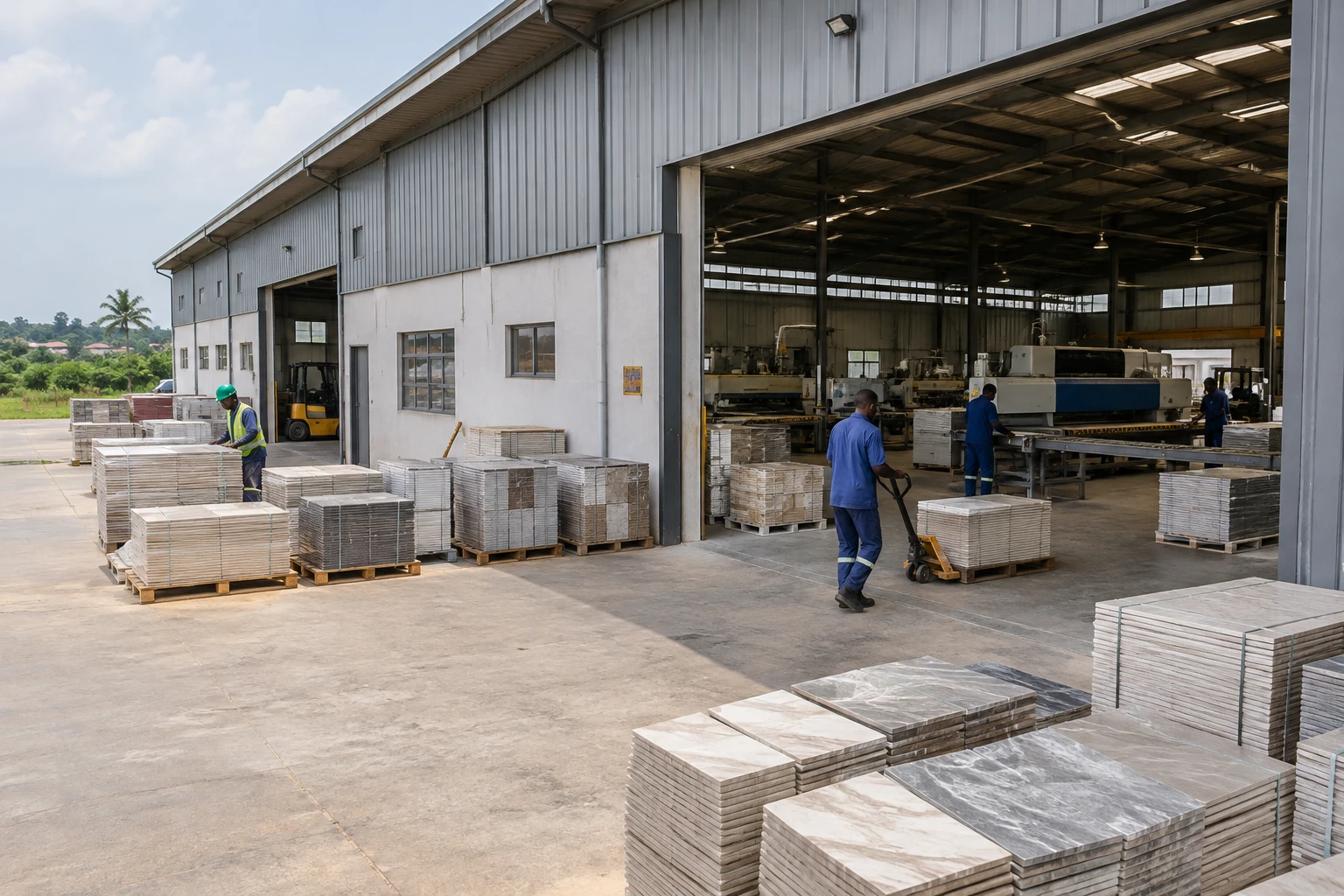
Can a factory supply more tiles to Nigerian construction sites while selling beyond the country’s borders? In Sagamu, Ogun State, Veenocks’ expansion puts that ambition to the test: increasing local production and preparing regional markets.
Higher capacity in Ogun State
The project, estimated at $145 million, is set to raise the factory’s annual capacity from 3.3 million to 9.9 million square metres. Afreximbank, the African Export-Import Bank, has announced a senior loan of $81.9 million to finance the expansion. The remaining cost has not been detailed in the information published.
The announcement was made on 2 November 2026. It follows an agreement reached in August 2024, when Afreximbank granted Veenocks a $2 million project-preparation facility. The financing paid for the technical, commercial, financial, legal, environmental and social studies needed to assess the project. The bank says the advance was repaid through the senior financing.
Veenocks operates its factory in Sagamu, in south-west Nigeria, and is part of R28 Holdings. The announced increase concerns installed capacity; it does not in itself mean that actual production will immediately reach that level. The available information specifies neither the commissioning timetable nor the construction stages.
Reducing external purchases, without promising lower prices
The project aims to increase the supply of tiles made in Nigeria and make better use of raw materials available in the country, according to the objectives set out by the company and Afreximbank. Higher local production could give distributors and construction businesses more choice. But no direct effect on prices has been established: energy, transport, equipment and input costs will also affect the final cost.
Imports also require a cautious assessment. Customs figures cited in some reports of the announcement are not corroborated here by a comparable series covering all porcelain tiles. UN statistics distinguish several categories of ceramic products, so they do not allow a single total for the Nigerian market to be confirmed without qualification.
The financing also does not guarantee that all the added value will remain in the country. The origin of the machinery, the share of imported materials and supply contracts have not been detailed. These factors will matter in measuring the investment’s real impact on Nigerian suppliers and foreign currency requirements.
Jobs announced and markets to win
The site already employs more than 200 people, according to Afreximbank. The expansion is expected to create a further 300 direct jobs. The bank also forecasts indirect benefits in raw-material supply, logistics and distribution. These are projections: the number of jobs actually created will depend on the project’s completion and its level of activity.
In the medium term, Veenocks plans to target eight markets: Benin, Togo, Ghana, Burkina Faso, Niger, Cameroon, Mauritania and Senegal. This list sets out a commercial ambition, not export contracts that have already been announced. To make it a reality, the company will need to make its products competitive and organise their transport to markets with different rules and distribution channels.
The project thus connects several economic areas. Nigeria is a member of ECOWAS, the West African community that seeks to facilitate trade among its member states. Cameroon, by contrast, is in Central Africa and does not belong to the organisation. At continental level, the African Continental Free Trade Area (AfCFTA) aims to reduce barriers to trade between African countries. These frameworks can create opportunities, but do not replace the infrastructure or customs formalities required.
Success will be measured beyond capacity
For Nigerian construction companies and distributors, more domestic production could diversify supplies. For workers and suppliers around Sagamu, the immediate stakes are the jobs and local orders actually generated. Regionally, regular exports would strengthen the place of Nigerian manufactured goods in African trade, beyond raw materials.
The next step will therefore be tangible: monitoring the progress of the expansion, the factory’s production ramp-up and the delivery of the announced jobs. It will also be important to see whether the target markets become real outlets. Tripling capacity is an industrial objective; its significance will depend on how much production is actually sold in Nigeria and neighbouring countries.



