Algeria
 Egypt
 Libya
 Morocco
 Sudan
 Tunisia
 Benin
 Burkina Faso
 Cabo Verde
 Côte d'Ivoire
 Ghana
 Guinea
 Guinea-Bissau
 Liberia
 Mali
 Mauritania
 Niger
 Nigeria
 Senegal
 Sierra Leone
 The Gambia
 Togo
 Central African Republic
 Chad
 DR Congo
 Equatorial Guinea
 Gabon
 Republic of the Congo
 São Tomé and Príncipe
 Burundi
 Comoros
 Djibouti
 Eritrea
 Ethiopia
 Kenya
 Madagascar
 Malawi
 Mauritius
 Mozambique
 Rwanda
 Seychelles
 Somalia
 South Sudan
 Tanzania
 Uganda
 Angola
 Botswana
 Eswatini
 Lesotho
 Namibia
 South Africa
 Zambia
 Zimbabwe
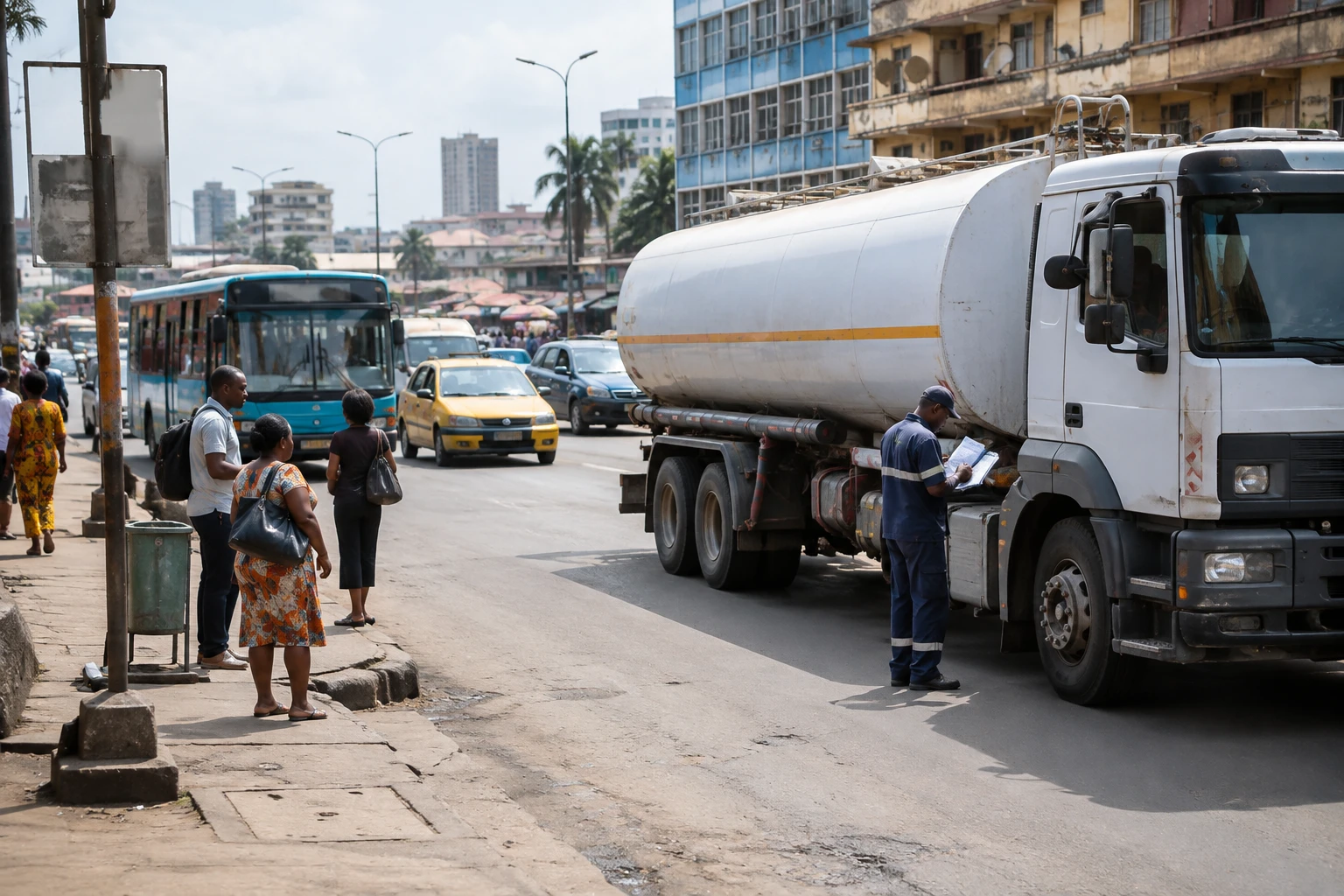
When a foreign refinery supplies a significant share of a country’s fuel, the question goes beyond the price per litre. It also concerns stocks, transport and the state’s ability to secure supply. In Cameroon, a new agreement with the Nigerian group Dangote places these issues at the forefront.
A supply arrangement built around three players
The Société nationale de raffinage (Sonara), Cameroon’s state-owned company, has concluded an agreement with Dangote Petroleum Refinery and MRS Holdings. Signed in Lagos, Nigeria, on 22 October 2026, it was presented in Yaoundé on 29 October. Sonara states that the arrangement is to cover around half of Cameroon’s petroleum product needs over 30 months, not three years.
The set-up divides roles among the partners: the Dangote refinery supplies the products, while MRS handles their transport. Sonara thus remains at the centre of the national supply system. This detail matters: according to the information published, it is not a simple direct purchase made by a new subsidiary from petrol stations.
A company named Dangote Oil & Gas Cameroon has also been reported in Douala. However, its existence and field of activity should not be confused with the terms of the supply contract signed by Sonara. The publicly available details do not yet allow the operational role of this subsidiary in the agreement to be precisely established.
Sonara stopped producing after a fire at its Limbé site in May 2019. Since then, Cameroon has relied on imports of refined products to supply its market. The agreement with Dangote offers a new supply route from Nigeria, where the group’s refinery is located near Lagos.
A response to dependence created since 2019
Cameroon produces crude oil but has not refined it in its national refinery since the fire. This situation illustrates an essential difference between producing hydrocarbons and having the facilities capable of refining them. It exposes the country to the costs of purchasing, transporting and securing fuel availability on international markets.
The Cameroonian authorities have already sought to diversify import channels. The Ministry of Mines, Industry and Technological Development reported that, in the first ten months of 2025, more than 1.58 million tonnes of liquid petroleum products were imported. This volume gives an idea of the logistical scale of the market, but on its own does not confirm the estimate of nearly 2,000 billion CFA francs sometimes cited for the annual bill.
Regional supply can reduce certain constraints linked to longer journeys. However, a closer refinery does not automatically guarantee cheaper fuel at the pump. The outcome will depend on the contract price, transport, storage, payment terms and how any savings are passed through into the price structure.
Stocks, transport and Sonara’s role
For motorists, hauliers and businesses, the immediate priority remains the regularity of deliveries. A stock shortage or logistical delay can disrupt travel and raise the costs of fuel-dependent activities. By contrast, the agreement does not yet permit the conclusion that pump prices will fall.
The question of storage will therefore be decisive. Sufficient reserves can help absorb delivery delays and pressures on markets. But they require available capacity, transparent management and clear rules on the ownership of stocks. Sonara and the Société camerounaise des dépôts pétroliers, which manages storage infrastructure, will play an important role in this organisation.
The decision to keep Sonara in the chain is also significant. The state-owned company no longer refines, but the agreement allows it to remain involved in supply. This may preserve a national capacity for coordination. The real scope of this participation will, however, depend on the responsibilities set out in the contract and on access to information about prices and volumes.
The market also concerns private operators who import, transport and distribute fuel. A major new source may alter their market shares and their relationships with suppliers. But the contract is not enough to establish that intermediaries will be eliminated, nor that costs will necessarily fall. These effects will need to be assessed on the basis of the commercial terms actually applied.
A Cameroonian issue in a Central African market
Cameroon belongs to the Economic and Monetary Community of Central Africa (CEMAC), which brings together six states sharing, among other things, a common currency and economic institutions. The countries of the region face, to varying degrees, the challenge of turning their hydrocarbon production into secure access to refined products. The agreement with Dangote therefore places the relationship between Yaoundé and Lagos within a broader regional context.
Nigeria is a neighbouring partner, but it is not a member of CEMAC. Energy cooperation between the two countries thus links different economic areas. For Cameroon, geographical proximity may be a logistical advantage. It does not, however, replace solid storage capacity or a sustainable strategy for returning Sonara to operation.
In the coming stages, several elements will merit monitoring: the volumes actually delivered, purchase prices, transport costs, the build-up of stocks and the effective duration of the arrangement. Comparing the announced commitments with the observed results will show whether this diversification strengthens Cameroon’s energy security, beyond the mere announcement of a contract.
Cross-reference sources: Reuters report on the agreement and dependence on imports, information on Sonara’s announcement and partners, Cameroonian ministry data on petroleum product imports and BEAC annual report on CEMAC.